This article is part of our 365-day renewal strategy guide.
A customer win-back campaign is a structured effort to re-engage churned or lapsed customers and bring them back, treating them as a specialized pipeline rather than lost revenue. Because former customers already know your product, winning them back costs far less than acquiring a new customer, often recovering revenue at near-zero customer acquisition cost. A deliberate win-back strategy turns churn from a dead end into a recoverable pipeline.
Most teams write off canceled customers. The smart ones run a win-back motion. This guide covers how to win back lost customers: segmentation, messaging, examples, and measurement.
What Is a Customer Win-Back Strategy?
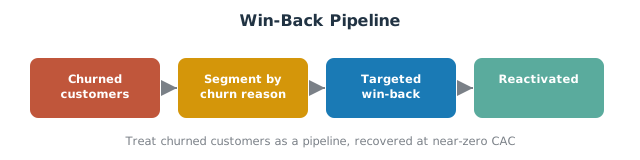
A customer win-back strategy is a plan to re-engage customers who have churned and convince them to return. It treats lapsed customers as their own pipeline with its own messaging, offers, and cadence, separate from new-customer acquisition and ongoing retention.
It works because former customers are warmer than cold prospects: they understand the product, you have their data, and you know why they left. A win-back campaign uses that knowledge to make a targeted, relevant case to return.
Understanding Why Customers Churn
You cannot win back customers without understanding the reasons for customer churn. Common reasons why customers leave include poor onboarding, unrealized value, a lost champion, price, or a better competitor offer. Understanding the reasons for customer churn lets you tailor your customer winback strategies: a customer who left over a fixable product gap needs a “we’ve changed” message, while one who left over price needs a value-led case, not a discount.
Segment your churned base by churn reason and former value. Customer segmentation is what separates effective winback efforts from spray-and-pray: a small, well-targeted set of attempts to win back high-value former customers beats a mass email to everyone who ever cancelled. The reasons why customers churned also tell you which segments are worth pursuing at all; some customers were a poor fit and are not worth winning back.
Why Win-Back Beats New Acquisition
- Lower cost. Re-engaging a former customer is far cheaper than acquiring a new customer, improving your LTV:CAC ratio.
- Higher intent. Lapsed customers already saw value once; the barrier to return is lower than a first purchase.
- Better data. You know their use case, history, and churn reason, so you can personalize the win-back.
- Compounding loyalty. A recovered customer who returns often becomes more loyal, having compared the alternatives.
How to Win Back Lost Customers
A successful win-back campaign follows a clear sequence:
- Understand why they left. Mine churn reasons and customer feedback. The reasons for customer churn shape the entire campaign; you cannot win back a customer without addressing why they left.
- Segment your customer list. Not all churned customers are equal. Segment by churn reason, former value, and recency, then prioritize the highest-value, most-winnable segments.
- Craft win-back messaging. Lead with what has changed: new features, fixed issues, a better experience. Make it about them, not you.
- Choose the offer and channel. A win-back email is the workhorse; pair it with a targeted offer where it fits. Personalize, do not blast.
- Sequence the outreach. A short win-back email series (acknowledge, what’s new, a reason to return) outperforms a single message.
- Route to the right owner. High-value accounts get a human (sales or CS) reaching out, not just an automated email.
Win-Back Email Examples
Effective win-back emails are personal and specific. A few angles that work:
- “We’ve changed” email: acknowledge the issue that caused churn and show it is fixed.
- “Here’s what you’re missing” email: highlight new features or outcomes since they left.
- “We’d love you back” offer: a time-bound incentive to return, used sparingly to protect margin.
- “Tell us why” feedback email: sometimes the win-back starts by listening, which re-opens the relationship.
Map these into a short win-back email series rather than a one-off send.
Avoiding Common Win-Back Mistakes
- Generic blasts. Untargeted win-back efforts annoy more than they recover. Segment and personalize.
- Ignoring the churn reason. Inviting a customer back without fixing why they left fails.
- Leading with discounts. Discount-led win-backs attract the least loyal customers; lead with value and changes.
- No measurement. Without tracking, you cannot tell which win-back messaging works.
Win-Back, Customer Loyalty, and Lifetime Value
A win-back is not just recovered revenue; it is a chance to rebuild customer loyalty. A reactivated customer who returns because you addressed why they left often becomes more committed than before, raising their customer lifetime value over the second relationship. This is why customer reactivation deserves a place alongside acquisition and retention as a distinct growth motion.
Treat winback as an extension of your customer retention strategies, not a separate marketing strategy bolted on. The same understanding of customer experience and customer satisfaction that prevents churn also powers the win-back: you use email marketing and a clean email list to re-open the conversation, but the substance is a genuine reason to return. The strongest programs make winback efforts continuous, regularly revisiting inactive and former customers rather than writing them off, because today’s lapsed customer can be tomorrow’s reactivated, loyal account. Catching disengagement before it becomes churn (see silent churn) keeps more customers active in the first place, but a disciplined win-back recovers those you still lose.
Measuring Win-Back Success
Track the win-back campaign like any pipeline: reactivation rate (percentage of churned customers who return), recovered revenue, and cost per win-back. Compare the cost of winning back customers against new customer acquisition cost to prove the ROI. Over time, refine segmentation and messaging based on which strategies for winning back customers actually convert.
Building Win-Back Into Your Retention Motion
The most successful win-back programs are not one-off campaigns but a permanent part of how the business treats customer relationships. Set a cadence to revisit former customers: a quarterly review of lapsed accounts, segmented and prioritized, keeps win-back efforts continuous rather than reactive. Each cycle, refresh your win-back messaging with what has genuinely changed, new features, fixed issues, better customer experience, so the case to return stays current.
Tie win-back metrics into your broader customer retention reporting so leadership sees recovered revenue alongside churn and renewal rate. Over time, the data reveals which segments and which ways to win customers back actually pay off, and which churned customers are not worth pursuing. A mature motion also feeds insight upstream: the reasons customers left, surfaced during win-back, point straight at the product and onboarding fixes that prevent the next wave of churn. In that sense, a win-back program is both a revenue recovery engine and a continuous source of customer feedback that strengthens retention across the entire customer base.
Frequently Asked Questions
What is a customer win-back campaign? A structured effort to re-engage churned or lapsed customers and bring them back, run as a specialized pipeline with its own messaging and offers.
How can you win back lost customers? Understand why they left, segment your churned list, craft personalized win-back messaging around what’s changed, use a short email series, and route high-value accounts to a human.
Why is a win-back strategy important? Re-engaging former customers recovers revenue at far lower cost than new acquisition, because they already know and once valued your product.
What are common win-back mistakes? Generic blasts, ignoring the churn reason, leading with discounts, and failing to measure results.
How do you measure win-back success? Track reactivation rate, recovered revenue, and cost per win-back, and compare it to new customer acquisition cost.
Win-back is the recovery motion in the 365-day renewal strategy; catching silent churn early prevents many cancellations in the first place.
A churned customer is not a lost customer; they’re an untapped pipeline. SWOTBee builds win-back and retention programs for mid-market companies across Energy, Manufacturing, and SaaS.
Get your 1-page renewal leakage estimate →
No call needed. Prefer to talk it through first? Book a free 30-minute discovery call →