This article is part of our guide to SaaS renewal metrics.
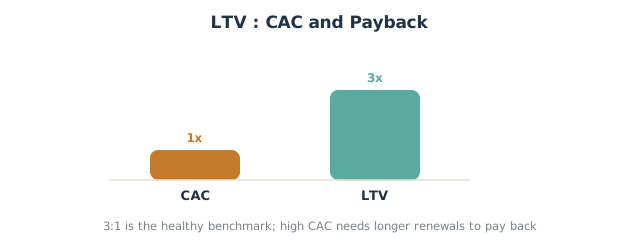
The LTV to CAC ratio measures the relationship between what a customer is worth (lifetime value) and what it cost to acquire them (customer acquisition cost). A good LTV to CAC ratio is around 3:1. The hidden link: a high customer acquisition cost means you must keep customers renewing for longer to recover that cost and turn a profit. CAC sets the bar; renewals clear it. That is why retention is a unit-economics issue, not just a customer success one.
If you acquire customers expensively and they churn early, you lose money on every deal no matter how good the product. This guide explains the LTV to CAC ratio, why 3x is the benchmark, and how renewals determine whether your acquisition is profitable.
What Is the LTV to CAC Ratio?
Two metrics, one relationship:
- CAC (customer acquisition cost): the total sales and marketing cost to acquire a new customer, divided by the number of new customers acquired in the period.
- LTV (customer lifetime value): the total revenue (or gross profit) you expect from a customer across the entire relationship.
The LTV to CAC ratio divides LTV by CAC. It measures how much value each acquired customer returns for every dollar spent to win them, which is the core test of a sustainable SaaS business model.
How to Calculate LTV and CAC
Calculate CAC:
CAC = total sales and marketing spend ÷ number of new customers acquiredCalculate LTV (a common version):
LTV = average revenue per customer × gross margin × average customer lifetimeCalculate the ratio:
LTV : CAC = LTV ÷ CACFor example, if LTV is $30,000 and CAC is $10,000, the LTV-CAC ratio is 3:1.
A Worked CAC and LTV Calculation
A quick CAC calculation: if you spent $200,000 on sales and marketing in a quarter and acquired 20 new customers, your CAC is $200,000 ÷ 20 = $10,000. To calculate your LTV, take average revenue per customer ($12,000/year), apply gross margin (80%), and multiply by average customer lifetime (3 years): $12,000 × 0.8 × 3 = $28,800. To calculate LTV to CAC, divide LTV by CAC: $28,800 ÷ $10,000 = 2.9, just under the healthy benchmark. This simple LTV ratio is one of the most important SaaS metrics for any SaaS business, because it tells you whether growth is profitable.
Why a 3x LTV to CAC Ratio Is Considered Good
A 3:1 ratio is the widely cited healthy benchmark because it balances growth and efficiency:
- Below 1:1 you lose money on every customer: CAC exceeds what the customer is worth.
- 1:1 to 3:1 you are profitable but may be under-investing in growth or carrying high acquisition costs.
- 3:1 is the sweet spot: strong returns with room to invest in acquisition.
- Much above 3:1 can mean you are under-investing in growth and could acquire more aggressively.
The ratio measures the relationship between cost and value; 3x leaves enough margin to fund the business after acquisition, support, and overhead.
Industry Benchmarks (and Why the Ratio Can Vary)
The 3:1 LTV to CAC ratio is the common SaaS industry benchmark, but the ratio can vary by stage and model:
- Early-stage SaaS companies often show a lower ratio because CAC is high relative to a short customer history that understates LTV.
- Mature SaaS companies with strong retention push the ratio higher as LTV compounds across renewals.
- Product-led businesses can run a higher ratio because self-serve acquisition lowers CAC.
So while 3:1 is the reference industry benchmark, compare your CAC LTV ratio against your own trend and your segment, not just a single number. The point is direction: a rising ratio means efficiency is improving; a lower ratio over time is a warning. Understanding what the CAC LTV ratio is for your business, and why it moves, is essential for any SaaS metrics review.
How High CAC Forces Longer Renewals
Here is the connection most teams miss. CAC is paid up front; LTV accrues over time through renewals. The CAC payback period is how long it takes a customer’s revenue to repay their acquisition cost. A higher CAC pushes the payback period out, which means:
- You must guarantee more renewals just to break even. If CAC takes 18 months to repay and customers churn at 12 months, you lose money on every deal.
- Early churn is catastrophic. With a high customer acquisition cost, a customer who does not renew never reaches profitability.
- Retention becomes the profit lever. Every additional renewal cycle is almost pure margin once CAC is repaid, so improving the renewal rate directly improves unit economics.
This is why a high CAC business lives or dies on retention: the longer customers renew, the higher the LTV, and the better the LTV-CAC ratio becomes.
The CAC Payback Period
The CAC payback period is the companion metric to the LTV to CAC ratio: it measures how many months of a customer’s revenue it takes to repay their acquisition cost. The formula is CAC ÷ (monthly revenue per customer × gross margin). A payback under 12 months is strong for SaaS companies; beyond 18 months, you are carrying acquisition cost for a long time and rely heavily on renewals to turn a profit. Payback and the LTV ratio tell complementary stories: the ratio shows lifetime profitability, the payback period shows how fast you recover cash. Watch both, because a healthy LTV to CAC ratio with a long payback period can still strain cash flow in a fast-growing business.
How to Improve Your LTV to CAC Ratio
You improve the ratio from both sides:
- Increase LTV by lifting retention and expansion: catch silent churn early, score renewal risk, and grow accounts via cross-sell and upsell. Increasing your LTV is usually the highest-leverage move because it compounds across every renewal.
- Reduce CAC by improving conversion of cheaper channels, leaning on product-qualified leads, and tightening sales and marketing efficiency.
- Shorten payback by improving onboarding so customers reach value (and the first renewal) faster.
A healthy ratio is rarely won by cutting CAC alone; the durable gains come from higher LTV through retention.
To improve LTV specifically, focus on the levers that extend and deepen the customer relationship: faster onboarding, proactive success, and expansion. Increasing your LTV by even one renewal cycle can move the ratio more than a large cut to CAC, because retained revenue is high-margin. In short: reduce CAC where you can, but improve LTV relentlessly, since a higher LTV is what makes the whole ratio work.
Frequently Asked Questions
What is a good LTV to CAC ratio? Around 3:1. It means each customer returns three times their acquisition cost over their lifetime, leaving healthy margin to fund the business.
Why is a 3x LTV to CAC ratio considered good? It balances profitability and growth: enough return to be sustainable, with room to keep investing in acquisition.
How is the LTV to CAC ratio calculated? Divide customer lifetime value by customer acquisition cost. CAC is total sales and marketing spend divided by new customers acquired.
Why does high CAC require longer renewals? CAC is paid up front and recovered through renewals over time. A higher CAC lengthens the payback period, so customers must renew longer before the deal becomes profitable.
How do you improve the LTV to CAC ratio? Raise LTV through retention and expansion, reduce CAC through more efficient acquisition, and shorten the payback period with faster onboarding.
LTV:CAC is the unit-economics metric in our SaaS renewal metrics guide; renewals are what make it work.
Acquisition gets the headlines; renewals pay the bills. SWOTBee builds retention, renewal forecasting, and unit-economics reporting for mid-market companies across Energy, Manufacturing, and SaaS.
Get your 1-page renewal leakage estimate →
No call needed. Prefer to talk it through first? Book a free 30-minute discovery call →