This article is part of our guide to SaaS renewal metrics.
Silent churn is when customers leave without a word: no complaint, no support ticket, no warning, just a non-renewal. Counterintuitively, the customers who file ten support tickets usually renew, because they are engaged; the real flight risks are the ones who stop using your product, skip check-ins, and stop replying to emails. Detecting silent churn means watching behavior, not waiting for complaints.
Silent churn happens without saying a word, which is exactly what makes it dangerous. By the time the renewal date arrives, the decision was made months ago. Here is what causes it, the warning signs, and how to detect it early.
What Is Silent Churn?
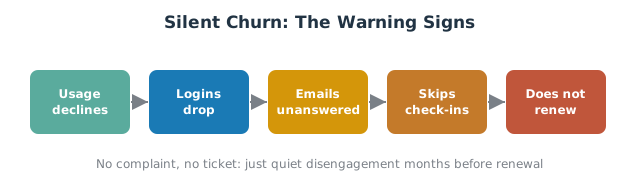
Silent churn is customer churn that happens without any explicit signal: the customer simply disengages and then does not renew. Of the different types of churn (voluntary, involuntary, and silent), silent churn is the hardest to catch because there is no event to react to. The customer does not complain, downgrade, or raise a flag. They quietly stop using your product and leave without a word.
This matters because acquiring new customers costs far more than retaining existing ones. A high customer acquisition cost means every silently churned customer is expensive to replace, so reducing silent churn directly protects ROI.
Why Engaged (Even Frustrated) Customers Renew
It feels backwards, but a customer who submits support tickets and complains is engaged: they are invested enough to want it fixed. A responsive support team that resolves their issue often turns a frustrated customer into a loyal one. The dangerous customer is the one who never complains, never opens a ticket, and never replies, because they have already disengaged. Silence is not satisfaction; it is often abandonment in progress.
What Causes Silent Churn
Common causes of silent churn:
- Poor onboarding. Customers who never reach value disengage quietly. A weak start is the leading cause.
- Low product adoption. When customers stop using your product, or never adopt key features, churn risk rises.
- Loss of the champion. The internal advocate leaves and no one else sees the value.
- Slow response times. Even without complaints, slow support erodes the relationship.
- No proactive contact. If customer success never reaches out, disengagement goes unnoticed.
These factors lead to silent churn well before the renewal conversation.
Warning Signs of Silent Churn
The indicators of silent churn are behavioral, and they show up in your data:
- Declining product usage. Falling logins, sessions, or feature use is the clearest early signal.
- Dropping engagement. Unopened emails, skipped check-ins or QBRs, and no responses.
- Reduced breadth of use. Fewer active users on the account, or use narrowing to one feature.
- Going dark after a change. A new admin or reorg followed by silence.
- Falling NPS or CSAT with no follow-up.
Any one of these is a yellow flag; several together, especially near a renewal, is a red one.
How to Detect Silent Churn Early
You cannot wait for customers to tell you. Detect silent churn with data and automation:
- Track engagement and usage data. Bring product usage, login recency, and support activity into one view per account.
- Build a health score. Combine usage, engagement, and support signals into a single score so disengagement surfaces automatically. See renewal risk scoring.
- Automate alerts. Use automation to flag accounts whose usage or engagement drops below a threshold, so customer success acts in days, not at renewal. This is where churn-prevention workflows earn their keep.
- Watch the right KPIs. Track usage trend, engagement recency, and CSAT as leading KPIs on a dashboard, not just churn rate, which is a lagging metric.
- Reach out proactively. A simple check-in to a quiet account often re-engages it (or surfaces the real issue) before the renewal.
How to Reduce Silent Churn
- Fix onboarding so customers reach value fast and keep using your product.
- Run proactive customer success, not reactive support, so disengagement is caught early.
- Tighten response times so the relationship stays warm even between issues.
- Re-engage quiet accounts with value-led outreach well before renewal.
Reducing silent churn lifts your renewal rate and your customer lifetime value at the same time, because the cheapest customer to keep is the one who never decided to leave.
Frequently Asked Questions
What is silent churn? Customer churn that happens without any complaint or warning: the customer disengages, stops using the product, and does not renew, without saying a word.
Why is silent churn important to understand? Because it is invisible until the renewal is lost, and replacing a churned customer costs far more than retaining one given high customer acquisition costs.
What are the warning signs of silent churn? Declining product usage, unanswered emails, skipped check-ins, fewer active users, and falling NPS or CSAT with no follow-up.
How can businesses detect silent churn? By tracking usage and engagement data, building a health score, and automating alerts when activity drops, so customer success acts early.
Do customers who complain churn more? Usually less. Complaining customers are engaged; the bigger flight risk is the quiet customer who has already disengaged.
Silent churn is one of the churn-risk signals in our SaaS renewal metrics guide.
The most dangerous churn is the kind you never hear: quiet disengagement that surfaces only at renewal. SWOTBee builds churn-risk detection and customer health scoring for mid-market companies across Energy, Manufacturing, and SaaS.
Get your 1-page renewal leakage estimate →
No call needed. Prefer to talk it through first? Book a free 30-minute discovery call →