This article is part of our guide to SaaS renewal metrics.
A blended churn rate averages every customer together, which lets healthy old cohorts mask toxic new ones. SaaS cohort analysis fixes this by grouping customers (usually by signup period) and tracking how each cohort retains over time. A company can post a comfortable 2% blended churn while its most recent cohorts churn at 8%, a problem that only cohort retention analysis reveals. For any subscription business, cohort-based retention is not optional.
Blended metrics are reassuring and often wrong. This guide explains what cohort analysis is, the types, how to perform one, and how to read a retention curve so you see your true retention.
What Is SaaS Cohort Analysis?
A cohort is a group of customers who share a characteristic, most often the period they signed up. SaaS cohort analysis tracks each cohort of customers separately over time, so you can see how a specific cohort retains, churns, or expands month by month rather than averaging everyone into one number.
Why it matters for a subscription business: a blended retention number mixes a loyal two-year-old cohort with a struggling new cohort. The average looks fine while the newest customers leak. Cohort analysis in SaaS surfaces that divergence, turning a single retention number into actionable insights about which customers stay and why.
Why Blended Churn Hides the Truth
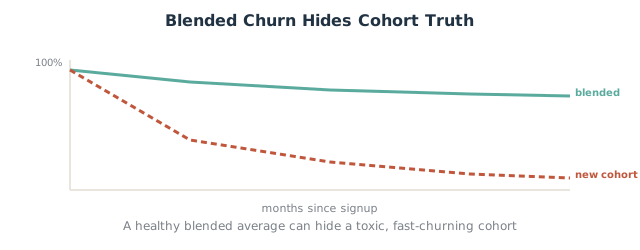
Imagine a SaaS company with 1,000 customers and 2% monthly churn. Healthy, right? Now split by acquisition cohort: customers acquired through referrals churn at 1%, while a new paid-acquisition channel brings customers who churn at 8%. The blended 2% hides a cohort that is bleeding.
If you only watch the blended churn rate, you scale the bad channel because the average looks safe. Cohort analysis helps you catch this early, before the toxic cohort grows large enough to drag down the whole business. This is why cohort-based retention is one of the most important SaaS metrics.
The reverse can also happen: low-retention customers leave first, so the remaining base looks healthier even though nobody became more likely to stay. That survivor mix shift in retention reporting is why executives should compare like-for-like cohorts instead of accepting an improving aggregate rate at face value.
Types of Cohort Analysis in SaaS
There are three main types of cohort analysis:
- Acquisition cohorts. Group users by when they signed up (the signup month or quarter). Acquisition cohort analysis is the classic retention view: how does each signup cohort retain over time?
- Behavioral cohorts. Group users by what they did (activated a feature, hit a usage milestone). A behavioral cohort reveals how actions drive retention.
- Revenue cohorts. Group by revenue characteristics (plan, deal size). A revenue cohort shows dollar retention and net revenue retention by segment.
Each answers a different question. Acquisition cohorts show when retention changes; behavioral cohorts show why; revenue cohorts show the financial impact.
The Metrics That Matter in Cohort Analysis
The most important metrics for SaaS cohort analysis:
- Retention rate per period (the core retention metric): what percentage of the cohort remains active each month.
- Churn or retention curve: how the retention number declines (and ideally flattens) over the cohort’s life.
- Revenue retention / net revenue retention by cohort: whether the cohort’s recurring revenue grows or shrinks.
- Customer lifetime value (LTV): estimated from how long and how well a cohort retains.
Together these turn churn and retention into something you can act on rather than just report.
How to Perform a SaaS Cohort Analysis
Here is how to conduct a cohort analysis, step by step:
- Define your cohorts. Decide the grouping (usually signup month). Clear cohort definitions are the foundation; a vague cohort base produces noise.
- Build the cohort table. Rows are cohorts (e.g., Jan, Feb, Mar signups); columns are months since signup. Each cell is the percentage of that cohort still active. This cohort chart is the heart of the analysis.
- Plot the retention curve. For each cohort, plot retention over time. A healthy SaaS product shows the curve flattening (retention stabilizes); a curve that keeps falling means no sticky core.
- Compare cohorts. Read down the columns: are newer cohorts retaining better or worse than older ones at the same age? This is the comparison that blended numbers hide.
- Segment further. Split by acquisition channel, plan, or behavior to find which customer cohort drives high churn and which retains best.
A simple cohort analysis template (a spreadsheet with the cohort table and a retention curve chart) is enough to start; you do not need specialized software to run a basic cohort analysis.
Reading the Retention Curve
The retention curve is the payoff of running a cohort analysis. Three shapes to know:
- Falling and not flattening: customers never find lasting value. The cohort retains poorly and LTV is low.
- Falling then flattening (the “smile” plateau): a sticky core remains. This is what a healthy cohort retains toward.
- Flattening then rising (revenue): when measured on dollars, a revenue cohort can rise above its starting value as expansion outpaces churn, the same dynamic as net revenue retention.
Where the curve flattens tells you your long-term retention rate and feeds your LTV estimate.
Using Cohorts to Predict Behavior and LTV
Because each cohort shows how customers in a cohort behave over time, cohort data is the cleanest input for predicting customer behavior and estimating customer lifetime value. If your oldest acquisition cohorts retain 70% at 24 months, you can model LTV for newer cohorts with far more confidence than a blended average allows. Cohort analysis also flags early-warning behavior: a new cohort whose retention curve drops faster than prior cohorts predicts higher churn before it fully lands. Pair this with renewal risk scoring to act on individual accounts.
Common Pitfalls to Avoid
- Too-small cohorts. Tiny cohorts produce noisy retention numbers. Group enough customers per cohort to be meaningful.
- Ignoring channel and plan. A blended cohort can still hide a bad acquisition channel. Segment.
- Confusing logo and revenue retention. A cohort can lose many small customers (low logo retention) while dollar retention stays high. Track both.
- Reading too early. Young cohorts have not revealed their retention curve yet. Give them time before drawing conclusions.
Following these best practices keeps your cohort analysis honest and actionable.
Frequently Asked Questions
What is SaaS cohort analysis? It groups customers (usually by signup period) and tracks how each group retains, churns, or expands over time, instead of averaging everyone into one blended number.
What are the types of cohort analysis? Acquisition cohorts (by signup time), behavioral cohorts (by action taken), and revenue cohorts (by plan or revenue). Each answers a different retention question.
How do you perform a cohort analysis? Define cohorts, build a cohort table (cohorts as rows, months-since-signup as columns), plot the retention curve, then compare cohorts and segment further.
Why is blended churn misleading? It averages healthy and unhealthy cohorts together, so a toxic new cohort can be hidden by loyal older customers until it is large enough to hurt.
How does cohort analysis help estimate LTV? The retention curve from older cohorts shows how long customers stay, which is the core input for modeling customer lifetime value for newer cohorts.
Cohort analysis is one of the metrics in our SaaS renewal metrics guide; pair it with the at-bat renewal rate for a complete retention picture.
Blended averages are where retention problems hide: healthy cohorts masking toxic ones. SWOTBee builds cohort retention reporting and churn-risk analytics for mid-market companies across Energy, Manufacturing, and SaaS.
Get your 1-page renewal leakage estimate →
No call needed. Prefer to talk it through first? Book a free 30-minute discovery call →