SaaS renewal metrics are the numbers that tell you whether your recurring revenue is safe: renewal rate, net revenue retention (NRR), gross revenue retention (GRR), churn rate, and the forecasting and unit-economics metrics that sit behind them. This RevOps guide explains each metric, how to calculate it, what a good benchmark looks like, and how to catch churn risk before it hits the bottom line. The goal: cut through vanity metrics to a single source of truth.
Most SaaS companies track renewal numbers that quietly lie to them. A healthy-looking blended churn rate hides toxic cohorts; a forecast built on the wrong revenue base misses by quarters. The metrics below, measured properly, fix that.
What Are SaaS Renewal Metrics?
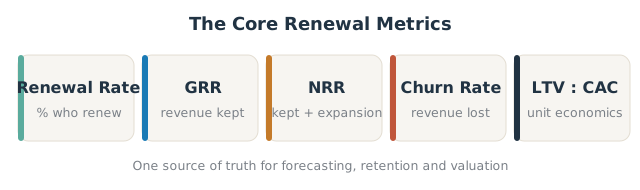
Renewal metrics measure how well a subscription business keeps and grows its existing customers. They answer three questions: how many customers (and how much revenue) renew, how much you expand or lose, and how predictable that is. Together with churn and retention metrics, they are the core SaaS KPIs every customer success team and RevOps leader reports on.
The five most important metrics for SaaS renewals:
- Renewal rate (count-based and revenue renewal rate)
- Net revenue retention (NRR)
- Gross revenue retention (GRR)
- Churn rate
- Customer lifetime value (LTV) relative to acquisition cost
How to Calculate the Renewal Rate
The renewal rate measures the percentage of customers (or revenue) that renew their subscriptions. There are two views, and confusing them is the most common mistake:
- Count-based renewal rate = (number of customers who renew ÷ number of customers up for renewal) × 100.
- Revenue renewal rate = (renewed ARR ÷ ARR up for renewal) × 100.
The critical detail: only measure the specific cohort of customers whose contracts are actually expiring in the period. This “at-bat” approach prevents healthy long-term contracts from masking poor performance. See measuring at-bat renewal rate for the full method, and how to track renewal rate in HubSpot dashboards.
When you calculate renewal across your customer count, be precise about the denominator. The count-based renewal rate uses the total number of customers up for renewal in the window, not your entire customer base. A renewal rate calculation that quietly includes customers who are not even up for renewal will overstate your customer renewal rate every time. Done correctly, the same renewal rate measures performance consistently, so tracking it across periods is meaningful.
Renewal Rate vs Retention Rate
They are not the same. Renewal rate focuses on contracts up for renewal in a window; retention rate measures the overall customer base over time. Renewal rate is the sharper operational signal; broader retention metrics tell the longer story. Tracking renewal rates over time matters more than any single reading.
Gross vs Net Revenue Retention
Two metrics, two very different stories:
- Gross revenue retention (GRR) = how much recurring revenue you keep before any expansion, after churn and downgrades. It caps at 100% and measures how well you patch leaks.
- Net revenue retention (NRR) = GRR plus expansion (upsell and cross-sell). It can exceed 100%, and investors prize NRR over 115% because it shows existing customers fund growth on their own.
The gap between the two is your expansion engine. For the valuation lens and how to measure each, see gross vs net revenue retention.
What Is a Good Renewal Rate?
Benchmarks depend on segment, but as a guide: strong SaaS renewal rates sit around 90% or higher for annual contracts, with enterprise SaaS often higher than self-serve. Renewal rates of 80% or below signal a retention problem. NRR benchmarks: 100% is treading water, 110%+ is healthy, 120%+ is best-in-class. The factors that influence renewal rates most are product value, onboarding quality, and executive engagement.
What Influences Renewal Rates (and How to Improve Them)
Strong renewal rates are not luck. The factors that move them, and the customer retention strategies that work, are consistent across SaaS providers:
- Onboarding and time-to-value. Customers who reach value early renew at far higher renewal rates. A weak start shows up at renewal time.
- Executive engagement. When a customer renews, it is usually because a senior stakeholder sees ongoing value. Losing that contact is a leading risk.
- Proactive renewal conversations. Many SaaS companies wait until the contract is almost up. The strongest renewal performance comes from customer success managers who open the renewal conversation 90 days out.
- Consistent value delivery. A good customer experience across the year is what makes customers renew their contracts without a fight, and it lifts your upsell rate at the same time.
Increasing customer retention here is what raises both your customer retention rate and overall retention across the entire customer base. Because renewal rate determines so much of SaaS finance (it drives net dollar retention and, ultimately, valuation), even a few points of improvement compounds.
Forecasting Renewal Revenue
A renewal forecast is only as good as the revenue base it uses. The biggest forecasting error is blending Total Contract Value (TCV) with Annual Recurring Revenue (ARR), which distorts multi-year deals. Keep them separate. See TCV vs ARR forecasting, and why your renewal forecast is wrong and how to fix it. For consumption pricing, forecasting usage-based revenue needs a different model entirely.
Catching Churn Risk Early
Churn rate (churned revenue ÷ starting revenue) is a lagging metric. The leading signals matter more:
- Cohort analysis reveals churn that a blended rate hides. See why blended churn hides your true retention.
- Survivorship bias can make aggregate retention rise after weak customers leave, even when no comparable segment improves. See why rising NRR can hide a shrinking customer base.
- Silent churn is the real risk: customers who go quiet, skip check-ins, and stop replying renew far less often than the ones who complain. See detecting silent churn.
- A predictive health score turns these signals into one number. See renewal risk scoring.
Expansion and Efficiency Metrics
Renewals are also where growth compounds:
- SaaS quick ratio measures whether new and expansion revenue outpace churn and contraction. See calculating the SaaS quick ratio.
- Cross-sell vs upsell must be tracked separately to understand your expansion strategy. See cross-sell vs upsell.
- Product-qualified signals flag expansion (and renewal risk) before the conversation. See product-qualified signals for expansion.
- CAC, LTV, and payback decide whether a renewal is even profitable. See the cost of high CAC on LTV and renewals.
Renewal Metrics Glossary (Quick Reference)
| Metric | Formula | Good benchmark |
|---|---|---|
| Renewal rate (count) | Renewed customers ÷ customers up for renewal | 90%+ |
| Revenue renewal rate | Renewed ARR ÷ ARR up for renewal | 90%+ |
| Gross revenue retention | (Start ARR − churn − downgrades) ÷ Start ARR | 90%+ |
| Net revenue retention | (Start ARR − churn − downgrades + expansion) ÷ Start ARR | 110%+ |
| Churn rate | Churned ARR ÷ Start ARR | <5%/yr |
| SaaS quick ratio | (New + expansion) ÷ (churn + contraction) | 4+ |
| LTV:CAC | Lifetime value ÷ acquisition cost | 3:1+ |
Frequently Asked Questions
What are the most important SaaS renewal metrics? Renewal rate, net revenue retention (NRR), gross revenue retention (GRR), churn rate, and LTV relative to CAC. Together they show whether recurring revenue is safe and growing.
How is the SaaS renewal rate calculated? Divide the customers (or ARR) that renewed by the customers (or ARR) up for renewal in the period, then multiply by 100. Measure only the cohort actually expiring (at-bat).
What is a good SaaS renewal rate? Around 90% or higher for annual B2B contracts; 80% or below signals a retention problem. Enterprise SaaS typically renews higher than self-serve.
What is the difference between renewal rate and retention rate? Renewal rate measures contracts up for renewal in a window; retention rate measures the overall customer base over time.
What is the relationship between churn rate and renewal rate? They are inverses on the revenue you keep: a higher churn rate pulls your renewal and retention rates down.
These metrics tell you whether renewals are healthy; the complete guide to building a renewal pipeline in HubSpot shows you how to operationalize them, and the 365-day renewal strategy shows you how to win and expand them.
Use the HubSpot management reporting guide to carry approved renewal definitions into a recurring decision pack. The revenue, forecast, goal, and ROI reporting path connects those retention measures with target, forecast, and broader revenue reporting.
Measuring renewals is where most teams fool themselves: blended averages, mixed revenue bases, and lagging signals. SWOTBee builds renewal forecasting, dashboards, and churn-risk scoring for mid-market companies across Energy, Manufacturing, and SaaS.
Get your 1-page renewal leakage estimate →
No call needed. Prefer to talk it through first? Book a free 30-minute discovery call →