This article is part of our guide to SaaS renewal metrics.
Upselling sells the same customer more or a higher tier of what they already have; cross-selling sells them a complementary product or service. Both increase revenue from existing customers, but they are different motions and must be tracked separately. Upsell is “more of the same, bigger”; cross-sell is “a related product alongside.” Mixing them in your pipeline hides which expansion strategy actually works.
Cross-selling and upselling are the two engines of expansion revenue, and expansion is what pushes net revenue retention above 100%. This guide covers the key differences, examples of each, the techniques that work, and the risks to avoid.
What Is Upselling?
Upselling encourages customers to buy a higher tier, more volume, or an upgrade of the product they already use. The customer’s need stays the same; you sell a bigger or better version of the solution.
Examples of upselling:
- Moving a customer from a Pro plan to an Enterprise plan.
- Adding more seats, storage, or usage capacity to an existing subscription.
- Upgrading to a version with advanced features.
Upselling works because the customer has already chosen your product; you are deepening an existing purchase, not introducing a new one.
What Is Cross-Selling?
Cross-selling sells a complementary product or service alongside what the customer already buys. The customer’s original need is met; you address an adjacent need with an additional product.
Examples of cross-selling:
- Selling an analytics add-on to a customer who bought your core CRM.
- Offering a security module to a customer using your platform.
- Bundling a complementary product that pairs with the initial purchase.
Cross-selling expands the relationship into new areas, which is why successful cross-selling tends to increase customer loyalty as well as revenue: the more products a customer adopts, the stickier they become.
Learn the Difference: Cross-Selling vs Upselling at a Glance
If you only learn the difference between cross-selling and upselling, learn this: upselling sells a better version of the product the customer already wants; cross-selling sells related or complementary products and services alongside it. Both are sales techniques aimed at existing customers, and both can boost revenue, but they are different motions. Cross-selling is a sales strategy of breadth (more products per customer); upselling is a sales strategy of depth (more value per product). Discover how cross-selling and upselling can boost average order value and customer lifetime value, and you will see why mature teams run both deliberately rather than ad hoc.
Cross-Sell vs Upsell: The Key Differences
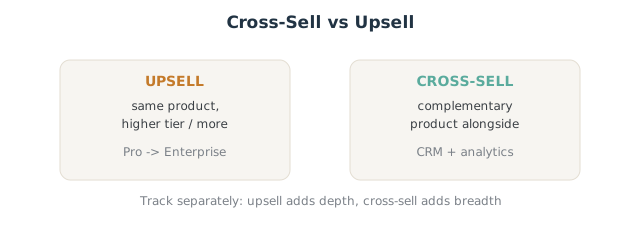
The difference between cross-selling and upselling comes down to what you are selling relative to the original purchase:
| Upsell | Cross-sell | |
|---|---|---|
| What you sell | More or higher tier of the same product | A complementary product or service |
| Customer need | Same need, bigger solution | Adjacent, new need |
| Example | Pro to Enterprise | CRM plus analytics add-on |
| Main effect | Higher value per existing product | More products per customer |
Both are sales tactics that increase revenue from your existing customer base and raise customer lifetime value, but they require different triggers, messaging, and timing. That is exactly why you should track upsell and cross-sell separately.
Why Track Cross-Sell and Upsell Separately
Lumping both into “expansion” hides which motion drives growth. Tracking them apart tells you:
- Which strategy scales. If upsell drives most expansion, your tiering and packaging are working. If cross-sell leads, your product portfolio is the lever.
- Where to invest. Separate data shows whether to build more tiers (upsell) or more complementary products (cross-sell).
- How to forecast. Upsell and cross-sell convert at different rates and timelines, so blending them distorts your expansion forecast and your net revenue retention analysis.
In your CRM, tag expansion deals as upsell or cross-sell so the reporting is clean from the start.
Cross-Selling and Upselling Techniques That Work
Effective cross-selling and upselling is timed and relevant, not pushy:
- Use product usage signals. Let usage tell you who is ready, using product-qualified signals. A customer hitting a usage limit is primed for an upsell; one using a feature that pairs with an add-on is a cross-sell candidate.
- Time it to value, and to renewal. The best moment to upsell or cross-sell is after the customer has seen results, ideally folded into the renewal conversation.
- Lead with the customer’s goal. Effective upselling and cross-selling frames the offer around the outcome the customer wants, not your revenue target.
- Use customer data. Mine CRM and product data to find cross-selling opportunities, then personalize the offer to the account.
- Bundle thoughtfully. Cross-selling offers that bundle genuinely complementary products raise average order value without feeling forced.
Done well, these techniques boost revenue per customer while improving customer satisfaction, because the customer gets more value.
Cross-Selling and Upselling in the Sales Process
Where these tactics fit in the sales process matters as much as the offer itself. A cross-sell or upsell landed at the wrong moment feels like a pushy sales pitch; landed at the right moment it feels like help. Map each motion to the customer journey:
- After a successful initial purchase and onboarding is the natural window to upsell, because the customer has seen the version of the product working and is open to more.
- When a complementary need surfaces is the moment to cross-sell, encouraging customers to purchase additional products and services that solve an adjacent problem.
- Before renewal is when both upsell and cross-sell opportunities should be reviewed, so expansion folds into the renewal conversation.
Effective upselling strategies and cross-selling strategies share a backbone: they use customer data to find upsell opportunities, they frame the offer around the customer’s goal, and they are timed to value. Cross-selling and upselling are essential growth levers precisely because selling to existing, satisfied customers converts far better than acquiring new ones, and it improves customer loyalty when done with restraint. The difference between upselling and cross-selling is what you sell; the discipline of timing and relevance is what makes either work.
The Risks of Cross-Selling and Upselling
Both tactics can backfire if mishandled:
- Pushing too early. Upselling or cross-selling before the customer has seen value erodes trust and can trigger churn.
- Irrelevant offers. A cross-sell that does not fit the customer’s need signals you do not understand them.
- Over-bundling. Forcing additional products or services the customer does not want damages the customer relationship.
- Discount dependence. Winning expansion only through discounts trains customers to wait for them and erodes margin.
The guardrail is relevance: every offer should make the customer’s outcome better, or it should not be made.
How Cross-Sell and Upsell Drive Lifetime Value
Both motions raise customer lifetime value, but through different mechanics. Upselling increases the value of an existing product line per customer; cross-selling increases the number of products per customer, which compounds retention because multi-product customers churn less. Satisfied customers who adopt more of your portfolio stay longer and spend more, so a deliberate mix of upselling and cross-selling can boost both revenue and loyalty across the customer base. The teams that win track each separately, measure conversion, and feed the learnings back into packaging and the renewal motion.
Frequently Asked Questions
What is the difference between cross-selling and upselling? Upselling sells more or a higher tier of the same product; cross-selling sells a complementary product or service. Upsell deepens an existing purchase; cross-sell broadens it.
What is an example of upselling? Moving a customer from a Pro to an Enterprise plan, or adding seats to their existing subscription.
What is an example of cross-selling? Selling an analytics add-on to a customer who already uses your core product.
Why track upsell and cross-sell separately? They convert at different rates and reveal different growth levers; blending them hides which expansion strategy works and distorts forecasting.
What are the risks of cross-selling and upselling? Pushing too early, offering irrelevant products, over-bundling, and relying on discounts, all of which can erode trust and margin.
Cross-sell and upsell are the expansion levers in our SaaS renewal metrics guide.
Expansion done wrong feels like pressure; done right it feels like help. SWOTBee builds expansion tracking and renewal pipelines for mid-market companies across Energy, Manufacturing, and SaaS.
Get your 1-page renewal leakage estimate →
No call needed. Prefer to talk it through first? Book a free 30-minute discovery call →