This article is part of our guide to SaaS renewal metrics.
Product-qualified signals are usage-based triggers that show an existing customer is ready to expand: hitting a usage quota, adopting an advanced feature, or adding users. A customer showing these signals is a product-qualified lead (PQL) for expansion, and tracking them lets you time an upsell right before renewal, when buying intent is highest. Instead of guessing, you let product usage data tell you which accounts are ready to buy more.
PQLs are the most reliable expansion signal in B2B SaaS because they are based on what customers actually do, not what they say. This guide explains what a PQL is, how it differs from an MQL and SQL, and how to score and act on expansion signals.
What Is a Product-Qualified Lead (PQL)?
A product-qualified lead is a user or account that has experienced real value in your product and shown buying intent through usage. For expansion, a PQL is an existing paying customer whose product usage signals they are ready for a higher tier, more seats, or an add-on.
PQLs are valuable because they convert far better than other lead types: the customer has already used the product and seen the ROI, so the sales conversation starts from value, not from scratch. For product-led growth and product-led sales motions, PQLs are the core of the pipeline.
PQL vs MQL vs SQL
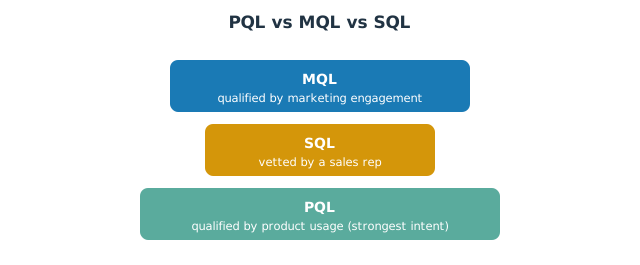
The lead types differ by the signal that qualifies them:
- MQL (marketing qualified lead): qualified by marketing engagement (downloads, email opens). Intent is inferred from content interaction.
- SQL (sales qualified lead): an MQL a sales rep has vetted as worth pursuing.
- PQL (product qualified lead): qualified by product usage. The signal is behavior inside the product, which is a much stronger predictor of buying intent than an MQL’s content engagement.
The key difference: MQLs and SQLs guess at intent from outside the product; PQLs measure it from inside. That is why PQLs are more likely to convert.
Expansion Signals to Track
Expansion signals are the specific usage triggers that identify a PQL ready to grow. Track these as data points across your customer base:
- Hitting a usage quota or limit (seats, API calls, storage). A customer bumping against a limit is the strongest expansion signal there is.
- Advanced feature adoption. Using features tied to a higher tier signals readiness to upgrade.
- Adding users. Growing the number of active users on an account predicts a seat expansion.
- High overall product usage. Power users who use your product daily are prime expansion candidates.
- Cross-team adoption. Usage spreading to new departments signals a larger deal.
Combine product usage data with engagement and, where useful, third-party research intent data to see which accounts are in a buying cycle.
How to Identify, Score, and Grow PQLs
To operationalize product-qualified signals:
- Define your PQL criteria. Decide which usage triggers indicate expansion readiness for your ideal customer profile (ICP). One clear quota signal beats a dozen vague ones.
- Bring usage data into the CRM. Integrate product usage data so sales and customer success see the signals on the account record. Without this integration, PQLs stay invisible.
- Score the signals. Combine product usage, engagement data, and account fit into a score that ranks accounts by expansion readiness, the mirror image of renewal risk scoring. Some teams layer an AI predictive model over the data points to rank buying signals across accounts.
- Route high-intent accounts. When an account becomes a qualified PQL, create a task for the owner to start the expansion conversation, ideally before the renewal so it folds into one deal.
- Time it to the renewal. A PQL flagged 60 to 90 days before renewal lets you combine the renewal and the upsell into a single, value-led conversation.
Acquisition PQLs vs Expansion PQLs
This guide to product qualified leads covers two related motions. In acquisition, a PQL is a free trial or freemium user whose product activity shows they are getting value from your product and are ready to become a paying customer; the job is to convert PQLs into paying customers. In expansion, the PQL is an existing customer whose usage shows opportunities for expansion. Both rely on the same idea: behavioral signals from inside your product beat marketing qualified leads sourced from content. Whether you are trying to convert trial users or grow paying customers, product data and CRM data together tell you which target accounts are in research mode and which are hot leads showing signs they are ready to buy.
For B2B SaaS companies, the strongest setup blends three inputs: product usage (what they do inside your product), engagement intent data (how they interact with sales and marketing), and buyer intent data or third-party research signals (whether accounts are in research mode elsewhere). Layering these key signals gives sales teams and the customer success team a shared, ranked view of the buying intent of a B2B account, so prioritizing PQLs becomes a daily routine rather than a quarterly guess. The payoff is revenue growth from customers who are already proving, based on product usage, that they are ready.
How to Convert PQLs Into Expansion Revenue
Identifying a PQL is half the job; converting qualified PQLs is the other half. Once an account shows the signs they are ready to buy, the play is fast and relevant:
- Confirm readiness from customer data. Check that the signals are real (sustained usage, not a one-off spike) before reaching out. The best signal is a customer consistently using the product and hitting limits.
- Lead with the value they are already getting. Because the customer is using the product daily, frame the expansion around the outcome they are achieving, not a feature list. Customers are ready to expand when more of your product solves more of their problem.
- Time it to the renewal. Fold the expansion opportunities into the renewal so it is one conversation, not two.
- Separate research-mode from ready-to-buy. Some accounts that are in research mode are exploring, not buying; treat them with education, and reserve direct offers for accounts showing strong buying signals.
Done well, this turns product usage into a predictable stream of expansion opportunities, and it works for converting a free-trial new customer just as well as expanding an enterprise account.
Why PQLs Beat Guesswork for Expansion
Expansion revenue is what pushes net revenue retention above 100%. Most teams chase expansion by gut feel or blanket outreach, which annoys customers and wastes rep time. PQLs replace that with evidence: you prioritize outreach to accounts whose usage proves they are ready, lifting conversion rates and protecting the customer relationship. The same usage signals that flag expansion also flag risk when they fall, so the model serves both growth and retention. Track which expansions come from upsell versus cross-sell to refine the motion.
Frequently Asked Questions
What is a product-qualified lead (PQL)? An account or user that has shown buying intent through product usage. For expansion, it is an existing customer whose usage signals readiness for a higher tier, more seats, or an add-on.
How do PQLs differ from MQLs and SQLs? MQLs and SQLs infer intent from marketing engagement and sales vetting; PQLs measure intent from actual product usage, which predicts buying intent far more reliably.
What are expansion signals? Usage triggers like hitting a quota, adopting advanced features, or adding users that indicate an existing customer is ready to expand.
How do you score PQLs? Combine product usage, engagement data, and account fit into a score that ranks accounts by expansion readiness, then route high scorers to sales or customer success.
When should you act on a PQL for expansion? Ideally 60 to 90 days before renewal, so the upsell folds into the renewal conversation.
Product-qualified signals are one of the expansion metrics in our SaaS renewal metrics guide. For what the evidence actually says about using usage data to predict renewal risk itself, rather than expansion timing, see our research on which usage metric actually predicts renewal.
Expansion is won by evidence, not guesswork: usage signals beat gut feel every time. SWOTBee connects product usage data to the renewal pipeline for mid-market companies across Energy, Manufacturing, and SaaS.
Get your 1-page renewal leakage estimate →
No call needed. Prefer to talk it through first? Book a free 30-minute discovery call →