This article is part of our 365-day renewal strategy guide.
A Customer Success Qualified Lead (CSQL) is an expansion opportunity identified by the customer success team based on a customer’s success, usage, and intent, then passed to sales. Because CSMs are closest to the customer, they spot expansion signals that marketing and sales miss, making CSQLs one of the highest-converting lead types and a key driver of net revenue growth. Training your post-sale team to generate CSQLs turns customer success into a revenue engine.
Your CSMs sit on a goldmine of buying intent. This guide explains what a CSQL is, how it differs from MQLs and PQLs, and how to identify and generate them.
What Is a Customer Success Qualified Lead?
A customer success qualified lead (CSQL) is an existing customer flagged by the CS team as ready for expansion, an upsell, cross-sell, or new use case, based on their success with your product and observed buying signals. Unlike a cold lead, a CSQL comes from an account that already trusts you and is achieving value.
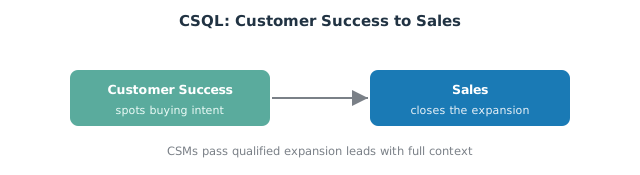
CSQLs sit at the intersection of customer success and sales: the CSM identifies the opportunity and hands a qualified CSQL to a sales rep to close, so the customer relationship stays intact while revenue grows.
CSQL vs MQL vs PQL
Different qualified leads come from different signals:
- MQL (marketing qualified lead): qualified by marketing engagement (content, email).
- PQL (product qualified lead): qualified by product usage signals.
- CSQL: qualified by the customer success team’s direct knowledge of the account, combining product usage, relationship health, and stated needs.
The CSQL is often the strongest of the three for expansion, because it blends data with human insight: the CSM knows not just that usage is high, but why, and what the customer wants next.
Why CSQLs Matter for Revenue Growth
- Higher conversion. CSQLs come from customers already succeeding with your product, so they close faster than cold leads.
- Lower cost. Expansion via CSQLs has near-zero customer acquisition cost compared to new business.
- Higher NRR. A steady flow of CSQLs feeds expansion, lifting net revenue retention.
- Stronger relationships. Because the CSM initiates, expansion feels like help, not a sales push.
How to Identify and Generate CSQLs
To build a CSQL engine, train the CS team to spot and pass opportunities:
- Define CSQL criteria. Agree the signals that qualify a lead: high adoption, a new use case, a stated goal, a team expansion, or hitting a usage limit.
- Watch the signals. Combine product usage data, customer health, and customer insights from conversations. A customer succeeding and asking “can it also do X?” is a CSQL.
- Capture it in the CRM. Give CSMs a simple way to flag a CSQL with context, so nothing is lost.
- Define the handoff. Set a clear SLA for passing CSQLs to sales, with the context the rep needs (the customer’s need, the value already realized).
- Align incentives. Credit CSMs for sourcing CSQLs so they are motivated to surface expansion, not just protect the renewal.
CSQLs Across the Customer Journey
CSQLs emerge at specific points in the customer journey, and training your team to spot them means knowing where to look. Strong signals appear after a successful onboarding (the customer is getting value and engagement levels are high), when usage spreads to new teams, or when a customer states a new desired outcome. A positive customer experience is the precondition: customers who are succeeding generate CSQLs, customers who are struggling generate churn.
Treat the CSQL as its own metric and pipeline indicator, distinct from marketing qualified leads and sales qualified leads. Where marketing efforts produce MQLs from content, CSQLs come from customer data and customer usage that only the post-sale team sees. For B2B SaaS, focusing on CSQLs is one of the most efficient ways to increase revenue, because nurturing these leads costs far less than new acquisition and strengthens customer loyalty and customer retention at the same time.
To operationalize it, give CSMs simple criteria (leads that show clear expansion intent), a fast handoff to an account executive or sales team, and credit for the outcome. When customer success and the sales process are aligned around CSQLs, expansion becomes a steady, predictable stream rather than an occasional surprise.
Making the CS-to-Sales Handoff Work
The CSQL only converts if the handoff is seamless. The CSM should pass the lead with the customer’s context, the use case, the realized value, the stakeholders, so the sales rep continues the conversation rather than restarting it. Tie CSQLs into the renewal: an expansion opportunity surfaced 60 to 90 days before renewal can fold into one conversation. This alignment of customer success and sales is what turns post-sale teams into a long-term customer revenue engine, complementing whitespace analysis and the broader land-and-expand motion.
Frequently Asked Questions
What is a customer success qualified lead (CSQL)? An expansion opportunity identified by the customer success team based on a customer’s success and intent, then passed to sales to close.
How do CSQLs differ from MQLs and PQLs? MQLs come from marketing engagement and PQLs from product usage; CSQLs come from the CS team’s direct knowledge of the account, blending data with human insight.
Why are CSQLs important for revenue growth? They convert faster and cheaper than cold leads and feed expansion, which lifts net revenue retention.
How do you identify CSQLs? Define qualifying criteria, watch product usage and customer health, capture flags in the CRM, and set a clear handoff to sales.
When should a CSQL be passed to sales? As soon as the signal is clear, ideally 60 to 90 days before renewal so the expansion folds into the renewal conversation.
CSQLs are how customer success fuels expansion in the 365-day renewal strategy.
Your CSMs hear buying intent every day; CSQLs are how you act on it. SWOTBee builds CSQL and expansion programs for mid-market companies across Energy, Manufacturing, and SaaS.
Get your 1-page renewal leakage estimate →
No call needed. Prefer to talk it through first? Book a free 30-minute discovery call →