This article is part of our 365-day renewal strategy guide.
Customer value realization is the point at which a customer actually achieves the business outcomes they bought your product for, and recognizes it. It is the only true driver of renewals. High product adoption is not enough: a customer can use your product daily and still churn if it is not solving their core business problem, or if you never prove that it is. Renewals are won by delivering measurable value and making that value visible.
Adoption is a means; value realization is the end. This guide explains what value realization is, its framework and stages, and how to measure it.
What Is Customer Value Realization?
Customer value realization is the stage in the customer lifecycle where the customer receives and recognizes the value your product promised. There are two halves, and both matter:
- Deliver value: the product produces the business outcome (time saved, revenue gained, cost cut).
- Recognize value: the customer, especially the economic buyer, sees and believes that outcome.
Value realization in customer success means engineering both: ensuring customers reach outcomes and ensuring they know it. A customer who realizes value renews; a customer who got value but never recognized it still questions the spend at renewal.
Why Adoption Alone Doesn’t Drive Renewals
Adoption metrics (logins, feature usage) are leading indicators, not proof of value. A team can adopt your product heavily and still not move the business metric they care about. When that happens:
- The day-to-day user is happy, but the economic buyer sees no business impact.
- At renewal, finance asks “what did this deliver?” and nobody has the answer.
- A cheaper competitor looks like a reasonable swap, because the unique value was never quantified.
This is why value realization, not adoption, is the metric that predicts renewal. Pair it with renewal risk scoring so low realization flags a renewal at risk early.
The Value Realization Framework (Stages)
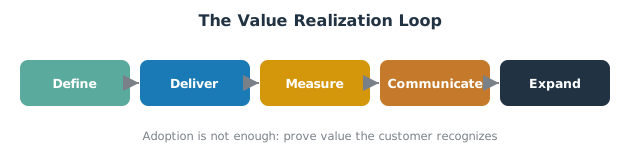
A value realization framework maps value across the customer journey:
- Define value. At onboarding, agree the customer’s goals and the metrics that define success. No value definition, no way to prove it later.
- Deliver value. Drive adoption toward those specific outcomes, not generic usage.
- Measure value. Quantify the outcome against the baseline (the hard part most teams skip).
- Communicate value. Surface the proof in QBRs and executive business reviews so decision-makers recognize it.
- Expand value. Use realized value as the foundation for expansion and the next 12 months.
This continuous value loop, run across the customer lifecycle, is what a strong customer success team operationalizes.
How to Measure Customer Value Realization
To measure value realization, tie product usage to business outcomes:
- Baseline at the start. Capture the customer’s metric before your product (e.g., hours spent, conversion rate).
- Track the outcome, not just usage. Measure the change in that business metric over time.
- Quantify ROI. Translate the outcome into money where possible; a quantified return is the strongest renewal argument.
- Score it. Roll realized value into customer health so you can see which accounts have proven value and which have not.
Measuring value realization turns a soft story into a number you can defend at renewal.
Value Management and Value Engineering
Mature customer success teams treat this as a discipline, not an afterthought. Value management is the ongoing practice of defining, measuring, and communicating the value customers receive across the entire customer base; value engineering is the upfront work of quantifying expected value before and during the sale, then proving it later.
Together they create a continuous value loop: you set a value definition with the customer, ensure value realization through adoption tied to outcomes, and report the value they are getting at every touchpoint. Done consistently, this is how you exceed customer expectations, a customer who sees more value than they expected does not shop around at renewal. A clear value realization strategy also gives customer success managers a repeatable way to prove the product’s value to the customer’s business, rather than relying on goodwill.
The teams that win renewals make value visible by default. Every QBR opens with outcomes, every renewal conversation leads with ROI, and every account has an owner accountable for ensuring value realization, not just adoption.
Why Proving Value Drives Retention
Customers do not renew because they used your product; they renew because it helped their business and they know it. Proving value realization:
- Protects against churn by answering the “what did we get?” question before it is asked.
- Defends margin against competitor price-dropping, because value, not price, anchors the conversation.
- Exceeds customer expectations when you show outcomes they had not even tracked.
Value realization is the foundation everything else in the renewal strategy is built on.
Frequently Asked Questions
What is customer value realization? The point at which a customer achieves and recognizes the business outcomes they bought your product for. It combines delivering value and proving it.
What is value realization in customer success? The customer success practice of ensuring customers reach their goals with your product and see that value clearly, which drives retention and expansion.
Why is customer value realization important? It is the true driver of renewals. Adoption alone does not guarantee renewal; proven value does.
What are the stages of value realization? Define value, deliver value, measure value, communicate value, and expand value, mapped across the customer lifecycle.
How do you measure value realization? Baseline the customer’s metric, track the outcome (not just usage), quantify ROI, and roll it into a health score.
Value realization is the foundation of the 365-day renewal strategy. This claim, that adoption alone doesn’t guarantee renewal, has real quantitative backing too: see our research on which product usage metric actually predicts renewal.
Customers renew outcomes, not features. SWOTBee builds value-realization and customer health programs for mid-market companies across Energy, Manufacturing, and SaaS.
Get your 1-page renewal leakage estimate →
No call needed. Prefer to talk it through first? Book a free 30-minute discovery call →