This article is part of our 365-day renewal strategy guide.
When a competitor drops their price at your renewal, panic-discounting is the wrong response: it erodes margin, sets a bad precedent, and competes on the one dimension where someone can always undercut you. The right response to competitive pricing pressure is to reinforce your unique value proposition and the cost of switching, defending profitability rather than matching the lower price. You rarely win a price war; you win by making price the wrong question.
Competitive price pressure is a test of nerve and preparation. This guide covers how to respond, when (rarely) to flex, and how to defend your margins.
Why Panic-Discounting Fails
Matching a competitor’s lower price feels safe but is usually a mistake:
- It erodes margin immediately and permanently; discounts are hard to claw back.
- It sets a precedent. A customer who wins a panic discount expects one every renewal.
- It signals your list price was inflated, undermining trust.
- It competes on price, the one axis where a competitor with deeper pockets can always win a price war.
Direct price competition is a race to the bottom. Your renewal strategy should make value, not price, the basis of the decision.
Understand the Competitive Pricing Landscape
To defend against competitive pricing pressure, it helps to know the pricing strategies a competitor might use against you. Competition-based pricing (also called competitor-based pricing) sets prices by reference to rivals rather than cost or value. Within it, several competitive pricing strategies show up at renewal:
- Price matching: the competitor matches or beats your price to win market share.
- Penetration pricing: a low entry price to attract customers and gain a foothold.
- Loss leader pricing: pricing one product below cost (a loss leader strategy) to win the account, then profiting elsewhere.
- Dynamic pricing: prices that shift with demand or competitor moves.
Knowing which pattern you face shapes your reaction. A penetration-pricing newcomer is making pricing decisions to buy market position, often unsustainably; that is rarely a reason to match. Tools like a competitive pricing analysis (and pricing software or pricing tools that track competitor prices and the market price) help you see whether a competitor’s strategic price is a long-term strategy or a short-term grab. Either way, your competitive advantage rests on perceived value, not on matching every price change.
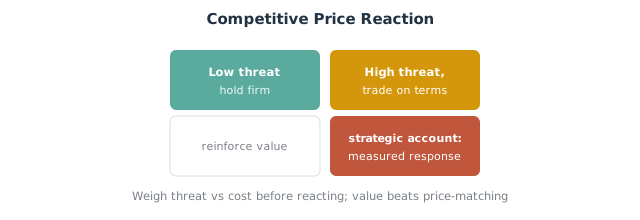
A useful mental model is a strategic price reaction matrix: weigh the threat (is it real, is the account at risk?) against the cost (margin losses, customer losses, precedent). High-threat, low-cost situations may justify a measured response; low-threat situations call for holding firm. Reacting to every competitor price move with a price reduction or price concessions erodes your margin and your market position over time, which is exactly how competitive pricing helps a challenger and hurts you.
The Proper Response to a Competitive Price
A disciplined reaction to competitive price moves follows a sequence:
- Stay calm and qualify. Is the competitor quote real, or a procurement tactic? Often it is a bluff.
- Reframe around value. Return to proven outcomes (value realization) and the business impact at risk if they switch.
- Quantify switching cost. Migration, retraining, integration rebuild, and risk are real costs the cheaper option ignores. Make them explicit.
- Differentiate. Reinforce what only you offer: the unique capabilities, support, and outcomes behind your value proposition.
- Flex on terms, not list price. If you must move, trade a smaller concession for a longer term or expansion, never a naked discount.
How to Defend Your Margins
To mitigate price competition without a price war:
- Build switching costs through value. The more value realized and the more departments using you (via land-and-expand), the harder you are to displace; research shows relational switching costs, not contract terms, do the actual work here.
- Multi-thread. A competitor’s price lands harder when you only know one contact; broad relationships give you defenders inside the account.
- Use value-based pricing. Anchor on the value delivered, not the competitor’s number, and use good-better-best tiers to offer choice without dropping your target price.
- Hold pricing power. Brands that consistently prove value possess pricing power and can defend premium pricing through a renewal.
When to Actually Flex on Price
Discipline does not mean never moving. Flex when:
- The account is strategically important (logo, reference, expansion potential) and you get something in return.
- A genuine, verified competitive gap exists and a small concession protects a large renewal.
- You can trade price for a multi-year commitment that improves lifetime value.
Even then, structure it as a trade, not a capitulation, so you protect both the renewal and the precedent.
The goal of a renewal pricing strategy is to remain competitive on value while protecting your customer base and margin. You stay competitive not by having the lowest price points but by making your perceived value high enough that competitor prices become irrelevant to the decision. Brands that consistently demonstrate value rarely have to win a price war, because their customers are not shopping on price in the first place.
Building Pricing Power Before the Pressure
The best defense against competitive price pressure is built long before renewal. Pricing power, the ability to hold your price without losing the customer, comes from perceived value, switching costs, and relationships, not from clever pricing tools alone. Companies that invest in proving value all year possess pricing power and rarely face direct price competition at renewal, because the customer is not evaluating them on price.
Practically, that means: keep a current competitive pricing analysis so you know where you genuinely stand on price and value; reinforce your value proposition at every QBR so the customer base sees worth beyond cost; and avoid training customers to expect price concessions by holding firm on list price and trading only on terms. A competitive market will always have someone willing to set a lower price to grab market share, often through penetration pricing or a loss leader they cannot sustain. Your job is not to match every move but to make your value so clear that competitive pricing helps your challenger far less than they hoped. That is a long-term strategy, and it is the only durable answer to price competition.
Frequently Asked Questions
Should you match a competitor’s lower price at renewal? Usually no. Panic-discounting erodes margin and sets a precedent. Reinforce your value and the cost of switching instead.
What is the proper response to competitive price pressure? Qualify whether the threat is real, reframe around proven value, quantify switching costs, differentiate, and flex on terms rather than list price.
How do you defend margins against competitor price-dropping? Build switching costs through realized value, multi-thread the account, use value-based pricing and tiers, and maintain pricing power by consistently proving value.
When should you flex on price? For strategically important accounts, a verified competitive gap, or a multi-year trade, always structured as a trade for something in return.
Why avoid a price war? Direct price competition is a race to the bottom that a deeper-pocketed competitor can win; competing on value is more defensible.
Defending value is part of the negotiation discipline in the 365-day renewal strategy.
If price is the only reason a customer stays, you never really had them. SWOTBee builds value-led renewal and pricing strategies for mid-market companies across Energy, Manufacturing, and SaaS.
Get your 1-page renewal leakage estimate →
No call needed. Prefer to talk it through first? Book a free 30-minute discovery call →