This article is part of our honest guide to whether HubSpot scales with business growth.
Growth-Driven Design (GDD) is a website methodology that replaces the big, risky one-time redesign with continuous, data-driven improvement: you launch a strong “launch pad” site fast, then improve it month over month based on real user data. On HubSpot, GDD pairs naturally with the CMS and analytics, but it is not right for every organization, and the official HubSpot Academy certification is now retired even though many pages still present it as live. This honest 2026 guide covers what GDD is, how it works, and when it is genuinely worth it.
What Is Growth-Driven Design?
Growth-Driven Design (often written growth driven design, or GDD) is an agile, iterative web design methodology created by Luke Summerfield and popularized through HubSpot. Instead of treating your website as a project you finish and forget, GDD treats it as a product you continuously improve. The goal is to reduce the risk, cost, and guesswork of a traditional website redesign by shipping sooner and letting real user data, not assumptions, drive what you build next.
Growth-Driven Design vs Traditional Web Design
The contrast is the whole point:
| Traditional web design | Growth-Driven Design |
|---|---|
| Big upfront build, months to launch | Launch pad site live fast |
| Large one-time cost and risk | Spread cost, lower risk |
| Decisions on assumptions | Decisions on user data |
| Outdated quickly, redesign in 2 to 3 years | Continuous improvement, never stale |
Traditional web design front-loads everything and then leaves the site to age. GDD launches a deliberately imperfect but solid site, then improves the highest-impact pages continuously.
How Does Growth-Driven Design Work? The Three Stages
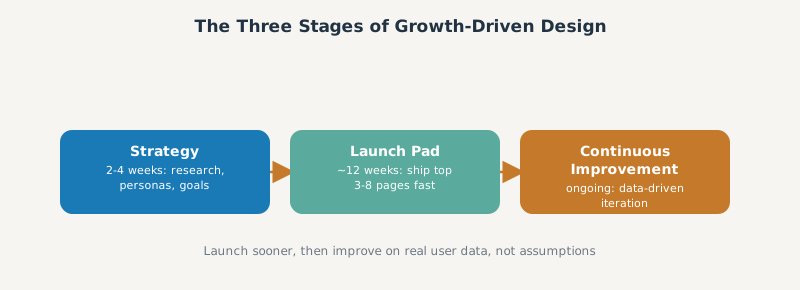
GDD runs in three stages:
- Strategy (about 2 to 4 weeks). Research personas and the user journey, set goals, and build a wish list of website improvements grounded in data, not opinion.
- Launch Pad (about 12 weeks). Build and ship the 3 to 8 highest-impact pages, a site better than what you have but deliberately not “finished.” Getting it live fast is the point.
- Continuous Improvement (ongoing). Use real analytics and user feedback to prioritize improvements (often with an ICE score), then build, learn, and repeat. This is where GDD compounds.
Each phase feeds the next in a flexible workflow rather than a one-and-done website development project. The objective is not a perfect launch but the optimal site over time: you go live with the launch pad, watch how the current website performs against real goals, and adapt. Creating a website this way treats web design methodology as a continuous discipline, which is why it tracks the trend of buyer behavior instead of freezing your site the day it ships.
This is the same predict-build-learn loop that underpins HubSpot’s broader growth frameworks, applied to your website.
Why Use Growth-Driven Design With HubSpot?
HubSpot is a strong home for the growth driven design methodology because the HubSpot CMS, analytics, and CRM are connected. You can see how a change to your website design affects not just traffic but pipeline, since the same platform tracks the visitor from first page view through to closed deal. That closed-loop data is exactly what the continuous-improvement phase needs to prioritize the next round of work, and it is why a HubSpot partner or agency running GDD can optimize for conversion and SEO performance, not just looks. HubSpot research cites roughly 16.9% more leads and 11.2% more revenue after six months of growth-driven design (a vendor-sourced figure, so treat it as directional). The approach is lean and strategic: ship a launchpad site, learn, then adapt continuously rather than relying on traditional methods that go live once and slowly outdate.
What Happened to the GDD Certification?
The HubSpot Academy growth driven design certification is retired: the course page no longer resolves, and HubSpot Academy support and the HubSpot community have confirmed it is gone, yet many third-party pages still present it as a live credential and some rank by serving certification “answers” dumps. We do not publish exam answers. If you want to learn to build a website the GDD way, use the methodology and the three stages above as your study structure, focusing on user experience (UX) and continuous improvement rather than chasing a retired badge.
Is Growth-Driven Design Worth It?
GDD is worth it when your website is a real revenue channel and you can commit to ongoing iteration: a continuous budget, someone owning the data, and the discipline to act on it. It is overkill for a small brochure site that rarely changes, or for a team that cannot sustain the monthly improvement cycle. In those cases a focused traditional redesign is fine. The honest test: if you will genuinely run the continuous-improvement loop, GDD pays off; if it will stall after launch pad, it will not. The same goes for the platform underneath it, which is why we cover whether HubSpot scales with your business before you commit.
Frequently Asked Questions
What is Growth-Driven Design? A website methodology that replaces the big one-time redesign with a fast launch-pad site plus continuous, data-driven improvement, reducing the cost and risk of traditional web design.
What are the three stages of Growth-Driven Design? Strategy (research and goals, 2 to 4 weeks), Launch Pad (ship the highest-impact pages, about 12 weeks), and Continuous Improvement (ongoing data-driven iteration).
How is GDD different from traditional web design? Traditional design is a big upfront build that ages until the next redesign. GDD launches sooner and improves continuously based on real user data instead of assumptions.
Is the HubSpot Growth-Driven Design certification still available? No. The HubSpot Academy GDD certification is retired and the course page no longer resolves, although outdated pages still present it as live.
Is Growth-Driven Design worth it? Yes, if your website is a revenue channel and you will commit to ongoing iteration. For a rarely-updated brochure site, a focused traditional redesign is usually enough.
SWOTBee runs Growth-Driven Design on HubSpot as a revenue program, not a one-off project, with the closed-loop data to prove what works. We only recommend it when the continuous loop will actually run.
Get your 1-page renewal leakage estimate →
No call needed. Prefer to talk it through first? Book a free 30-minute discovery call →