This article is part of our honest guide to whether HubSpot scales with business growth.
A HubSpot growth strategy is the plan for using HubSpot’s tools and a clear growth framework to attract, convert, and retain customers as you scale. The confusion is that “HubSpot growth strategy” has two meanings: how HubSpot the company grew, and how you build your own growth strategy on HubSpot. This guide handles both, and it does what no other ranking page does: maps HubSpot’s four overlapping growth frameworks (funnel, flywheel, Loop Marketing, and Four Fits) together with clear “use this when” guidance.
The HubSpot Growth Frameworks, Finally Mapped Together
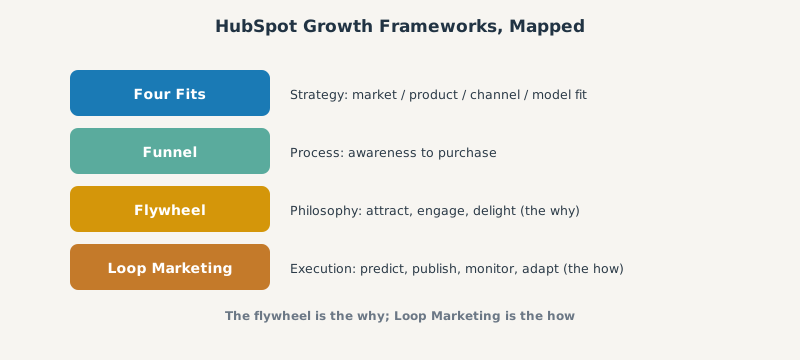
Most articles describe one framework and ignore how it relates to the others. Here is the hierarchy:
| Framework | Layer | Use it for |
|---|---|---|
| Four Fits (Brian Balfour) | Strategy | Deciding market, product, channel, and model fit before you scale |
| Funnel | Process | Tracking a linear path from awareness to purchase |
| Flywheel | Philosophy | Building momentum from happy customers (attract, engage, delight) |
| Loop Marketing | Execution | Running growth in the AI era through live iteration |
The cleanest one-line framing: the flywheel is the why, Loop Marketing is the how. The loop builds on the flywheel and funnel, it does not replace them.
Four Fits: the Strategy Layer
Created by Brian Balfour (HubSpot’s VP of Growth from 2014 to 2016), Four Fits says four things must all hold to reach scale: market/product, product/channel, channel/model, and model/market fit. The core insight: products are built to fit channels; channels do not mold to products. Use it before you pour money into growth.
Flywheel: the Philosophy
HubSpot replaced the funnel with the flywheel in 2018 to capture that happy customers create momentum. Attract, engage, delight, and reduce friction at every stage, because friction kills flywheels. Use it to think about retention and referral, not just acquisition.
Loop Marketing: the Execution Layer for the AI Era
Loop Marketing (Express, Tailor, Amplify, Evolve) is HubSpot’s newest framework, built for a world where a large share of searches end without a click. It runs on live iteration: predict, publish, monitor, adapt, in days not quarters, and it leans into structuring content for answer engines and LLM discoverability. The honest verdict practitioners give is “a bit of both”: real change plus some repackaging. It pairs naturally with product-led growth.
How to Build Your Own Growth Strategy on HubSpot
Frameworks are only useful when operationalized. Whichever business growth strategy you pursue (deepening your existing customer base, launching new products, entering new markets, or partnership outreach to reach new and potential customers), HubSpot is the platform that runs it. A marketer can build the whole motion, from buyer’s journey mapping to email marketing, on one scalable marketing platform instead of a sprawling marketing stack. The key components of a HubSpot growth strategy:
- Pick the framework for your stage. Four Fits to set strategy, flywheel to align teams, Loop Marketing to execute.
- Use HubSpot’s tools to run it. Inbound marketing and SEO to attract, automation and workflows to nurture, the CRM and sales pipeline to convert, and Service Hub to retain.
- Let data drive it. A growth strategy is only as good as the data behind it, so clean attribution and reporting tell you what to scale.
- Add AI deliberately. Breeze AI and HubSpot’s AI features accelerate content and analysis, but they amplify a strategy, they do not replace one.
- Measure the right metrics. Track revenue growth, conversion rates, CAC, and retention, not vanity metrics.
For SMBs especially, HubSpot’s strength is that this whole engine runs on one platform, so a small team can execute a sophisticated, sustainable growth strategy without a sprawling stack. Free templates and a business growth plan structure in HubSpot Academy give you a starting point, conversational tools and automation help you automate outreach, and the same system grows with you as you scale from startup to SaaS mid-market. The result is growth tied to your overall business, not a disconnected set of marketing efforts.
Common Challenges (and How to Avoid Them)
The recurring failure is treating HubSpot as the strategy rather than the engine for one. A CRM without process adoption is a black hole, so the biggest challenge is not the tooling, it is clean data, defined process, and disciplined measurement. Teams that nail the RevOps foundation get compounding growth; teams that buy hubs and hope do not. This is the same lesson behind whether HubSpot scales with your business: the platform scales, but only on top of good operations.
Frequently Asked Questions
What are the key components of a HubSpot growth strategy? A chosen growth framework (Four Fits, flywheel, or Loop Marketing), HubSpot’s tools to execute it (inbound, automation, CRM, service), clean data for attribution, and the right growth metrics.
What is the difference between the funnel, flywheel, and Loop Marketing? The funnel is a linear process model, the flywheel is a philosophy about momentum from happy customers, and Loop Marketing is an execution method for the AI era. The flywheel is the why; Loop Marketing is the how.
How does HubSpot help with business growth? It runs your whole growth engine on one platform: inbound marketing and SEO to attract, automation to nurture, the CRM and pipeline to convert, and reporting to measure and scale what works.
How can AI be used in a HubSpot growth strategy? HubSpot’s Breeze AI accelerates content creation, lead scoring, and analysis. It amplifies a sound strategy but does not replace the need for one.
Is HubSpot good for SMB growth? Yes. SMBs benefit most from running a complete growth strategy on a single platform, without the cost and complexity of stitching many tools together.
SWOTBee turns HubSpot growth frameworks into an operating system for your revenue, with the data and process that make them work. Strategy first, tools second.
Get your 1-page renewal leakage estimate →
No call needed. Prefer to talk it through first? Book a free 30-minute discovery call →