Yes, HubSpot CRM scales with business growth for most companies up to roughly 300 to 400 active sales users, and it scales especially well from startup to mid-market because the platform is modular, easy to adopt, and keeps admin overhead low. Beyond that ceiling, or with highly complex data, you start hitting architectural limits and the cost climbs faster than the headline price suggests. The honest rule of thumb practitioners repeat: HubSpot has a higher floor and Salesforce has a higher ceiling. This guide gives the real answer, the real numbers, and a decision framework, not the “it just scales” hand-waving you find everywhere else.
This is the pillar for our HubSpot for Business Growth series. It links to the deep dives on pricing, frameworks, product-led growth, and more.
Does HubSpot CRM Actually Scale With Business Growth?
HubSpot CRM scales well as your business grows because of how it is built, not because of marketing copy. The free CRM gives you a single source of truth from day one, and you add Marketing Hub, Sales Hub, and Service Hub as you need them with no rip-and-replace. That modularity is the core of why HubSpot can help you grow: you scale the platform in step with the business instead of buying capability you do not use yet.
Where it genuinely scales:
- Modular Hubs. Start with free CRM and add hubs as you scale your business, so the Smart CRM underneath stays one connected system.
- Lean admin. HubSpot keeps teams lean as you grow, with far less administrative overhead than a Salesforce build that needs dedicated developers.
- One platform, one record. Marketing and sales, the sales pipeline, customer data, and service all live on one platform, which is what keeps cross-team alignment intact as headcount grows.
The CRM capabilities that carry you as the company grows are the everyday ones: workflows that automate repetitive sales activities, native integrations with the tools you already use, dashboards and analytics that turn CRM data into decisions, and inbound features (landing pages, email marketing, lead nurture) that lift conversion rates without a separate marketing stack. HubSpot marketing automation, the knowledge base, and templated playbooks all scale with you, so a longer sales cycle or a bigger team does not mean ripping anything out. When you do need to bring history across, HubSpot’s data migration tooling and partner ecosystem help you move without losing records.
The Honest Scaling Ceiling
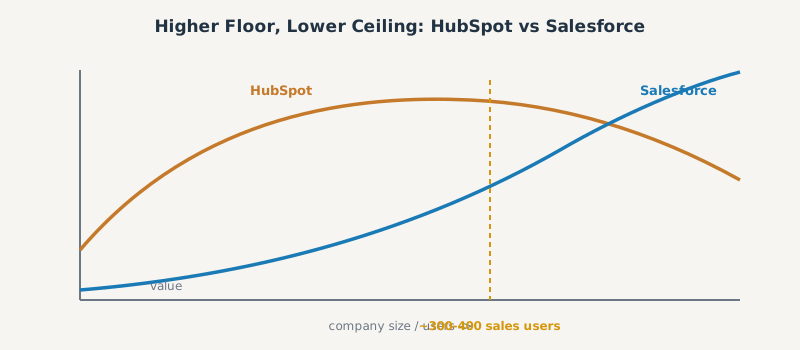
Every vendor-neutral practitioner cites the same soft ceiling: HubSpot scales well up to about 300 to 400 active sales users, and beyond that you begin hitting architectural limitations. That does not mean HubSpot fails at enterprise scale, only that very large or very complex sales organizations eventually find the customizations they need are easier on a higher-ceiling platform.
This is the “higher floor, lower ceiling” trade-off. HubSpot’s higher floor means a small or medium-sized business is productive in days, with powerful tools out of the box. Salesforce’s higher ceiling means it bends to almost any process if you invest the engineering. For most businesses under 500 employees, HubSpot delivers more value at lower cost, which is exactly the range where it scales best.
What Are the Limitations of HubSpot CRM?
An honest scaling guide names the limits. The most common ones that surface as a business grows:
- Contact-tier bill shock. Marketing Hub bills per marketing contact in 1,000-contact increments and auto-upgrades the tier as you cross a threshold (and never auto-downgrades). This is the single biggest source of “my bill jumped without warning” complaints.
- Feature-gating as you scale. Workflows and capabilities you build on Starter often require jumping to Professional within a year to keep them, a roughly 5x per-seat step up.
- Custom objects gated to Enterprise. Advanced data modeling needs the Enterprise tier, where some competitors include it lower down.
- Complex B2B relationship mapping. Native objects do not easily show company-to-company relationships, so VC, PE, and complex B2B teams build workarounds.
- Subscription and renewal reporting. Default reporting falls short for subscriptions, renewals, and multiple revenue streams, a common pain for SaaS as it scales.
- Data lock-in. Conversation logs and contact data are not trivial to export, so switching cost (not satisfaction) can keep you in place.
Knowing these up front is how you scale on HubSpot deliberately instead of being surprised by it.
What HubSpot Really Costs as You Scale
The headline price is not the cost at scale, and the gap is where growing teams get hurt. A 3-year total cost of ownership for a 10-person team on Marketing Pro plus Sales Pro runs around $110,000 against a naive expectation near $68,000, roughly a 62% overrun, once you add contact tiers, onboarding, and add-ons. A real 5-person team on Professional with 10,000 contacts pays $1,200 to $1,800 per month against the $890 headline.
The drivers are predictable: per-seat pricing, the marketing-contact tier multiplier, mandatory onboarding fees ($1,500 to $7,000 depending on hub and tier), and add-ons like a dedicated IP or advanced reporting. We break the full model down, stage by stage, in our guide to HubSpot pricing at scale. The naming has changed too: the old bundle is gone, and we cover what replaced it in HubSpot Growth Suite is now the Customer Platform.
Decision Framework: Scale on HubSpot or Migrate?
The question is not “is HubSpot good” but “does it scale for us.” Use this checklist. Lean toward staying on and scaling HubSpot if most of these hold:
| Stay and scale on HubSpot | Consider migrating (usually to Salesforce) |
|---|---|
| Under ~300 sales users | 400+ sales users |
| Marketing-led or blended go-to-market | Deep, industry-specific customization needs |
| Value fast time-to-value and lean admin | Have engineering to run a complex platform |
| Standard-to-moderate data complexity | Highly complex objects and territory logic |
| Cross-team alignment matters most | A single function needs depth above all |
A 25-person team runs about $20,400 per year on HubSpot Professional versus roughly $49,500 on Salesforce Enterprise, so for most growing mid-market companies the math favors scaling on HubSpot well before the ceiling.
Signs the Problem Is Your Data, Not the Platform
Before you blame the platform, check the architecture. A CRM without process adoption is a black hole. Most “HubSpot does not scale for us” complaints trace to messy data, no clear ownership, and broken attribution, not to a hard platform limit. Fixing the RevOps foundation (clean data, defined process, real attribution) resolves more scaling pain than a migration would, and it is cheaper.
HubSpot’s Biggest Competitors for Scaling
The honest comparison: Salesforce is the higher-ceiling alternative for very large or highly customized orgs; Pipedrive offers flat, predictable per-user pricing for lean sales-only teams but silos once you add marketing and service; Zoho competes on price. HubSpot sits between them: simpler than Salesforce, more scalable than Pipedrive or Zoho. That middle position is precisely why it fits companies in their fastest growth stage.
Proof: What Results Businesses See
Real outcomes from companies that scaled on HubSpot (vendor-reported, directional):
| Company | Result |
|---|---|
| GrowthLab Financial | Revenue doubled in under 3 years, 10x form submissions |
| TenantBase | 3x revenue YoY, sales team grew from 5 to 150 |
| IMPACT | 26% more deals closed YoY, 39% faster closed-won |
| Ving | 96% average yearly revenue increase after switching from Salesforce plus 6 tools |
The pattern is consistent: businesses that pair HubSpot with a real growth strategy and clean operations scale revenue on it. HubSpot offers the advanced tools that help you scale (sales and marketing alignment, automated business processes, and reporting that shortens the sales cycle) so sales and service teams close deals on one connected customer relationship management system as the company grows. To build that strategy, see our guide to HubSpot growth frameworks and, for software companies, HubSpot for product-led growth. If growth starts with your website, the growth-driven design approach applies the same iterate-on-data philosophy.
Frequently Asked Questions
Does HubSpot CRM scale with business growth? Yes, well, from small business to mid-market and up to roughly 300 to 400 active sales users. It scales through modular hubs and a single Smart CRM. Beyond that ceiling or with very complex data, you may hit architectural limits.
What are the limitations of HubSpot CRM? The main ones are marketing-contact tier bill shock, feature-gating that pushes you to higher tiers as you grow, custom objects gated to Enterprise, weak native subscription and renewal reporting, and data export friction.
How much does HubSpot cost as you scale? More than the headline. A 10-person team’s 3-year TCO can run about 62% over the naive estimate once contact tiers, onboarding, and add-ons are included. See our pricing-at-scale guide for the full model.
When should you migrate off HubSpot to Salesforce? Generally when you pass roughly 400 sales users or need deep, industry-specific customization and have the engineering to run it. Below that, scaling on HubSpot usually costs less and moves faster.
Is HubSpot good for small businesses that plan to grow? Yes. Its higher floor means fast time-to-value, and the modular model lets a small business add hubs as it scales without replacing the system.
SWOTBee helps growing companies decide whether to scale on HubSpot or move, and builds the RevOps foundation that makes HubSpot actually scale. We give you the honest math, not a sales pitch.
Get your 1-page renewal leakage estimate →
No call needed. Prefer to talk it through first? Book a free 30-minute discovery call →