This article is part of our honest guide to whether HubSpot scales with business growth.
Product-led growth (PLG) is a go-to-market strategy where the product itself drives acquisition, conversion, and expansion, usually through a free trial or freemium model, and HubSpot supports it by capturing product usage data, scoring product-qualified leads, and automating the path from signup to paying customer. HubSpot is itself a hybrid PLG company: freemium go-to-market, with a lot of revenue still coming through leads that sales interacts with. This guide shows how to run a PLG motion on HubSpot and how it differs from a sales-led approach.
What Does Product-Led Growth Mean?
Product-led growth means the product is the primary engine of growth, not the sales team. Instead of a salesperson convincing a prospect, users sign up for a free trial or freemium plan, experience value themselves, and convert to paying customers through self-service. Classic product-led growth companies include Slack, Calendly, and Zoom, where the product sells itself before sales is ever involved.
PLG differs from sales-led and marketing-led growth in where the work happens. Sales-led growth runs deals through reps and a structured sales process; marketing-led growth fills the funnel with campaigns; product-led growth uses the product experience to acquire and retain. Most successful SaaS companies blend them, and a hybrid model is exactly where HubSpot fits.
How Does HubSpot Support a Product-Led Growth Strategy?
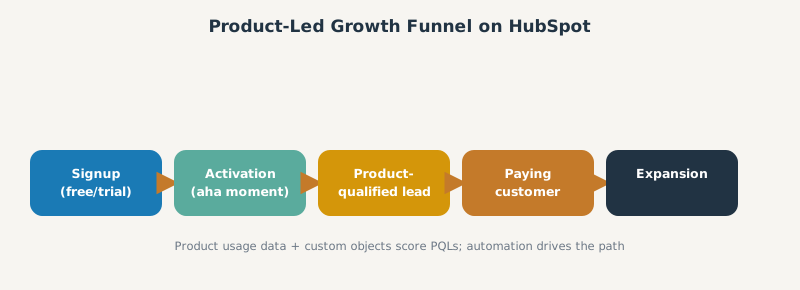
HubSpot supports PLG by turning product behavior into CRM signals you can act on. The key capabilities:
- Product usage data in the CRM. Sync product user data into HubSpot (often via a tool like Hightouch or Operations Hub) so usage lives next to the contact record.
- Custom objects. HubSpot’s custom objects let you model product accounts, workspaces, and usage in a data model that fits a PLG product.
- Product-qualified leads. Score signups on real product activity to surface product-qualified leads (PQLs), the users most likely to convert or expand, so sales engages only when the product has done its job.
- Automation. Automate onboarding and upgrade nudges, trigger sales outreach when a free account hits a PQL threshold, and route support tickets, all from product signals.
This is how HubSpot helps with lead generation in a PLG world: the product generates the lead, and HubSpot qualifies and routes it.
Building a PLG Motion on HubSpot, Step by Step
- Instrument the product. Decide which actions signal value (the “aha” moment) and capture them.
- Sync product data to HubSpot. Pipe activity data into custom objects or contact properties so it is usable in workflows and reporting.
- Define your PQL. Set the product-activity threshold that marks a free user as sales-ready or expansion-ready.
- Automate the path. Use workflows to drive onboarding, convert free trials to paid accounts, and alert sales reps on PQLs.
- Measure. Track signup-to-paid conversion, activation rate, and expansion, the metrics that matter for product-led growth.
Done well, this connects self-service acquisition to a light-touch sales process without the culture shift breaking either side.
The benefits of a product-led growth strategy are lower customer acquisition cost, faster activation, and higher customer lifetime value, because the product does the early selling and customer success focuses on the users most likely to expand. HubSpot’s free tools and freemium model fit this naturally: free users enter at the top, marketing automation nurtures them, and product-qualified leads hand off to sales. Most go-to-market (GTM) teams blend inbound and outbound, so PLG rarely replaces sales entirely; it changes where revenue growth starts. Transitioning to a product-led model is partly a change-management exercise, aligning product management, marketing, and sales around the same product data, and companies like Atlassian and Slack show how far a strong PLG strategy can carry a SaaS business.
Where Loop Marketing Fits
HubSpot’s newer Loop Marketing framework (Express, Tailor, Amplify, Evolve) complements PLG rather than replacing it. Loop Marketing is the execution layer for the AI era, built around live iteration (predict, publish, monitor, adapt) because a growing share of search now ends without a click. For a PLG product, that means structuring content for answer engines and LLM discoverability so self-service buyers find you, then letting the product convert them. We map Loop Marketing alongside the funnel, flywheel, and Four Fits in our HubSpot growth frameworks guide.
Is HubSpot the Right CRM for PLG?
For most B2B SaaS companies running a hybrid motion, yes. HubSpot gives you the CRM, automation, and reporting to operationalize PLG without stitching together separate tools, and it scales with you (see our guide on whether HubSpot scales with business growth). The main watch-outs are the same as any HubSpot deployment at scale: model your product data deliberately in custom objects, and keep contact-tier costs in check as signups grow.
Frequently Asked Questions
What does product-led growth mean? It is a go-to-market strategy where the product drives acquisition, conversion, and expansion, typically through freemium or free trials, rather than relying on a sales team to close every deal.
How does HubSpot support a product-led growth strategy? HubSpot captures product usage data, models it with custom objects, scores product-qualified leads, and automates onboarding and upgrade paths, so product signals drive the go-to-market motion.
What are examples of product-led growth companies? Slack, Calendly, Zoom, and Dropbox are classic PLG companies. HubSpot itself is a hybrid PLG company with a freemium model plus a sales-assisted motion.
How is PLG different from sales-led growth? In PLG the product acquires and converts users through self-service; in sales-led growth reps drive deals through a structured sales process. Most SaaS companies blend the two.
What metrics matter for product-led growth? Activation rate, signup-to-paid conversion, product-qualified lead volume, and net expansion are the core PLG metrics to track in HubSpot.
SWOTBee builds product-led growth motions on HubSpot: product data synced, PQLs scored, and the signup-to-revenue path automated. We connect the product to the pipeline.
Get your 1-page renewal leakage estimate →
No call needed. Prefer to talk it through first? Book a free 30-minute discovery call →