This article is part of our 365-day renewal strategy guide.
A single-threaded renewal depends on one contact. If that champion leaves, gets reorganized, or goes quiet, the renewal dies with them. Multi-threading in sales is the practice of building relationships with multiple stakeholders, so the deal survives any single departure. In enterprise deals with a buying committee, multi-threaded accounts renew and expand at far higher win rates than single-threaded ones.
The data is blunt: relying on one point of contact is the most common reason healthy-looking renewals collapse. This guide explains what multi-threading is, why it matters, and how sales teams implement it.
What Is Multi-Threading in Sales?
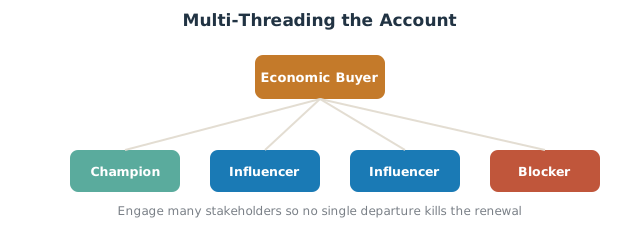
Multi-threading in sales means engaging multiple decision-makers and influencers within an account rather than working through a single point of contact. A multi-threaded sales approach maps the full buying group, the economic buyer, influencers, end users, and potential blockers, and builds a relationship with each.
Single-threaded selling is the opposite: one rep, one contact, one thread. It feels efficient until that contact changes roles. Multi-threaded selling spreads the relationship across the buying committee so no single change can sink the deal.
You will see the term written both ways: multithreading and multi-threading mean the same thing, and a multithreaded (or multi-threaded) sales process simply engages more than one person. Whatever the spelling, sales multithreading is now standard practice in enterprise sales because modern buying decisions are made by committees, not individuals.
Multithreading vs Single-Threaded Sales
The contrast shapes the entire sales cycle:
- Single-threaded sales: one salesperson works one contact through the sales process. Fast to start, fragile to finish. A single departure stalls the pipeline.
- Multithreaded sales: the sales rep (often with a sales leader or VP of Sales for executive air cover) builds relationships with multiple people across the buying decision. Slower to set up, far more durable, and proven to help teams win more deals and close big deals.
For complex deals, sales organizations increasingly treat the multithreading approach as a requirement, not an option. Sales professionals who multithread close more deals because they are never one conversation away from losing the account. Sales enablement and sales intelligence platforms now bake this in, surfacing buyer intent data and sales data so reps know which stakeholders to engage and when. Some teams use a digital sales room to give the whole buying group a shared space, keeping every thread warm between sales conversations.
Why Single-Threaded Renewals Fail
Champions move on. In B2B sales, the average tenure of a buyer in a role is short, and every departure resets a single-threaded relationship to zero. When your one point of contact leaves:
- The new decision-maker has no relationship with you and no memory of the value delivered.
- Your usage and ROI story has to be re-sold from scratch, often during the renewal window.
- A blocker you never knew about can quietly kill the renewal.
Multi-threading is insurance against all three. With relationships across multiple stakeholders, a departure is a setback, not a catastrophe.
Why Multi-Threading Matters for Renewals and Expansion
Engaging multiple stakeholders does more than de-risk the renewal:
- Higher win rates. Deals with broad executive buy-in close and renew more reliably than single-threaded ones.
- Bigger deals. More stakeholders means more use cases, which fuels expansion and a land-and-expand motion.
- Faster decisions. When the economic buyer is already engaged, the renewal does not stall waiting for an introduction.
- Better intelligence. Multiple relationships surface budget shifts, reorganizations, and competitor activity early.
This is why multi-threading sits at the center of a strong renewal strategy.
How to Map the Buying Committee
Effective multi-threading starts with mapping. For each account, identify and tag:
- Economic buyer: controls the budget and signs the renewal.
- Champion: advocates for you internally (never your only thread).
- Influencers: power users and team leads who shape the decision.
- Blockers: procurement, security, or finance who can stall or veto.
- End users: whose day-to-day experience proves or undermines value.
Record each contact, their role, and your relationship strength on the account in your CRM, so the whole sales team sees the coverage (and the gaps). This mapping is where sales strategies succeed or fail: a multi-threaded sales strategy is only as good as your visibility into the key stakeholders and the buying group behind the buying decision. Feeding intent data and sales intelligence into the map helps sales representatives prioritize which relationships to build first.
How Sales Teams Implement Multi-Threading
- Set a coverage standard. For enterprise accounts, require relationships with at least the economic buyer plus two influencers. No single-threaded renewals above a revenue threshold.
- Tailor outreach per stakeholder. Each role cares about different outcomes; tailor your sales conversations to what matters to that person.
- Use QBRs to widen the thread. An executive business review is the perfect venue to bring new stakeholders into the relationship.
- Track coverage as a metric. Report single-threaded accounts as a risk, the same way you track renewal risk scoring.
- Re-thread fast on change. When a contact leaves, treat it as a priority play: reach the replacement and re-establish the value story immediately.
Examples of Multi-Threading in Action
- A CSM brings the VP of Operations (economic buyer) into a QBR alongside the day-to-day admin (champion), so the renewal is no longer dependent on the admin.
- An account executive, noticing usage spreading to a second team, builds a relationship with that team’s lead, turning a single-department deal into a whitespace expansion opportunity.
- A seller maps a procurement blocker early and addresses security concerns months before renewal, removing a last-minute veto.
Frequently Asked Questions
What is multi-threading in sales? Engaging multiple stakeholders in an account, the economic buyer, influencers, and blockers, instead of relying on a single point of contact.
Why is multi-threading important? It protects deals from champion departures, raises win rates, enables expansion, and surfaces risks early. Single-threaded deals collapse when the one contact leaves.
How does multi-threading differ from single-threading? Single-threading works through one contact; multi-threading builds relationships across the buying committee so no single change sinks the deal.
How can sales teams implement multi-threading? Map the buying committee, set a coverage standard, tailor outreach per stakeholder, use QBRs to widen relationships, and track single-threaded accounts as a risk.
Does multi-threading help with renewals specifically? Yes. Renewals depend on relationships; a multi-threaded account survives reorganizations and renews far more reliably than a single-threaded one.
Multi-threading is the relationship foundation of the 365-day renewal strategy.
The renewal you lose is usually the one that depended on a single person. SWOTBee builds account-mapping and renewal playbooks for mid-market companies across Energy, Manufacturing, and SaaS.
Get your 1-page renewal leakage estimate →
No call needed. Prefer to talk it through first? Book a free 30-minute discovery call →