This article is part of our complete guide to B2B customer retention.
Customer retention consulting is expert help to reduce churn and grow your existing customer base: a consultant diagnoses why customers leave, designs the strategy and systems to keep them, and builds the operational backbone (health scores, automation, renewal pipelines) to make retention repeatable. It is the fastest way to fix retention when you know you are losing customers but do not have the time or in-house expertise to fix it. This guide explains what a customer retention consultant does, the signs you need one, what an engagement costs, and how to choose the right partner.
For the underlying playbook, start with our B2B customer retention guide.
What Does a Customer Retention Consultant Do?
A customer retention consultant turns a vague “we have a churn problem” into a concrete plan and a working system. The work usually spans four areas:
- Diagnosis. Analyze why customers churn, using your data, cohort analysis, and customer feedback to find the real causes, not the symptoms.
- Strategy. Design the retention strategy: onboarding, value realization, health scoring, and expansion, mapped to your customer lifecycle.
- Systems. Build the operational backbone in your CRM, health scores, automated workflows, renewal pipelines, and dashboards, so retention runs without heroics.
- Enablement. Train your customer success and account teams to run the new motion and measure it.
The output is not a slide deck; it is a retention program that keeps customers and a team that can run it.
What Customer Retention Consultants Deliver
Good retention consultants go beyond advice to build the capabilities that keep customers. Typical deliverables include:
- Customer retention strategies mapped to your customer lifecycle, with clear plays to boost loyalty at each stage and a defined owner for each one.
- Data analytics and business intelligence. They leverage analytics to find churn drivers and to measure revenue growth from retention, turning raw customer data into insight.
- Journey mapping and CX improvements. By mapping the customer journey, consultants enhance the customer experience (CX) at the moments that drive customer satisfaction and brand loyalty.
- Personalization at scale. They design personalized customer experiences and tailored solutions so engagement feels relevant, not generic, even as you scale.
- Customer onboarding and engagement programs. Strong onboarding and ongoing customer engagement are where retaining customers is won, so consultants build these as repeatable systems.
The best practices a consultant brings (proactive client success, seamless customer interactions, and a scalable retention engine) are what transform retention from reactive firefighting into predictable customer growth.
How Retention Consulting Drives Revenue Growth
Retention consulting pays for itself through revenue growth from your current customers. Keeping and growing existing customers is cheaper than acquiring new customers, and loyal customers spend more and refer others. The compounding effect shows up in customer lifetime value: every month you retain an account, its lifetime value rises while its acquisition cost stays fixed. By improving customer loyalty and reducing customer churn, a consultant lifts the lifetime value of every account and positions your business to grow without leaning entirely on new-customer acquisition. For SaaS companies especially, where recurring revenue compounds, even a small improvement in retention drives outsized revenue growth, which is why retention is increasingly seen as a growth lever, not a cost center.
Signs You Need Customer Retention Consulting
You likely need help when:
- Churn is rising and you cannot clearly explain why.
- You have no reliable way to score churn risk, so you cannot see which accounts are at risk before they leave.
- Renewals are reactive scrambles instead of a managed pipeline.
- Customer data is scattered, so no one has a single view of the customer.
- Your team knows what to do but does not have the systems or time to do it consistently.
If two or more of these are true, a focused engagement usually pays for itself quickly, because even a small improvement in retention compounds across your recurring revenue.
What a Retention Consulting Engagement Looks Like
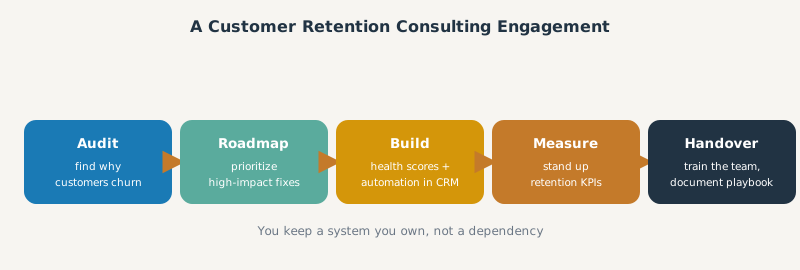
A typical engagement moves through diagnosis, design, build, and enablement:
- Audit. Review your churn data, customer journey, and current systems to find where customers slip away.
- Roadmap. Prioritize the highest-impact fixes and sequence them.
- Build. Implement health scores, automation, and renewal pipelines in your CRM.
- Measure. Stand up the retention KPIs so you can see the program working.
- Handover. Train the team and document the playbook so the gains stick.
The right partner leaves you with a system you own, not a dependency. The measure of a good engagement is whether your team can retain customers without them.
How to Choose Among Customer Retention Consultants
Choose a partner who:
- Builds systems, not just strategy. Look for hands-on implementation in your actual CRM, not advice alone.
- Knows your stack. Deep expertise in your platform (for many mid-market teams, HubSpot) means faster, cleaner results, the basis of our CRM for customer retention work.
- Ties work to metrics. They should commit to moving specific retention KPIs, not vanity deliverables.
- Transfers knowledge. The goal is a team that can run retention after they leave, owning the client relationships and the system behind them.
- Works on your customer relationships, not around them. Retention work that routes every conversation through the consultant improves the metric temporarily and leaves nothing once the engagement ends.
Five Questions, and the Answers That Should Worry You
Knowing what to ask is only half of it. What separates a useful first call from a pleasant one is knowing which answers are evasions. Ask these five, and listen for the pattern in the third column.
| Ask | A good answer sounds like | Walk away if you hear |
|---|---|---|
| “What will you build, specifically, in our CRM?” | Named objects, properties and workflows, with a rough sequence | “We’ll define that during discovery” as the whole answer |
| “Which retention metric will you commit to moving, and by when?” | One metric, a number, a timeframe, with caveats | “All of them”, or a refusal to name any |
| “What does month four look like after you leave?” | A handover plan, documentation, a named internal owner | Vagueness, or an assumption you will retain them |
| “Tell me about an engagement that did not work” | A specific example and what they learned | “They’ve all gone well” |
| “What would make you tell us not to hire you?” | Real disqualifiers, readily offered | Nothing comes to mind |
The last question is the most diagnostic and the one people forget to ask. Anyone who has done this work has turned business away, and can tell you why in one sentence. A consultant who cannot name a single situation where they are the wrong choice is either inexperienced or is selling to you rather than assessing you.
One more test that costs nothing: ask them to explain your own churn problem back to you before you have explained it. A partner who has looked at your public pricing, your product and your segment will have a hypothesis. One who has not will ask you to describe your business, which tells you exactly how much preparation the engagement will get.
What Customer Retention Consulting Costs
Most firms will not publish a number, which makes budgeting for this genuinely hard. Here is the honest shape of the market.
Engagements fall into three tiers:
- A diagnostic audit. A fixed-scope review of where revenue leaks, delivered as findings you can act on with or without the consultant. This is the cheapest way to find out whether you have a strategy problem or a systems problem, and it is where most engagements should start.
- An audit plus build. The diagnosis, then the implementation: health scores, automated workflows, renewal pipelines and dashboards built in your CRM. Priced by scope, and usually the tier that actually changes the retention number.
- Ongoing retained advisory. A monthly arrangement where the consultant runs or supervises the retention motion. Sensible once the system exists, expensive before it does.
The trap is buying tier three before tier one. Retained advisory on top of a broken system bills every month for judgement your team cannot execute on, because the operational backbone is not there yet.
SWOTBee’s renewal audit is $600, credited in full toward any build. We publish the number because withholding it wastes everyone’s time, and because a fixed-price diagnostic is the only honest way to sell a diagnosis. Before that, the 1-page renewal leakage estimate and the 30-minute call are free.
What Counts as a Good Retention Rate?
There is no single benchmark that survives contact with a real business, because retention rates are not comparable across contract length, segment or pricing model. An annual enterprise contract and a monthly self-serve subscription produce numbers that look similar and mean nothing alike.
Two rules matter more than any benchmark:
- Measure by cohort, not blended. A blended rate averages your best and worst customers into a figure that hides both. See why blended churn hides your true retention for how the arithmetic conceals the problem.
- Separate logo retention from revenue retention. You can lose customers and still grow revenue, or keep every logo while revenue shrinks. They are different failures with different fixes.
For the formulas, benchmark ranges and how to calculate each properly, see our guide to SaaS churn rate and the full set of customer retention KPIs.
When You Should Not Hire a Retention Consultant
A consultant is the wrong purchase in at least three situations, and a good one will tell you so on the first call.
- Your churn is a product problem. If customers leave because the product does not do what they bought it for, no amount of health scoring, automation or lifecycle design fixes that. Retention systems make a working product stickier; they do not rescue one that is not.
- You have not talked to churned customers. If nobody has asked why accounts left, do that first. It is free, it takes a week, and it frequently produces an answer that makes the engagement unnecessary or reshapes it entirely.
- You have the expertise but not the priority. If your team knows exactly what to build and simply has not been given the time, you have a resourcing decision to make, not a consulting one. Hiring an outsider to work around an internal prioritisation problem tends to produce a system nobody owns after handover.
Frequently Asked Questions
What is customer retention consulting? Expert help to reduce churn and grow your existing customers: diagnosing why customers leave, designing the retention strategy, and building the systems (health scores, automation, renewal pipelines) that make retention repeatable.
What does a customer retention consultant do? They diagnose churn causes, design a retention strategy across the customer lifecycle, build the operational backbone in your CRM, and enable your team to run and measure it.
When should I hire a retention consultant? When churn is rising and unexplained, you cannot see at-risk accounts early, renewals are reactive, or your team lacks the systems and time to run retention consistently.
How much does customer retention consulting cost? It varies by scope, from a focused audit to a full build-and-enable engagement. The return usually justifies it quickly, because retention improvements compound across recurring revenue.
What should I look for in a retention consulting partner? One that builds systems (not just strategy), knows your CRM deeply, commits to moving specific retention KPIs, and transfers knowledge so your team owns the program.
What is a reasonable customer retention rate? There is no portable benchmark, because retention depends on contract length, segment and pricing model. Measure by cohort rather than blended, and track logo retention and revenue retention separately, since they fail in different ways and need different fixes.
How can automation help with customer retention? Automation removes the dependence on someone remembering. Health scores update themselves, at-risk accounts raise alerts before the renewal window, renewal deals get created on schedule, and account managers get tasks instead of reminders they set manually. The gain is consistency, not cleverness.
What is the difference between a retention consultant and a customer success platform? A platform gives you somewhere to run the motion; a consultant decides what the motion should be and builds it. Buying a platform before you have a defined retention process usually produces an expensive tool nobody has configured.
SWOTBee is a customer retention consulting partner for mid-market B2B and SaaS: we diagnose churn, build the retention system on HubSpot, and hand your team a program they own. Stop losing customers you already won.
Get your 1-page renewal leakage estimate →
No call needed. Prefer to talk it through first? Book a free 30-minute discovery call →