This article is part of our complete guide to B2B customer retention.
Customer retention KPIs are the metrics that tell you how well you keep and grow your existing customers: the customer retention rate, churn rate, net and gross revenue retention, customer lifetime value, repeat purchase rate, and NPS. Tracked together, they turn retention from a feeling into a managed number. No single metric captures retention, which is why the best teams watch a small set of complementary KPIs to track. This guide explains the key customer retention metrics, how to calculate each, and how to use them to improve customer loyalty.
Knowing which KPIs to track for your business (and what each one actually measures) is the difference between guessing and managing. The customer retention rate measures the share of customers you keep; paired with metrics like repeat purchase rate, churn, and customer value over their lifetime, these retention metrics give a true indicator of customer loyalty. Measuring client retention KPIs consistently is essential, because customer retention metrics help you see what drives loyalty and where to act.
For the strategy behind the numbers, start with our B2B customer retention guide.
The Core Customer Retention KPIs
| KPI | What it measures | How to read it |
|---|---|---|
| Customer retention rate | Share of customers kept over a period | Higher is better; 85%+ is healthy B2B SaaS |
| Customer churn rate | Share of customers lost | The inverse of retention; watch the trend |
| Gross revenue retention (GRR) | Revenue kept before expansion | Caps at 100%; shows pure leakage |
| Net revenue retention (NRR) | Revenue kept after expansion | Can exceed 100%; 110%+ is excellent |
| Customer lifetime value (CLV) | Total value of a retained customer | Justifies retention spend |
| Repeat purchase rate | Share of customers who buy again | Key for ecommerce and transactional models |
| Net Promoter Score (NPS) | Customer sentiment and loyalty | A leading indicator of future retention |
These are the KPIs for customer retention that, read together, give a complete picture.
Why Customer Retention KPIs Matter for Business Growth
Tracking customer retention metrics is essential because retention, not acquisition, is what compounds into durable growth. Acquiring a new customer costs far more than keeping an existing one, so a high customer retention rate lowers your effective customer acquisition cost and lifts the value of a customer over time. Customer retention KPIs provide the insight to see whether your retention efforts are working: they show where you lose customers, which segments are loyal, and how customer loyalty and retention translate into revenue. Without the right metrics you are guessing; with them, you can measure and improve customer retention deliberately. In short, retention metrics turn customer loyalty from a hope into a number you can manage and grow.
Beyond the Core: More Retention Metrics to Track
The core KPIs cover most needs, but a few additional metrics give deeper insight into your customer base:
- Revenue churn rate. The recurring revenue lost in a period, including downgrades, a sharper view than the monthly customer churn rate alone.
- Existing customer revenue growth rate. How much your existing customers grow over time, the expansion side of retention.
- Customer satisfaction score (CSAT). A direct read on customer satisfaction at key moments in the customer journey.
- Customer engagement. Logins, feature usage, and activity that show how engaged each customer is.
- Customer acquisition cost (CAC). Paired with lifetime value, it shows whether retention is making acquisition pay off.
Analyzing customer behavior across these metrics, segmented by customer segments, surfaces the patterns behind both loyalty and churn.
How to Calculate the Key Retention Metrics
- Customer retention rate = ((customers at end minus new customers acquired) / customers at start) x 100.
- Customer churn rate = (customers lost / customers at start) x 100.
- Gross revenue retention = (starting MRR minus churn minus downgrades) / starting MRR x 100.
- Net revenue retention = (starting MRR minus churn minus downgrades plus expansion) / starting MRR x 100.
- Customer lifetime value = average revenue per customer x average customer lifespan (or average revenue divided by churn rate).
For the deeper definitions of the revenue metrics, see gross vs net revenue retention and the broader renewal metrics explained. For churn specifically, see SaaS churn rate.
Leading vs Lagging Retention Metrics
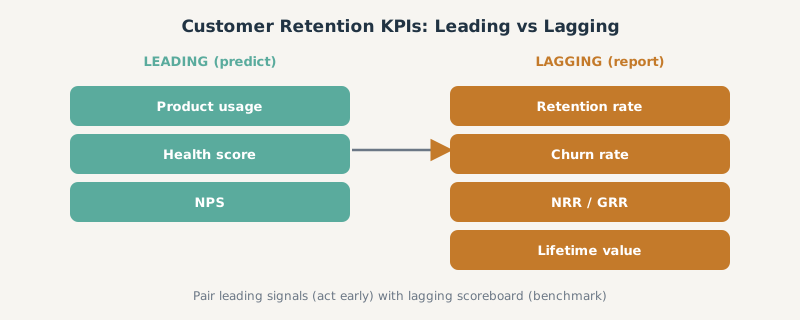
A crucial distinction: most retention KPIs are lagging (they report what already happened), but the most valuable signals are leading (they predict what will). Customer retention rate and churn rate are lagging. Product usage, customer health scores, and NPS are leading: they move before a customer churns, so they give you time to act. The best retention programs pair a lagging scoreboard (retention rate, NRR) with leading indicators (usage, health) so they can intervene early, the approach in silent churn detection.
How to Use Customer Retention KPIs
Metrics only matter if they drive action:
- Set a baseline and benchmark. Know your current retention rate and churn rate before you try to improve them.
- Segment. Track KPIs by cohort, plan, and industry, because the average hides where you actually lose customers (see cohort retention analysis).
- Pair leading with lagging. Use health scores and usage to act before the retention rate moves.
- Tie KPIs to owners and plays. Each metric should have someone accountable and a playbook to move it.
- Review on a cadence. Watch monthly for trends, quarterly for benchmarking.
Build these into a CRM dashboard so the numbers are live, not assembled in a spreadsheet once a quarter, the operational backbone covered in CRM for customer retention.
How to Improve Your Customer Retention Rate
Tracking retention is only half the job; the metrics exist to improve customer retention. Once you can see the numbers, the levers that move them are consistent across businesses:
- Fix the weakest stage. Use your metrics to find where customers drop off (onboarding, mid-lifecycle, renewal) and focus there first.
- Act on customer feedback. Close the loop on surveys and CSAT so customers feel heard, which lifts customer satisfaction and loyalty.
- Improve the customer experience. A better customer experience at the moments that matter is the most reliable way to improve your customer retention rate.
- Intervene early. Use leading indicators to reach at-risk accounts before they churn.
- Grow loyal customers. Turn satisfied customers into advocates and expansion revenue, lifting existing customer revenue growth.
The five key factors behind strong retention (a valuable product, good onboarding, proactive support, ongoing value, and acted-on feedback) are what these KPIs ultimately measure.
Tools to Track Customer Retention Metrics
You can track customer retention metrics in a spreadsheet, but it does not scale. The practical options:
- A CRM (such as HubSpot) for the unified customer view and live retention dashboards.
- Customer success platforms for health scores and account-level tracking.
- Analytics tools for cohort and usage analysis.
- Survey and feedback tools for CSAT and NPS.
The best setup connects these so retention KPIs update automatically, the same principle behind dedicated customer retention software.
Common Mistakes When Tracking Retention KPIs
Even teams that track retention make avoidable errors: watching only one metric (logo retention while revenue churn hides downgrades), failing to segment so the average masks the problem, treating lagging metrics as the whole story without leading indicators, and measuring without acting. Avoid these and your customer retention KPIs become a tool for growth, not just a report.
Frequently Asked Questions
What are the most important customer retention KPIs? Customer retention rate, churn rate, net and gross revenue retention, customer lifetime value, and a leading indicator like NPS or product usage. Track them together, not in isolation.
How do you calculate customer retention rate? Subtract new customers acquired in a period from the customers at the end, divide by the customers at the start, and multiply by 100.
What is the difference between gross and net revenue retention? Gross revenue retention caps at 100% and shows pure revenue lost to churn and downgrades; net revenue retention adds expansion and can exceed 100%.
What is a good customer retention rate? Roughly 85% or higher by logo for B2B SaaS, with best-in-class companies achieving net revenue retention above 110% through expansion.
What is the difference between leading and lagging retention metrics? Lagging metrics (retention rate, churn rate) report what already happened; leading metrics (usage, health scores, NPS) move before churn, giving you time to intervene.
SWOTBee builds live customer retention dashboards on HubSpot, the KPIs that matter, leading and lagging, wired to the plays that move them. Measure retention, then improve it.
Get your 1-page renewal leakage estimate →
No call needed. Prefer to talk it through first? Book a free 30-minute discovery call →