B2B customer retention is the practice of keeping your existing business customers subscribed, active, and growing, instead of losing them to churn. It matters because retaining an existing customer is far cheaper than acquiring a new one, and in B2B SaaS, retention (not acquisition) is what compounds into durable revenue. This guide covers why B2B customer retention matters, how to measure it, the strategies that actually keep customers, what causes churn, and how a CRM and automation improve retention. It is the hub for our deeper guides on each part.
B2B customer retention differs from B2C: deals are larger, buying centers have multiple stakeholders, and a single churned account can erase the revenue of dozens of new logos. That is why B2B brands treat retention as a revenue discipline, not a support afterthought.
Why B2B Customer Retention Matters
Acquiring a new customer costs far more than keeping an existing one, and existing customers spend more over time. In B2B SaaS, where revenue is recurring, a high customer retention rate is the engine of growth: it protects the revenue base, lifts customer lifetime value, and turns satisfied accounts into referrals and expansion. Poor retention quietly drains revenue no matter how strong new customer acquisition looks, because you are filling a leaky bucket.
The math is simple. If you retain customers and grow them, new sales add to a stable base. If you churn them, new sales just replace lost revenue. Prioritizing customer retention is the highest-leverage move most B2B businesses can make.
How to Measure B2B Customer Retention
You cannot improve what you do not measure. The core metric is the customer retention rate: the percentage of customers (or revenue) you keep over a period.
To calculate customer retention rate: take the customers at the end of a period, subtract new customers acquired during it, divide by the customers at the start, and multiply by 100. A good B2B SaaS customer retention rate is typically 85% or higher by logo, and the best companies exceed 90% by revenue.
Pair logo retention with revenue-based metrics, because expansion can offset churn:
| Metric | What it tells you |
|---|---|
| Customer (logo) retention rate | Share of accounts kept |
| Gross revenue retention | Revenue kept before expansion |
| Net revenue retention | Revenue kept after expansion and upsell |
| Customer churn rate | Share of customers lost |
| Customer lifetime value | Total value of a retained account |
For the full breakdown of these revenue metrics, see our guides to customer retention KPIs and metrics, gross vs net revenue retention, and the broader renewal metrics explained.
What Causes Poor B2B Customer Retention and Churn
Customer churn rarely happens at the renewal date; it builds over the contract. The common causes:
- Weak onboarding. Customers who never reach first value churn fastest.
- Lack of value realization. If the product does not visibly solve the customer’s needs, retention suffers.
- Single-threaded relationships. When you know only one stakeholder and they leave, the account is at risk.
- Silent disengagement. Usage drops long before anyone cancels, the classic silent churn.
- Poor customer experience and support. Slow or unhelpful service erodes trust.
The leading indicator of churn is declining product usage, not a complaint. Tracking it is how proactive teams retain customers before the cancellation, which we cover in cohort retention analysis.
B2B Customer Retention Strategies That Work
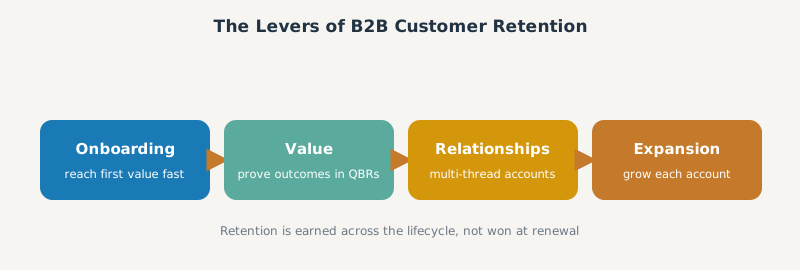
The most effective B2B customer retention strategies share one trait: they deliver and prove value continuously, not just at renewal. The core plays:
- Nail onboarding. Get every new customer to first value fast, with a clear success plan.
- Drive value realization. Tie the product to the customer’s outcomes and revisit them in QBRs, the heart of our customer value realization guide.
- Multi-thread relationships. Build trust with several stakeholders so the account does not hinge on one champion (see multi-threading renewals).
- Be proactive with health scores. Use customer health and risk scoring to intervene before churn (see churn prevention with health scores).
- Make customers feel heard. Close the loop on customer feedback and Net Promoter Score so customers feel the product evolves around their needs.
- Grow accounts. Upselling and cross-sell deepen the relationship and lift retention; expansion is the strongest retention signal, mapped in whitespace analysis.
These plays compound. A customer who is onboarded well, sees value, knows several people at your company, and is growing simply does not churn.
Building Customer Loyalty and Trust
Strategies keep customers; loyalty makes them advocates. Building trust is the foundation of B2B customer loyalty: deliver on promises, provide exceptional customer service, and educate customers so they get more from your product or service over time. Customer education (onboarding content, webinars, best-practice guides) is one of the most underrated retention efforts, because customers who understand the product see more value and are far less likely to churn.
A B2B loyalty program looks different from a B2C punch card. It rewards the behaviors that signal a healthy account: deeper adoption, multi-team usage, and advocacy. Rather than leaning on discounts, the strongest B2B customer marketing nurtures current customers with relevant content mapped to their customer journey and specific needs, so each account feels the relationship is built around them. Prioritizing customer retention this way (treating the existing customer base as a growth channel, not a cost center) is what separates B2B brands with high customer retention rates from those constantly acquiring new customers to replace the ones they lose.
To gauge whether it is working, track the effectiveness of your customer retention efforts against your retention rate and customer satisfaction scores over time, and adjust the plays that move them.
How CRM and Automation Improve B2B Customer Retention
Technology turns retention from a hope into a system. A CRM gives you one view of every customer (usage, support history, renewal date, health) so nothing slips, and automation makes the proactive plays repeatable at scale: triggered onboarding, renewal reminders, and health-based alerts. This is the operational backbone of retention, and we go deep on it in our CRM for customer retention and customer retention software guides.
For B2B SaaS specifically, the strategies and benchmarks have their own playbook, covered in SaaS customer retention strategies, and the metric to watch is your SaaS churn rate. If you sell on Shopify, the same principles adapt to repeat purchase in our Shopify customer retention guide.
How to Win Back Churned B2B Customers
Retention does not end at churn. A structured win-back program recovers a meaningful share of lost accounts, because they already know your product and the switching cost of coming back is low. Segment churned customers by why they left, fix that reason, and re-engage with a specific offer, the approach in our churned customer win-back guide.
Frequently Asked Questions
What is B2B customer retention? It is keeping your existing business customers subscribed, active, and growing rather than losing them to churn. In B2B SaaS it is the primary driver of durable, compounding revenue.
Why is B2B customer retention important? Retaining an existing customer is far cheaper than acquiring a new one, existing customers spend more over time, and in recurring-revenue models retention protects and compounds the revenue base.
How do you measure B2B customer retention? Track the customer retention rate (logo), plus revenue metrics like gross and net revenue retention and customer lifetime value. Pair them, because expansion can offset logo churn.
What is a good B2B customer retention rate? Roughly 85% or higher by logo is healthy for B2B SaaS, and leading companies exceed 90% by revenue with strong net revenue retention from expansion.
How does B2B customer retention differ from B2C? B2B has larger deals, multi-stakeholder buying centers, and longer relationships, so a single churned account hurts more and retention depends on multi-threading and proven value, not one-off offers.
How can technology improve B2B customer retention? A CRM centralizes the customer view and automation makes proactive plays (onboarding, health alerts, renewal reminders) repeatable, so teams act before churn instead of after.
SWOTBee builds B2B customer retention programs on HubSpot: the health scores, automation, and renewal pipelines that keep customers and grow them. Retention is a system, and we build it.
Get your 1-page renewal leakage estimate →
No call needed. Prefer to talk it through first? Book a free 30-minute discovery call →