This article is part of our 365-day renewal strategy guide.
Good-better-best pricing is a tiered pricing strategy that offers three packages at different price points, structured so the middle (or target) tier looks like the obvious choice. At renewal and expansion, presenting good-better-best tiers naturally anchors the customer toward your target package and makes the upgrade feel like their decision, not your push. It is one of the most effective approaches to pricing for driving expansion without hard selling.
Three choices beat one. This guide explains what good-better-best is, why it works, and how to implement the three tiers for renewal upgrades.
What Is Good-Better-Best Pricing?
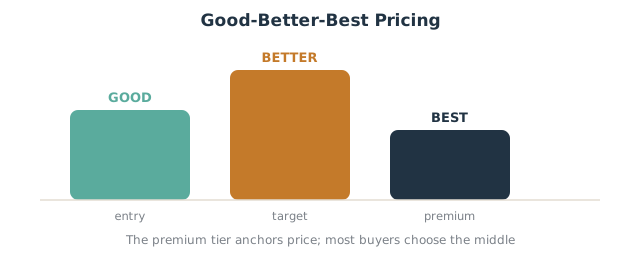
Good-better-best is a tiered pricing approach with three options:
- Good: an entry tier that covers core needs at a lower price.
- Better: the target tier, the package you want most customers on, with the best value-to-price balance.
- Best: a premium tier with everything, which anchors the price ceiling and makes “better” look reasonable.
This good-better-best strategy gives customers a choice of pricing tiers rather than a single take-it-or-leave-it price, which raises both conversion and average deal size.
Why the Good-Better-Best Strategy Works
The model works because of how people make decisions:
- Anchoring: the “best” tier sets a high reference point, making the “better” tier feel like good value by comparison.
- Choice, not yes/no: offering tiers shifts the question from “do I buy?” to “which do I buy?”, which lifts conversion.
- The compromise effect: most buyers avoid the cheapest and the most expensive, naturally gravitating to the middle, your target package.
- Self-selection: customers who need more upgrade themselves to “best,” capturing more revenue without a hard sell.
At renewal, this turns an upgrade conversation into a simple tier choice.
Good-Better-Best Among Pricing Strategies
Good-better-best is one of several pricing strategies, and it pairs well with the fundamentals. The classic 3 C’s of pricing, cost, customers, and competition, still set the boundaries: cost defines your floor, customers’ willingness to pay defines the ceiling, and competition shapes the middle. Within those boundaries, the four broad types of pricing strategies (cost-plus, value-based, competition-based, and dynamic) describe how you set prices; good-better-best is a packaging approach layered on top of whichever you choose.
What makes the good better best approach so durable is that it works for almost any product or service. Whether you run a SaaS pricing model, a service business, or even field service, offering a good package, a better tier, and a best version lets customers self-select. Customers can easily compare the options and make informed decisions, and many will spend more money than they would have on a single lower-priced option, lifting average sales without a hard sell. The key is designing clear “fence attributes,” the specific capabilities that separate better and best, so the jump from one tier to the next is obvious and worth it.
How to Implement Good-Better-Best Pricing
To build a tiered pricing structure that drives upgrades:
- Define the target tier first. Decide which package you want most customers on (the “better”), then design the others around it.
- Make “good” a real but limited option. It should serve genuine needs while leaving clear reasons to upgrade.
- Load “best” to anchor. Include premium capabilities so it justifies a higher price and makes “better” look like the smart middle.
- Use clear value gaps. Each tier should add obviously worthwhile capability, so moving from good to better to best feels logical.
- Present three, not five. Too many pricing options cause decision paralysis; three is the sweet spot.
At renewal, show the customer their current tier alongside the next one up, framing the upgrade against the value they will gain.
Good-Better-Best at Renewal and Expansion
The renewal is the ideal moment to use good-better-best. A customer who has realized value on the “good” tier is primed to move to “better,” and the tier structure makes that natural. Pair it with whitespace analysis to know which capabilities the account needs next, and use it as the anchor in contract negotiation so the conversation is about which tier, not whether to discount. This is how tiered pricing quietly drives upsell without pressure.
Why the Strategy Drives More Revenue
The good-better-best pricing strategy works on the revenue line for three reasons. First, it captures customers at different price points: budget-conscious buyers take the good tier instead of walking away, while high-need customers self-select into best and spend more money than a single price would have captured. Second, it simplifies the decision: customers can easily compare three clear pricing options and make informed decisions, which lifts conversion versus a confusing menu. Third, it raises average sales by anchoring; the best version makes the better tier feel like the sensible choice, nudging customers up from the lower-priced option.
For a service business or SaaS company setting prices, this means you do not have to guess a single perfect price. You offer a structured set of multiple pricing options and let the market sort itself, then watch which tier most new customers choose and refine from there. Used at renewal, the same good-better-best approach turns a flat re-sign into an upgrade opportunity, which is why it appears throughout a strong renewal strategy.
Frequently Asked Questions
What is a good-better-best pricing strategy? A tiered pricing approach offering three packages at different price points, designed so the target (usually middle) tier is the obvious choice.
Why does good-better-best pricing work? It uses anchoring and the compromise effect: the premium tier makes the target tier look reasonable, and offering choice lifts conversion versus a single price.
How do you implement good-better-best pricing? Define the target tier first, make the entry tier real but limited, load the premium tier to anchor, use clear value gaps, and present exactly three options.
How does good-better-best help at renewal? It turns an upgrade into a simple tier choice, anchoring the customer toward the target package and driving expansion without hard selling.
How many pricing tiers should you offer? Three. More than that causes decision paralysis and dilutes the anchoring effect.
Tiered pricing is the upgrade lever in the 365-day renewal strategy.
Give customers a choice between tiers, not a choice between you and leaving. SWOTBee builds pricing and expansion strategies for mid-market companies across Energy, Manufacturing, and SaaS.
Get your 1-page renewal leakage estimate →
No call needed. Prefer to talk it through first? Book a free 30-minute discovery call →