This article is part of our complete guide to HubSpot and NetSuite integration.
NetSuite CRM vs HubSpot is rarely an either-or choice: HubSpot is a purpose-built CRM and marketing platform for high-velocity go-to-market teams, while NetSuite CRM is a module inside an ERP, best when finance owns the single source of truth. For most mid-market companies the answer is to run HubSpot for the front office, keep NetSuite for the back office, and integrate the two. This comparison covers capabilities, pricing, ease of use, and adoption so you can decide which CRM fits, or whether you need both.
To see how the two platforms work together once you have chosen, return to our HubSpot NetSuite integration guide.
Assessing Core Capabilities: NetSuite CRM vs HubSpot
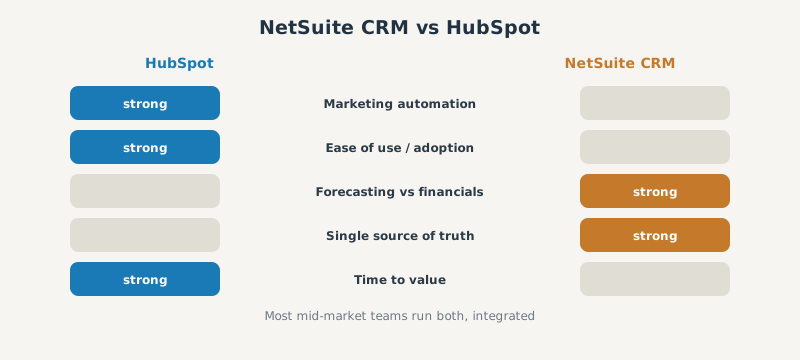
The first thing to understand is that NetSuite CRM and HubSpot are not the same kind of CRM system. HubSpot is a dedicated customer relationship management and marketing platform; HubSpot CRM is the product. NetSuite CRM is one module of Oracle NetSuite, sitting beside finance, inventory, and order management in a single ERP. Both are popular CRM choices in the mid-market, but they package CRM functionalities very differently: HubSpot is a CRM platform first, while NetSuite CRM offers CRM capabilities as an extension of the ERP. The differences between NetSuite CRM and HubSpot come down to what your CRM needs are.
HubSpot for High Velocity Go To Market Teams
HubSpot is built for teams that generate and convert demand at speed. As a cloud-based CRM, it bundles marketing automation, email marketing, sequences, and sales engagement natively rather than bolted on, and HubSpot is known for CRM tools that reps and managers actually use. HubSpot focuses on the front office, and the CRM is genuinely user-friendly. When go-to-market velocity, marketing automation, and adoption matter most, HubSpot is the stronger CRM. Practitioners are blunt about it: on sales and marketing functionality, there is “absolutely no comparison” with NetSuite’s basic campaign tools. Whereas NetSuite leads with finance, HubSpot leads with the customer relationship.
NetSuite CRM for ERP Centric Operations
NetSuite CRM shines when the business already runs NetSuite ERP and wants one database for everything. NetSuite provides a customer record that shows opportunities alongside invoices, payment history, support cases, backlog, and renewal dates, and NetSuite offers this as part of the broader NetSuite ERP rather than a standalone CRM. Forecasting is tied directly to financials, and SuiteAnalytics dashboards report across the whole company without a separate BI tool. If finance leads and an ERP-centric single source of truth is the goal, NetSuite CRM makes sense. The trade-off is that NetSuite CRM includes fewer native marketing tools, so what NetSuite provides in financial depth it lacks in go-to-market reach.
Pricing Realities and Total Cost of Ownership
Pricing is where NetSuite CRM and HubSpot differ most, and where the real total cost of ownership hides.
The Impact of Shared Licensing versus Module Based Costs
HubSpot uses published, negotiable, per-seat pricing. Sales Hub Professional runs roughly $90 to $100 per seat per month plus a one-time onboarding fee, and HubSpot offers cheaper or free seats for non-reps and a contact-based model for Marketing Hub. NetSuite is quote-based: a platform base fee (often around $999 per month and up) plus per-user licenses of roughly $99 to $199 each, with CRM bundled into the base rather than billed separately.
The bigger gap is the hidden cost. NetSuite changes typically need a SuiteScript developer at $150 to $250 per hour, so a simple lead-routing tweak can become a $2,000 project, and a dedicated administrator runs six figures a year. HubSpot’s no-code builders let an existing sales-ops or marketing manager make the same change. When you compare NetSuite CRM and HubSpot on pricing, count the people, not just the licenses.
| Factor | HubSpot | NetSuite CRM |
|---|---|---|
| Pricing model | Per-seat, published, negotiable | Quote-based, per-user + base platform |
| CRM cost | Standalone tiers | Bundled into the ERP base |
| Customization | No-code builders | SuiteScript developers |
| Time to value | Weeks (around 36 days) | Months (3 to 6 typical) |
| Ease of use | Top-rated, adopts in a day | Often called clunky and slow |
Scaling Limitations and RevOps Alignment
Both platforms scale, but in different directions. HubSpot scales with go-to-market complexity: more campaigns, more reps, more pipeline. NetSuite scales with operational and financial complexity: more subsidiaries, more inventory, more revenue-recognition rules.
Measuring End User Adoption and Administrative Overhead
For RevOps, adoption is the deciding factor more often than features. NetSuite is finance-first, which depresses sales adoption and leads to messy CRM data and expensive custom coding. HubSpot is repeatedly ranked top for usability, with most reps productive in a day or two. The cheapest CRM is the one your team actually uses, so weigh administrative overhead and end-user adoption as heavily as the capability checklist when you compare NetSuite or HubSpot.
When to Combine Both Platforms
The most common mistake is assuming you must use NetSuite CRM just because you run NetSuite accounting. You do not. The mainstream mid-market answer is to combine both platforms: HubSpot wins and manages the customer, NetSuite serves and invoices the customer, and an integration keeps them in sync. Can HubSpot integrate with NetSuite? Yes, through a native connector, an iPaaS such as Celigo or Workato, or a custom build; our HubSpot ERP integration guide walks through these options for NetSuite and the other major ERPs.
Eliminating Manual Data Entry and Consolidating Revenue Reporting
When the two platforms are connected, a closed-won HubSpot deal creates the NetSuite customer and sales order automatically, so reps stop creating records by hand and finance stops re-keying quotes. Revenue reporting consolidates onto one customer record, marketing attribution ties to recognized revenue, and forecasts finally reconcile with actuals. That is why most companies that compare NetSuite CRM vs HubSpot end up keeping both and integrating them rather than choosing one.
Choosing the Right CRM for Your Business
So which CRM is the best choice? Compare HubSpot vs NetSuite on the work your team actually does. Choose HubSpot when you need a scalable CRM for a marketing-led, high-velocity sales motion and want fast time to value. Choose NetSuite CRM if you need financial depth and already live in the NetSuite platform. Choose both, integrated, when sales should run in HubSpot and finance must stay in NetSuite, which is the most common outcome in the mid-market CRM market. HubSpot can be integrated with NetSuite using a native connector or an iPaaS, so the data flow between front office and back office stays clean whichever system owns each record. For the build itself, see our HubSpot to NetSuite integration setup guide and the data mapping pitfalls to avoid.
Frequently Asked Questions
Is NetSuite similar to HubSpot? Not really. HubSpot is a dedicated CRM and marketing platform; NetSuite CRM is a module inside an ERP. They overlap on contact and opportunity management but serve different jobs.
Does NetSuite have a CRM tool? Yes. NetSuite CRM is part of the broader NetSuite ERP and covers sales force automation, forecasting, and basic marketing, with customer data living next to finance and inventory.
Which CRM is better, NetSuite or HubSpot? For sales and marketing velocity, adoption, and ease of use, HubSpot is better. For an ERP-centric single source of truth tied to financials, NetSuite CRM fits. Many mid-market teams use both.
Is NetSuite CRM any good? It is strong when you already run NetSuite ERP and want one system, with forecasting tied to financials. It is weaker on marketing automation and ease of use compared with HubSpot.
Can HubSpot integrate with NetSuite? Yes. HubSpot integrates with NetSuite via a native connector, iPaaS platforms, or a custom API build, which is how most companies run both together.
How do NetSuite CRM and HubSpot compare on pricing? HubSpot is per-seat and published; NetSuite is quote-based per-user plus a platform fee. NetSuite’s hidden costs (admins and developers) often make it the more expensive option to operate.
SWOTBee helps mid-market RevOps teams choose between NetSuite CRM and HubSpot, and connect them when the answer is both. We map your go-to-market motion to the right system so you stop paying for tools your team will not adopt.
Get your 1-page renewal leakage estimate →
No call needed. Prefer to talk it through first? Book a free 30-minute discovery call →