This article is part of our complete guide to CRM and ERP integration.
The order-to-cash process (O2C) is the set of steps a business runs from the moment a customer places an order to the moment the cash is collected and applied: order entry, fulfillment, invoicing, payment collection, and reconciliation. It is the back-office engine of revenue, and its efficiency directly affects cash flow and customer satisfaction. This guide covers the order-to-cash steps, why the process matters, the common challenges, how automation optimizes it, and best practices.
The order-to-cash cycle is the downstream half of quote-to-cash and a core process that a CRM and ERP integration automates.
What Is the Order-to-Cash Process and Why It Matters
Order-to-cash (O2C, sometimes OTC) is the end-to-end business process that covers everything that happens after a customer order: capturing the order, fulfilling it, billing for it, and collecting and recording the payment. It matters because it is where revenue actually becomes cash.
A simple way to explain the order-to-cash cycle: the moment a customer decides to place an order, a chain of work begins across sales, the supply chain, and finance, and it does not end until the cash is in the bank and reconciled. That is why O2C is described as an end-to-end process rather than a single task, it ties the customer relationship on the front end to the fulfillment process and accounts receivable on the back end. Understanding the full order-to-cash cycle (and being able to explain each stage) is a core skill in revenue operations and finance roles. A slow or error-prone order-to-cash cycle ties up working capital in outstanding invoices, frustrates customers with billing mistakes, and obscures the financial health of the business. A fast, accurate O2C process protects cash flow and customer trust at the same time.
The Steps in the Order-to-Cash Process
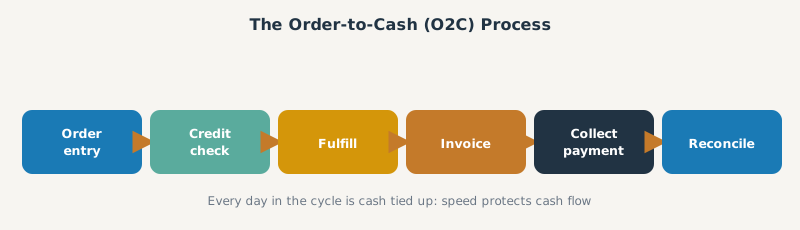
The order-to-cash process steps are:
- Order entry. The customer places an order, captured in the CRM or order management system (ideally synced from the closed deal, not re-keyed).
- Credit management. Check and approve customer credit terms where relevant.
- Order fulfillment. Pick, pack, and ship the product, or provision the service.
- Invoicing. Generate an accurate invoice from the order in the ERP.
- Payment collection. Collect payment and manage any outstanding invoices.
- Cash application and reconciliation. Apply the payment to the right account and reconcile the books.
- Reporting. Analyze the cycle to find and fix bottlenecks.
Each step depends on accurate data from the one before, so a connected order management system and ERP keep the whole O2C cycle moving.
Order-to-Cash vs Quote-to-Cash
The two are often confused. Quote-to-cash starts earlier, at the quote, and includes configuring, pricing, and contracting. Order-to-cash starts at the order and runs through fulfillment, invoicing, and payment. Put simply, order-to-cash is the back portion of the broader quote-to-cash process. If you are automating the front (quoting and order creation), see our quote-to-cash guide; this article focuses on what happens once the order exists.
Common Challenges in the Order-to-Cash Process
The friction in order-to-cash usually comes from disconnected systems and manual work:
- Manual order entry. Re-keying orders from the CRM into the ERP causes delays and errors.
- Invoicing errors. Mismatches between the order and the invoice trigger disputes and slow payment.
- Slow collections. Poor visibility into outstanding invoices lengthens the cycle and hurts cash flow.
- No real-time status. When sales and service cannot see order or payment status, customer experience suffers.
These challenges are why so many companies integrate their CRM and ERP: it removes the manual handoffs that create them.
How Automation and AI Optimize Order-to-Cash
Technology transforms the order-to-cash cycle:
- Automated order entry. Syncing the order from the CRM to the ERP removes re-keying and its errors.
- Automated invoicing. The ERP generates invoices straight from the order, in real time.
- AI-assisted collections. AI can predict late payers and prioritize collections, shortening days-sales-outstanding.
- Real-time dashboards. Live visibility into the O2C cycle surfaces bottlenecks before they hurt cash flow.
For a HubSpot and NetSuite stack, the closed deal flows into NetSuite as a sales order and invoice automatically, the mechanics of which are in our HubSpot to NetSuite setup guide.
How Order-to-Cash Affects Cash Flow and Financial Health
The order-to-cash cycle is, ultimately, a cash-flow process. Every day between receiving an order and applying the payment is a day your cash is tied up, so a long O2C cycle creates cash-flow problems even for a profitable business. The end-to-end business process from order placement to cash inflows determines days-sales-outstanding, the health of your accounts receivable, and how much working capital you have free. Reducing outstanding invoices and speeding lead-to-cash directly improves financial health, which is why finance teams watch the order-to-cash cycle so closely. Comparing the order-to-cash process against the broader quote-to-cash (the entire process from quote onward) shows where in the lifecycle cash gets stuck.
Order-to-Cash Software and Tools
Most companies run the order-to-cash process on an ERP plus an order management system, often the same platform. An order-to-cash software setup typically covers order entry, a purchase order workflow, order confirmations and order status tracking, invoicing, and accounts receivable. Large enterprises run O2C on systems like SAP or NetSuite; mid-market teams usually run it on NetSuite connected to their CRM. Whatever the system, the goal is a single, connected O2C system so the entire process, from receiving an order to cash application, runs on one set of accurate order details rather than spreadsheets and re-keyed data.
Best Practices for Managing the Order-to-Cash Process
To run an efficient order-to-cash process:
- Integrate the systems. Connect the CRM, order management, and ERP so data flows without re-entry.
- Standardize order entry. Consistent, validated order data prevents downstream errors.
- Automate invoicing and reminders. Speed up billing and follow-ups to shorten the cycle.
- Monitor the cycle. Track days-sales-outstanding and bottlenecks with real-time reporting.
- Align teams. Sales, finance, and operations should share one view of every order.
Done well, the order-to-cash process becomes a reliable, fast path from order to cash rather than a source of leakage and delay.
Frequently Asked Questions
What is the order-to-cash process? The set of steps from when a customer places an order to when the cash is collected and recorded: order entry, credit, fulfillment, invoicing, payment collection, and reconciliation.
What are the steps in the order-to-cash process? Order entry, credit management, order fulfillment, invoicing, payment collection, cash application and reconciliation, and reporting.
What is the difference between order-to-cash and quote-to-cash? Quote-to-cash starts at the quote and includes pricing and contracting; order-to-cash starts at the order and runs through fulfillment, invoicing, and payment. O2C is the back half of quote-to-cash.
Why is the order-to-cash process important? It is where revenue becomes cash. An efficient O2C process protects cash flow, reduces errors and disputes, and improves customer satisfaction; a slow one ties up working capital.
How does automation optimize order-to-cash? By syncing orders from the CRM to the ERP, automating invoicing, using AI to prioritize collections, and giving teams real-time visibility, automation shortens the cycle and reduces errors.
SWOTBee streamlines the order-to-cash process by integrating CRM and ERP, so orders, invoices, and payments flow automatically and cash arrives faster. Less manual work, healthier cash flow.
Get your 1-page renewal leakage estimate →
No call needed. Prefer to talk it through first? Book a free 30-minute discovery call →