This article is part of our complete guide to CRM and ERP integration.
Quote to cash (Q2C, also written quote-to-cash) is the end-to-end business process that runs from creating a customer quote to collecting the cash: configure and price the quote, get it signed, turn it into an order, fulfill it, invoice, and collect payment. It spans the front office (CRM and CPQ) and the back office (ERP billing and receivables), which is why a streamlined quote to cash process depends on a clean integration between the two. This guide covers the quote to cash meaning, the process and its steps, the software involved, how Q2C differs from CPQ and order to cash, the challenges, and how to automate it.
Quote to cash is one of the most valuable processes a CRM and ERP integration automates.
For a CRM-specific implementation, use our HubSpot quote-to-cash guide to connect approved quotes, customer agreements, billing and accounting. This article retains the general process definition.
What Is Quote to Cash? (QTC/Q2C Meaning)
Quote to cash, often abbreviated Q2C or QTC, is the full revenue lifecycle from the moment a sales rep creates a quote to the moment the business records the cash. It encompasses the entire sales cycle from quote creation through cash collection, not just the selling part: configuring the right product and price (CPQ), pricing strategy, contract creation and negotiation, order management, fulfillment, billing, recognized revenue, and collecting receivables. Because the quote to cash cycle crosses sales, finance, and operations, it touches the customer relationship management (CRM) system and the enterprise resource planning (ERP) system, and gaps at those handoffs are where revenue leaks.
“QTC” and “Q2C” are used interchangeably in the industry; there is no meaningful difference between the two abbreviations, or between “quote to cash” and the hyphenated “quote-to-cash.”
The Steps in the Quote to Cash Process
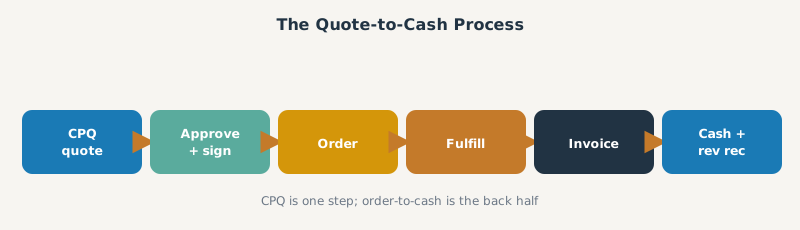
A typical quote to cash process involves these steps:
- Configure, price, quote (CPQ). The sales team configures the product or bundle, applies pricing strategy and any discount, and produces an accurate quote.
- Quote approval. Internal approval of pricing and terms and conditions before the quote goes out. This is where negotiation on price or terms usually happens.
- Contract creation and signature. The customer agrees; contract lifecycle management (CLM) tooling generates the contract and an e-signature closes it.
- Order creation. The signed quote becomes a sales order, ideally synced automatically into the ERP with no manual work re-keying it.
- Fulfillment. The product or service is delivered (order fulfillment), drawing down inventory where physical goods are involved.
- Invoicing and billing. The ERP generates the invoice based on the order and manages the billing process, including any upselling or cross-selling captured after the original quote.
- Payment collection. Payment is collected and applied against the receivable, improving cash flow the faster it closes.
- Revenue recognition. The finance team recognizes the revenue per the rules of the contract and applicable regulatory compliance standards.
Each step hands off to the next, so an error-free, end-to-end quote-to-cash process depends on data flowing cleanly between systems rather than being re-entered by hand, which is where human error and bottlenecks tend to appear. Getting the steps in the quote-to-cash process right the first time, rather than patching them later, is what lets sales, finance, and operations close deals without the process becoming its own cost center.
Quote to Cash vs CPQ vs Order to Cash
These terms overlap, which causes confusion:
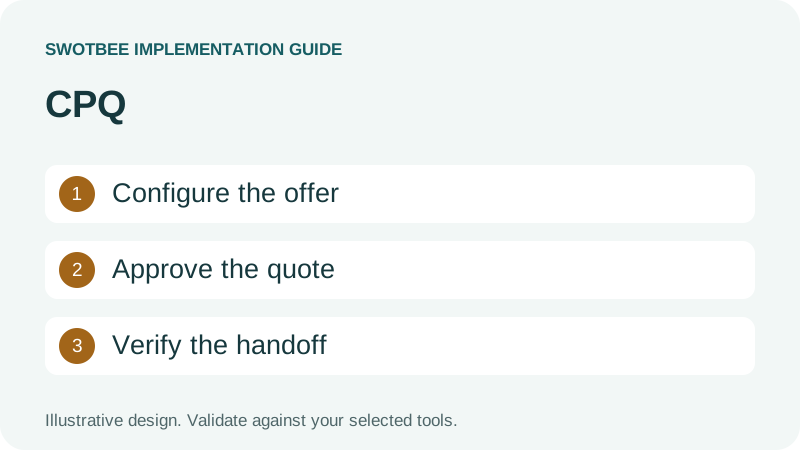
- CPQ (configure, price, quote) is one step inside quote to cash: producing an accurate quote quickly. CPQ software automates the front of the process, including generating a quote for a complex bundle without a spreadsheet.
- Quote to cash is the whole lifecycle from quote through cash collection, including CPQ.
- Order to cash (O2C) starts later, at the order, and runs through fulfillment, invoicing, and payment. It is the back half of quote to cash.
In short, CPQ is a part of Q2C, and order to cash is the downstream portion. We cover the back half in detail in our order-to-cash process guide, and the CPQ distinction specifically in quote to cash vs. CPQ.
Quote to Cash and Order to Cash: The Full Picture
Put together, quote-to-cash and order-to-cash describe the same underlying quote-to-cash cycle viewed from two starting points: quote-to-cash begins at the quote, order-to-cash begins once the order exists. A business that has automated order-to-cash but not the quoting and contract steps in front of it has fixed the back half of the process and left the front half, where most of the manual work and human error concentrate, untouched.
Teams evaluating a Q2C solution often ask whether they need a full platform or just a CPQ add-on. The honest answer: if quotes are simple and the CRM already talks to the ERP, a CPQ tool alone may be enough. If pricing is complex, contract management needs negotiation and an electronic signature step, and the business needs end-to-end visibility from quote to cash, a connected quote-to-cash process, not just a better quoting tool, is what closes the gap.
The Benefits of a Streamlined Quote-to-Cash Process
Improving the quote-to-cash process delivers measurable gains:
- Faster sales cycle. Reps generate an accurate quote quickly and move deals to close sooner.
- Better cash flow. Orders, invoices, and collections happen without manual delay.
- Fewer errors. Automation reduces errors and revenue leakage from mispriced quotes or contract-to-invoice mismatches.
- Cleaner revenue recognition. Consistent data makes revenue management and recognition reliable.
- Better customer experience. A smooth, fast process from quote to fulfillment reflects well on the business.
An integrated quote-to-cash process turns a series of manual handoffs into one connected revenue engine.
Common Challenges in Quote to Cash
The friction in quote to cash almost always sits at the seams:
- Disconnected systems. When the CRM, CPQ, and ERP do not share data, every handoff means manual work re-entering the same information, and stakeholders across sales, finance, and operations lose visibility into where a deal actually stands.
- Manual quoting errors. Without CPQ, reps misprice or misconfigure a bundle, causing downstream disputes and, over time, eroding customer lifetime value.
- Contract-to-invoice mismatches. Negotiated terms, including any post-sale upselling or cross-selling, that never reach billing cause revenue leakage that is hard to trace after the fact.
- Slow approvals and forecasting blind spots. Manual approval chains stall quotes, lengthen the sales cycle, and make accurate forecasting difficult because finance cannot see deals still stuck in the pipeline between quote and cash.
- Spreadsheet dependency. Teams that manage pricing, discount rules, or contract terms in a spreadsheet inherit its bottlenecks: no audit trail, no real-time communication between the person who owns the spreadsheet and everyone downstream of it.
These are exactly the problems a CRM and ERP integration is built to solve.
Software and Tools for the Quote to Cash Process
A modern quote to cash process runs on connected software rather than manual steps. The core tools:
- CRM (such as HubSpot or Salesforce) holds the customer relationship and the deal that starts the process.
- CPQ software lets sales reps configure-price-quote a quick and accurate quote, manage the approval process, and apply discounts and terms without manual data entry.
- CLM and electronic signature tools manage contract creation, negotiation, and the signature that turns a quote into a binding order. Contract management is the piece most manual quote-to-cash processes skip, and where terms most often drift from what finance eventually bills.
- ERP handles the billing process, revenue management, forecasting, and compliance with accounting standards.
- A payment processor (Stripe, for example, is common in subscription business model companies) collects the payment itself once the invoice is issued, which is a separate system from the ERP that generates the invoice.
Cost, tax handling, and analytics reporting all sit downstream of these systems: get the handoffs right and a performance indicator like days sales outstanding becomes a number finance can trust, not a guess assembled from five spreadsheets by five different stakeholders across sales, finance, and marketing.
A quote-to-cash implementation assigns responsibility for the customer, quote, agreement, invoice, payment and accounting record. Some CRMs include commercial and billing functions: HubSpot Revenue Hub is one example. Specialist CLM, billing or ERP tools remain options where the requirements justify them. This guide owns the generic process; the software guide covers selection.
See our full guide to quote-to-cash software for how these categories compare and how to choose between a full suite and best-of-breed tools.
When these are integrated, quote generation, the approval process, order creation, and the billing process flow as one connected quote to cash cycle. When they are not, each stage of the quote to cash process becomes a manual handoff where errors and delays creep in, and a slow Q2C process becomes a cash-flow problem. Improving the quote to cash process is largely about connecting these tools so the entire sales process, from an accepted quote to cash collected, runs without re-entry.
How to Automate the Quote to Cash Process
Automating quote to cash means removing the manual handoffs between systems:
- Use CPQ to generate accurate, approved quotes inside the CRM, cutting the manual work of pricing a bundle by hand.
- Add CLM and e-signature so a signed contract triggers the next step automatically instead of waiting on a scanned PDF.
- Sync the order to the ERP automatically when the deal closes, so no one re-keys it. In a HubSpot and NetSuite stack, this is the closed-won deal to NetSuite sales order flow, covered in our HubSpot to NetSuite setup guide.
- Automate billing and invoicing in the ERP from the order, including any negotiated upsell or cross-sell terms.
- Flow status back to the CRM so sales sees fulfillment and payment without leaving their system, and finance gets a forecasting signal instead of a blind spot.
- Integrate the systems so the whole quote to cash workflow runs on real-time data, the foundation covered in our CRM and ERP integration guide.
The result is an end-to-end, automated QTC process that speeds up sales cycles and protects revenue. Once a quote is created accurately the first time, the rest of the process, order, invoice, collecting payment, and revenue recognition, runs largely on its own, because the same connected quote and billing data passes through every step rather than being rebuilt at each handoff. Whether you call it QTC or Q2C, a quote-to-cash process built on real-time data instead of spreadsheets is what improves cash flow, and a well-run quote-to-cash accelerates the whole sales cycle from configuring products in the first step through the last dollar collected.
Frequently Asked Questions
What is quote to cash? The end-to-end process from building a customer quote to collecting the cash, including CPQ, contracts, order management, fulfillment, invoicing, payment, and revenue recognition across the CRM and ERP. Also written quote-to-cash, and abbreviated Q2C or QTC.
What is the difference between CPQ and quote to cash? CPQ (configure, price, quote) is one step within quote to cash that produces an accurate quote. Quote to cash is the full lifecycle from quote through cash collection, which includes CPQ.
What is the difference between quote to cash and order to cash? Quote to cash covers the whole lifecycle starting at the quote; order to cash (O2C) starts at the order and runs through fulfillment, invoicing, and payment. Order to cash is the back half of quote to cash.
What are the steps in the quote to cash process? Configure-price-quote, approval, contract and signature, order creation, fulfillment, invoicing, payment and collections, and revenue recognition.
How do you automate the quote to cash process? Use CPQ for quoting, sync the order to the ERP automatically on close, automate billing, flow status back to the CRM, and integrate the systems so the workflow runs on real-time data.
Does quote to cash software replace a CRM? No. Quote to cash software extends the CRM rather than replacing it. The CRM stays the system of record for the customer and the deal; Q2C tools handle pricing, approvals, contracts, and the handoff to the ERP.
How do CLM and e-signature fit into quote to cash? Contract lifecycle management (CLM) and e-signature tools sit between the quote and the order: once a quote is approved, CLM manages contract creation and negotiation, and e-signature closes it, so the signed contract can trigger order creation without manual re-entry.
What is the best quote to cash software? It depends on company size and stack. Salesforce CPQ and Revenue Cloud, HubSpot Revenue Hub with accounting integration where required, and dedicated Q2C platforms like DealHub or Conga each fit a different combination of deal complexity, existing CRM, and ERP.
SWOTBee automates quote to cash for mid-market companies by connecting CRM and ERP, so quotes become orders, invoices, and cash without the manual handoffs that leak revenue. One connected revenue engine, and it is the same connected system that keeps renewals from leaking once the first deal closes: a clean quote to cash process is what makes the renewal, the second cash collection on the same account, just as automatic as the first.
Get your 1-page renewal leakage estimate →
No call needed. Prefer to talk it through first? Book a free 30-minute discovery call →