This article is part of our guide to SaaS renewal metrics.
The SaaS quick ratio measures growth efficiency: how much new and expansion MRR a company adds for every dollar of churned and contraction MRR it loses. The formula is (new MRR + expansion MRR) ÷ (churned MRR + contraction MRR). A SaaS quick ratio of 4 means you add four dollars of recurring revenue for every dollar you lose, which is the widely cited benchmark for a healthy, efficiently growing SaaS business.
Unlike the accounting “acid test” quick ratio that measures a company’s ability to pay current liabilities, the SaaS quick ratio measures how efficiently a subscription business grows. This guide shows how to calculate it, what a good benchmark is, and how it compares to other SaaS metrics.
What Is the SaaS Quick Ratio?
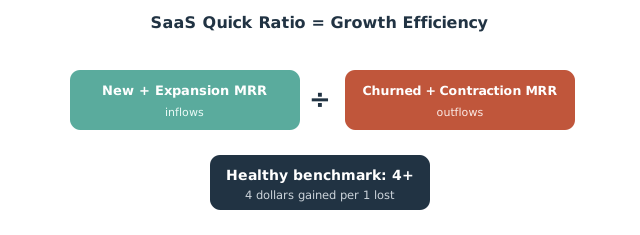
The SaaS quick ratio measures a company’s growth efficiency by comparing revenue inflows to outflows. It answers one question: for all the recurring revenue you are adding, how much are you losing at the same time? A high quick ratio means growth comfortably outpaces churn; a low quick ratio means you are filling a leaky bucket.
It is one of the most useful SaaS metrics because it captures both growth and retention in a single number. Two companies can post identical MRR growth while one has a quick ratio of 5 and the other 1.5: the first grows cleanly, the second only by outrunning heavy churn.
How to Calculate the SaaS Quick Ratio
The formula uses four MRR components over a period:
SaaS quick ratio = (new MRR + expansion MRR) ÷ (churned MRR + contraction MRR)- New MRR: recurring revenue from new customers.
- Expansion MRR: added recurring revenue from existing customers (upsell and cross-sell).
- Churned MRR: recurring revenue lost to cancellations.
- Contraction MRR: recurring revenue lost to downgrades.
To calculate your SaaS quick ratio, sum the inflows (new and expansion) and divide by the outflows (churned MRR and contraction MRR).
A Worked Example
Suppose in a month you add $80,000 new MRR and $40,000 expansion MRR, while losing $20,000 to churn and $10,000 to contraction:
Quick ratio = (80,000 + 40,000) ÷ (20,000 + 10,000) = 120,000 ÷ 30,000 = 4.0A quick ratio of 4 indicates healthy, efficient growth.
What Is a Good SaaS Quick Ratio?
The standard SaaS quick ratio benchmark is 4: a quick ratio that exceeds 4 indicates a company adding revenue far faster than it loses it. As a rough guide:
| Quick ratio | What it indicates |
|---|---|
| Below 1 | Shrinking: losses exceed gains |
| 1 to 2 | Inefficient growth, heavy churn |
| 2 to 4 | Growing, but with notable leakage |
| 4+ | Healthy, efficient growth |
Early-stage companies often post very high quick ratios simply because their churn base is small; as a SaaS business scales, sustaining a quick ratio above 4 gets harder and more meaningful. Benchmarks vary by stage and segment, so compare against your own trend as well as the industry benchmark.
What Influences the Quick Ratio (and How to Improve It)
Because the SaaS quick ratio measures inflows against outflows, you improve it from both sides:
- Grow the numerator: increase new MRR and, especially, expansion MRR. Expansion is high-margin and lifts both the quick ratio and net revenue retention.
- Shrink the denominator: reduce churned MRR and contraction MRR by catching silent churn and at-risk accounts early with renewal risk scoring.
Reducing churn usually moves the ratio more than chasing new logos, because the denominator is smaller and every dollar of revenue lost counts fully against you.
SaaS Quick Ratio vs Other Metrics
The quick ratio is one of several efficiency metrics, and it pairs well with others:
- Rule of 40: growth rate plus profit margin should exceed 40%. The Rule of 40 balances growth and profitability; the quick ratio balances growth and churn. They answer different questions.
- SaaS magic number: measures sales and marketing efficiency (new ARR per dollar of S&M spend). The magic number is about go-to-market efficiency; the quick ratio is about net revenue momentum.
- Net revenue retention: NRR isolates existing customers; the quick ratio includes new customers too.
Used together, these give investors and operators a full read on how efficiently a company grows.
Frequently Asked Questions
What is the SaaS quick ratio? A growth-efficiency metric comparing recurring revenue gained (new + expansion MRR) to recurring revenue lost (churned + contraction MRR).
How is the SaaS quick ratio calculated? (New MRR + expansion MRR) ÷ (churned MRR + contraction MRR).
What is a good SaaS quick ratio? 4 or higher is the common benchmark for healthy, efficient growth. Below 1 means the business is shrinking.
How does the quick ratio compare to the Rule of 40? The Rule of 40 balances growth and profitability; the quick ratio balances growth and churn. They are complementary, not interchangeable.
Is the SaaS quick ratio the same as the accounting quick ratio? No. The accounting (acid test) quick ratio measures a company’s ability to meet current liabilities; the SaaS quick ratio measures growth efficiency.
The quick ratio is one of the efficiency metrics in our SaaS renewal metrics guide.
Growth that outruns churn looks healthy until the churn catches up: the quick ratio is how you tell the difference. SWOTBee builds growth-efficiency and retention reporting for mid-market companies across Energy, Manufacturing, and SaaS.
Get your 1-page renewal leakage estimate →
No call needed. Prefer to talk it through first? Book a free 30-minute discovery call →