This article is part of our guide to SaaS renewal metrics.
Usage-based revenue forecasting predicts revenue when customers pay for what they consume rather than a fixed monthly seat price. Because consumption varies, you cannot just multiply seats by price: you forecast from usage patterns, trends, and customer-level consumption data. The trade-off is that usage-based pricing aligns revenue with value delivered but makes revenue less predictable than a standard subscription model. This guide explains how consumption-based forecasting works and how to make variable usage revenue more predictable.
As more SaaS companies adopt usage-based pricing models, forecasting has shifted from counting subscriptions to projecting consumption. Here is how to do it well.
What Is a Usage-Based Revenue Model?
In a usage-based model (also called consumption-based), customers are billed on actual usage: API calls, data processed, messages sent, compute consumed. Revenue scales up and down with how much customers use the product, rather than a flat subscription fee.
This differs from a standard subscription model in one key way: subscription revenue is fixed and recurring (the same MRR each period), while usage revenue is variable and tied to consumption. Many businesses run a hybrid of subscription and usage-based pricing, with a base platform fee plus consumption on top.
How Usage-Based Revenue Differs From Subscriptions for Forecasting
With fixed subscriptions, forecasting is straightforward: ARR is seats times price, and renewals are predictable. With a usage-based model, the same customer’s revenue can swing month to month, so:
- Revenue predictability drops. Variable usage means variable revenue, which is harder to project than fixed MRR.
- Renewals look different. Instead of a yes/no renewal, you forecast whether consumption (and therefore revenue) continues, grows, or shrinks.
- Expansion is automatic. When customers use more, revenue grows without a sales motion, which lifts net revenue retention but makes the number harder to predict.
Usage-Based vs Traditional SaaS Revenue
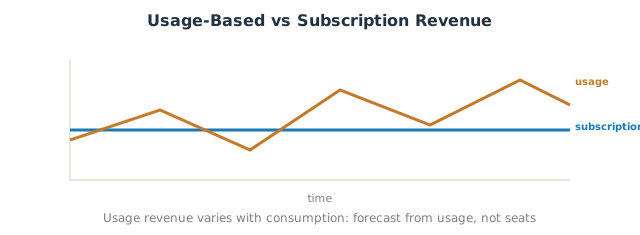
In a traditional SaaS model, monthly recurring revenue is fixed: each customer’s monthly revenue is the same until they upgrade or churn, which makes projected revenue easy. Usage-based SaaS breaks that pattern. Customer revenue rises and falls with consumption, so the same account can produce different monthly revenue every period.
This changes how you think about revenue growth. In a subscription model, growth comes from new customers and deliberate upgrades. In consumption-based models, growth also comes automatically as existing customers use more, which shows up as expansion revenue without a sales motion. That is great for net revenue retention but harder for revenue visibility, because the usage metric driving consumption revenue is outside your direct control. Many SaaS businesses therefore run a hybrid pricing plan: a subscription base for a predictable revenue floor plus usage pricing on top for upside.
How Consumption-Based Forecasting Works
Consumption-based forecasting projects future revenue from usage data rather than contracts. The core steps:
- Track usage at the customer level. Capture actual usage per account over time. Granular usage data is the foundation of any usage forecasting model.
- Identify usage patterns. Look for trends, seasonality, and growth trajectories in each customer’s consumption. A usage pattern that is rising, flat, or declining each forecasts differently.
- Segment by behavior. Group customers by usage profile (steady, growing, spiky) so you forecast each segment with the right assumptions.
- Project forward. Apply the usage trend to project revenue per customer, then aggregate. Blend bottom-up (per-customer usage) with top-down (overall growth rate) for a balanced forecast.
- Model ranges, not points. Because variable usage is uncertain, forecast a range (low, expected, high) rather than a single number.
This is one of several types of revenue forecasting; for usage models, the consumption-based approach is essential where a simple subscription run-rate would be wrong.
Usage-Based Revenue Recognition
Forecasting and revenue recognition are linked. With a subscription, you recognize revenue evenly across the term. With usage-based revenue recognition, you recognize revenue as the customer consumes, so recognized revenue tracks actual usage rather than a flat schedule. This means your projected revenue and your recognized revenue can diverge within a month if usage runs ahead of or behind plan. Accurate revenue reporting depends on capturing product usage data in near real time so finance can recognize revenue correctly and report consumption-based revenue without month-end surprises.
Tools for Usage-Based Forecasting
You do not need exotic software, but you do need the right inputs. Good forecasting tools for usage models share three traits: they ingest granular product usage data, they let you segment customers by usage pattern, and they output a range rather than a single number. Whether you build this in a spreadsheet, your data warehouse, or a billing platform, the goal is the same: predict future revenue from how customers actually use the product. Pair the forecast with usage alerts so a drop in a key usage metric flags churn risk early, the same discipline as renewal risk scoring.
The Challenges of Forecasting Usage-Based Revenue
Usage-based revenue is harder to forecast for several reasons:
- Variability. Consumption fluctuates with the customer’s own business, so revenue is inherently less predictable.
- Low-usage risk. A customer with declining usage is a churn signal even if they have not cancelled. Low usage is the consumption-model equivalent of silent churn.
- Revenue recognition complexity. Usage revenue is often recognized as consumed, which complicates deferred revenue and reporting.
- Lumpy expansion. A single large customer ramping usage can swing the forecast, so concentration matters.
Types of Revenue Forecasting for Usage Models
There are several types of revenue forecasting, and usage models often blend them:
- Bottom-up (usage-based): project each customer’s consumption from their own usage trend, then sum. Most accurate for variable revenue, but data-hungry.
- Top-down: apply an overall growth rate to total revenue. Fast but blunt for consumption revenue.
- Cohort-based: forecast usage by customer cohort, since newer cohorts often ramp differently than mature ones.
- Driver-based: tie revenue to a leading business driver (transactions processed, seats active) and forecast the driver.
For a usage-based SaaS business, a bottom-up forecast cross-checked against a top-down growth rate gives the most reliable projected revenue. When you first implement usage-based pricing, lean on driver-based forecasting until you have enough history for accurate per-customer usage forecasting.
How to Improve Usage-Based Revenue Predictability
You cannot make consumption perfectly predictable, but you can tighten the forecast:
- Add commitments. Minimum commitments or prepaid usage tiers create a predictable floor under variable revenue.
- Watch usage as a leading signal. Track usage trends per account so you see growth or decline early, the same discipline as renewal risk scoring.
- Blend models. A base subscription plus usage gives you a predictable core and variable upside, which forecasts better than pure usage.
- Tighten the data. Accurate, real-time usage data makes every forecast better; stale data makes consumption forecasting guesswork.
Done well, usage-based forecasting turns variable revenue from a black box into a managed range, which is what revenue operations and finance need to plan.
Frequently Asked Questions
What is a usage-based revenue model? A pricing model where customers pay for actual consumption (API calls, data, compute) rather than a fixed subscription fee, so revenue scales with usage.
What is consumption-based forecasting? Forecasting revenue from usage data and patterns rather than fixed contracts, projecting how much customers will consume and therefore pay.
How does usage-based revenue differ from a subscription model? Subscription revenue is fixed and recurring; usage-based revenue is variable and tied to consumption, which makes it less predictable but more aligned with value.
What are the challenges of forecasting usage-based revenue? Variability in consumption, low-usage churn risk, revenue recognition complexity, and lumpy expansion from large customers.
How can you make usage-based revenue more predictable? Add minimum commitments, watch usage trends early, blend subscription with usage, and keep usage data accurate and real-time.
Usage-based forecasting is one of the forecasting methods in our SaaS renewal metrics guide; see also TCV vs ARR for contract-based forecasting.
You can still use the HubSpot revenue versus target report structure, but the usage forecast must come from an approved consumption model. Do not substitute open deal amount for usage-derived revenue or present the variable outlook as closed actual.
Variable revenue is not unpredictable revenue if you forecast from usage. SWOTBee builds usage-based forecasting and revenue reporting for mid-market companies across Energy, Manufacturing, and SaaS.
Get your 1-page renewal leakage estimate →
No call needed. Prefer to talk it through first? Book a free 30-minute discovery call →