This article is part of our guide to who should run your renewals.
Fractional RevOps buys senior judgement a few days a month. A full-time RevOps hire buys continuous hands-on capacity. The choice is not really about cost, it is about whether your bottleneck is knowing what to do or having someone to do it. Companies that pick wrong usually do so by hiring a full-time RevOps leader to solve a decision problem, or retaining a fractional one to solve an execution problem. The cost of a full-time hire is easy to see; the cost of buying the wrong kind of help is not. This guide covers what each actually delivers, the real cost comparison, and which fits at each growth stage.
What Fractional RevOps Means, and What a Fractional RevOps Leader Actually Does
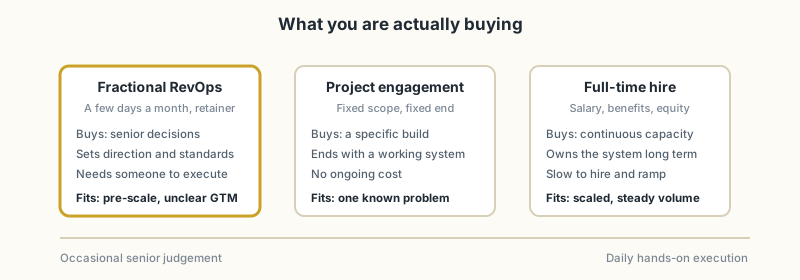
A fractional revenue operations leader operates as part-time leadership rather than part-time staff. The work is typically:
- Deciding the go-to-market operating model. How marketing, sales and customer success hand work between them, and who owns what.
- Setting the metric definitions. What counts as a qualified lead, what pipeline stages mean, how forecast categories are applied. Unglamorous, and the root of most reporting disputes between sales and marketing.
- Owning forecast quality. Not building the forecast, but making it defensible.
- Choosing and rationalising the tech stack. Deciding what the CRM should do natively and what genuinely needs another tool.
- Directing the people doing the work. An admin, an agency, or a project team.
Note what is not on that list: the configuration itself. A fractional leader who spends their days building workflows is expensive hands, and that is the most common way these engagements go wrong.
The Cost Comparison
The headline retainer against the headline salary is a misleading comparison. Include what surrounds each one.
| Fractional RevOps | Full-time RevOps hire | |
|---|---|---|
| Direct cost | Monthly retainer | Salary |
| On top | None | Benefits, payroll taxes, equity, roughly 20 to 30 percent |
| Recruitment | Days to start | 2 to 4 months to hire, plus agency fees |
| Ramp | Productive in week one | 1 to 3 months to full effectiveness |
| Seniority per pound | High, you are buying a fraction of a senior person | Constrained by budget, you get who the salary buys |
| Exit cost | Notice period | Redundancy, and the knowledge leaves |
| Capacity | A few days a month | Every day |
The honest summary: fractional is cheaper for seniority and more expensive per hour. If you need forty hours a week of hands-on work, fractional is the wrong instrument and will feel expensive very quickly. If you need eight hours a month of genuinely senior thinking, hiring full-time to get it means either overpaying for idle capacity or hiring someone too junior for the decisions.
Work out your own breakeven
The comparison people actually need is not “which is cheaper” but “at how many days a month does fractional stop making sense”. You can calculate that in about ten minutes.
Full-time true cost = salary x 1.25          (benefits, payroll taxes, equipment)
                    + recruitment cost        (agency fee, or your time)
                    ÷ 12                      = monthly cost

Fractional cost     = day rate x days per month
Set them equal and solve for days. A worked example, using round numbers you should replace with your own:
- Full-time RevOps salary £75,000, so true annual cost is roughly £93,750, or £7,810 a month
- Fractional day rate £1,200
- Breakeven: 7,810 ÷ 1,200 = 6.5 days a month
So above roughly six or seven days a month, the fractional arrangement costs more than an employee. Below it, you are paying less and getting a more senior person than £75,000 would hire.
Two adjustments that matter more than the arithmetic:
- Add the ramp. A full-time hire is not productive for the first one to three months, and you are typically two to four months from starting the search. Amortised over a two-year tenure, that is meaningful, and it all lands in year one.
- Subtract the idle capacity. If the actual RevOps workload is 10 days a month, a full-time hire is 12 days of salary for 10 days of work. Compare against real workload, not against a full month.
The number most teams land on is between five and eight days. If your honest estimate of the work is below that, fractional wins on cost as well as seniority. Above it, hire.
When Fractional RevOps Is Right for a SaaS Business
- You do not yet know what good looks like. Pre-scale companies frequently have execution capacity and no operating model. Direction is the constraint.
- The volume of work is lumpy. Quarterly planning, an annual pricing change, a systems migration, then quiet.
- You need seniority you cannot afford full-time. A fraction of someone who has done this at scale beats a full-time hire who has not.
- You are between hires. Keeping standards while recruiting, rather than letting the function drift for four months.
- The GTM motion is still changing. Committing headcount to an operating model that will be different in two quarters is premature.
When Hiring a Full-Time RevOps Leader Makes More Sense
- The hands-on work is steady and fills a role. If there is genuinely a week’s work every week, a retainer is a costly way to buy it.
- Systems need daily ownership. Someone has to respond when a workflow breaks on a Tuesday, and that is not what a fractional cadence is for.
- Institutional knowledge matters more than seniority. In-house knowledge compounds and does not leave when a contract ends.
- You are past the scaling inflection. Once the GTM motion is stable and volume is high, the value shifts from deciding the model to running it well.
- The team needs someone present. Some of the RevOps job is being available, and a few days a month cannot cover that.
The Third Option Most Comparisons Omit
Both fractional and full-time are ongoing commitments. Many companies asking this question actually have a defined, finite problem: the renewal process leaks, the forecast is not trustworthy, the CRM was configured badly two years ago.
A project engagement solves that with a fixed scope and an end date. No retainer, no headcount, and the system belongs to you afterwards. It is worth ruling this out before committing to either ongoing option, because “we need RevOps” often turns out to mean “we need one thing built properly”.
If your specific problem is renewals rather than the whole revenue engine, who should run your renewals covers that narrower decision, and a renewal-scoped audit will tell you whether the problem is as contained as it looks.
How a Fractional Engagement Actually Runs
Knowing the shape of the engagement matters, because “a few days a month” describes the invoice rather than the work.
A typical cadence is a standing weekly or fortnightly session with go-to-market leadership, a defined set of deliverables each month, and asynchronous access in between for the questions that cannot wait. What separates a strong fractional RevOps partner from a weak one is that the strong one commits to outputs. A revenue operations expert selling hours has no incentive to make the engagement efficient.
Expect the first month to look different from the rest. It is usually diagnostic: reviewing the CRM, the pipeline definitions, the reporting, the tech stack and how sales and marketing actually hand work between them. Direction that is set before that review is guesswork.
The failure mode to watch for is drift into delivery. A senior revenue operations expert building workflows is the most expensive configuration you will ever buy, and it happens gradually because it is easier than insisting someone else does it. Agree up front who executes.
What Happens to Your RevOps Function Either Way
Both routes leave you with something, and the difference matters more than the monthly cost.
A full-time hire builds RevOps infrastructure that stays. Institutional knowledge accumulates: why a stage was defined that way, which integration is fragile, what a qualified lead means here and why the definition changed. That knowledge is genuinely valuable and it is the strongest argument for in-house RevOps.
A fractional leader raises the standard of decisions while they are engaged, and the question is what remains afterwards. Good ones document deliberately and align your team around a written operating model, so the standard survives. Ones that keep the model in their head leave you where you started at a higher cost.
Ask directly how the engagement transfers knowledge. If a fractional RevOps partner cannot answer that, they are selling dependency rather than a revops function.
Which Fits Your Growth Stage
| Stage | Usually the right call |
|---|---|
| Pre-product-market-fit | Neither. The motion changes too fast to operationalise |
| Early scaling, under roughly $5M ARR | Fractional leadership, plus an admin or project help to execute |
| Scaling, $5M to $20M ARR | Fractional while you define the model, then a full-time hire to run it |
| Scaled, above roughly $20M ARR | Full-time in-house RevOps, with specialists for spikes |
| Any stage, one known broken system | A project engagement, regardless of the above |
Treat these as starting points rather than rules. Deal complexity and how many systems you run move the boundaries more than revenue alone.
Moving From Fractional to Full-Time
For most scaling companies the fractional vs full-time question is not permanent. It is a sequencing question, and treating it that way removes most of the anxiety from the decision.
The common path runs fractional first, then in-house. A senior RevOps leader defines the operating model, the metric definitions and the systems architecture over a few months. Once that exists and the work becomes execution rather than design, a full-time hire runs it. The hire is also easier to make at that point, because you can describe the role precisely instead of advertising for someone to work out what RevOps means here.
Three signals say it is time to switch:
- The questions have changed. They used to be “what should we do”, now they are “can someone do this”. Design is finished.
- The queue is permanent. A backlog of requests that never empties means the volume justifies a role.
- Response time is hurting. When waiting for the next session costs real money, a few days a month is no longer enough.
Running both is also legitimate and often underrated. A full-time RevOps professional handling execution, with a fractional executive retained for a day a month on strategy, gives a small revenue team senior oversight at a fraction of a second senior salary. That combination fits companies whose systems are demanding but whose RevOps team is one person.
The reverse move, full-time back to fractional, usually happens after a departure. Retaining a fractional leader while you recruit keeps standards from slipping, and it frequently clarifies what the replacement role should actually be.
Questions to Ask Before You Hire a Fractional RevOps Leader
- What are the deliverables each month? A good answer names outputs. A weak one names hours or a cadence of meetings.
- Who executes what you decide? If the answer is “you do”, confirm you have someone with the time.
- What happens between sessions? Asynchronous access matters more than session length for anything urgent.
- How does this end? A fractional engagement should have a view on what makes it unnecessary, whether that is a full-time hire or a stable system.
- Have you run this motion at our stage? RevOps at 200 people and RevOps at 20 are different jobs, and experience at the wrong end is a poor fit either way.
Frequently Asked Questions
What is fractional RevOps? A senior revenue operations leader working with you part-time on a retainer, usually a few days a month. You buy their judgement and direction rather than daily hands-on capacity.
How much does fractional RevOps cost compared with a full-time hire? Fractional is a monthly retainer with no benefits, equity or recruitment cost, and it can stop at any time. A full-time RevOps hire carries salary plus roughly 20 to 30 percent in employment costs, several months of recruitment, and a ramp period.
When does a full-time RevOps hire make more sense? When the volume of hands-on work is steady enough to fill a role, when the systems need daily ownership, and when institutional knowledge staying in-house matters more than seniority per pound spent.
What does a fractional RevOps engagement look like? Typically a fixed monthly cadence: a standing session with GTM leadership, defined deliverables per month, and asynchronous access between sessions. The best ones name deliverables rather than selling hours.
Can fractional RevOps do the hands-on build work? Some will, but it is expensive use of a senior rate. The common pattern is a fractional leader setting direction while a project engagement or an internal admin does the configuration.
Is fractional RevOps the same as a RevOps consultant? Not quite. A consultant is usually engaged for a defined project with an end date. A fractional leader is an ongoing part-time member of your leadership, with continuity rather than a deliverable as the point.
SWOTBee is neither fractional nor full-time: we build the renewal system, hand it over, and leave. If your RevOps question is really a renewals question, that is a smaller and cheaper problem than either hire.
Get your 1-page renewal leakage estimate →
No call needed. Prefer to talk it through first? Book a free 30-minute discovery call →