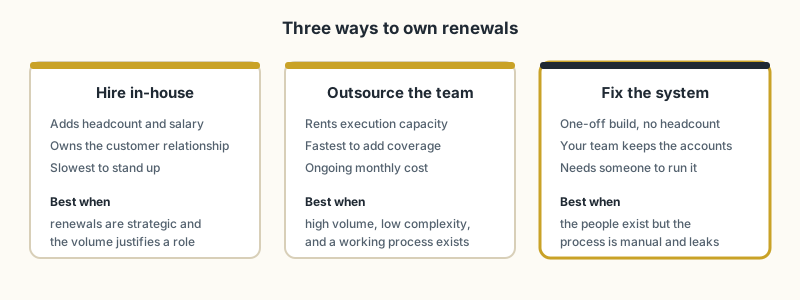
Outsourced renewal management means paying an external provider to run some or all of your renewal motion: tracking upcoming contract renewals, holding the renewal conversation, and closing the renewal. It is one of three ways to own renewals, alongside hiring an internal renewals team and fixing the renewal system you already have. The right answer depends on whether your constraint is capacity, expertise, or process. This guide compares all three honestly, including when outsourcing renewals is the wrong call.
SaaS Renewal Management: The Three Options Compared
| Hire in-house | Outsource the team | Fix the system | |
|---|---|---|---|
| What you buy | Headcount | Execution capacity | A working renewal process |
| Cost shape | Salary, ongoing | Retainer, ongoing | One-off build, then yours |
| Time to running | Slowest (hire, ramp) | Fastest | Weeks, not months |
| Who holds the customer | You | The provider | You |
| Fails when | Volume does not justify a role | Renewals are complex or strategic | Nobody is assigned to run it |
Most comparisons stop at the first two columns, because most of the people writing them sell one of the two. The third column matters because it is frequently the actual answer.
A fourth option, buying renewal management software, is really a variant of the third. Tools help once you have a renewal management process worth automating. Bought before that, they become another system nobody has configured.
What Outsourced Renewals Management Actually Covers
Scope varies widely between providers, and the word “outsourcing” hides the difference. In practice offers fall into three bands:
- Renewal administration. Tracking contract renewal dates, sending reminders, preparing paperwork. Your team still holds every customer conversation.
- Renewal execution. The provider runs the renewal conversation for a defined segment, usually your smaller or simpler accounts, and hands anything complex back.
- A full outsourced renewals team. The provider carries a renewal number across a book of business, with their own renewal managers, process and reporting.
Ask which band you are being sold. A proposal priced as administration and pitched as execution is the most common source of disappointment here.
The Benefits of Outsourcing Renewals, and When They Apply
Outsourcing renewals is a good fit under fairly specific conditions:
- High volume, low complexity. Many similar SaaS renewals, each individually small, where the renewal conversation is largely transactional and the contract terms rarely change.
- A defined renewal management process already exists. The provider is executing a motion you have documented, not inventing one. Outsourcing the renewals works when you are renting execution, not strategy.
- Capacity is genuinely the constraint. Your customer success team knows what to do and there are simply not enough hours to be proactive about it.
- Coverage gaps you cannot hire for. Time zones, languages, or a seasonal renewal peak that does not justify permanent headcount.
Under those conditions the benefits of outsourcing are real: it buys coverage faster than hiring can, it converts a fixed salary into a variable cost, and it protects recurring revenue you would otherwise lose to renewals nobody had time to work. That is a legitimate answer.
When Outsourcing Renewals Is the Wrong Call
A good provider will disqualify you in these situations. A less good one will not.
- Your renewal conversation is an expansion conversation. If renewals are where upsell and cross-sell opportunities surface, handing them to an external team routes your growth conversations through people who are not incentivised on growth and do not know the account history.
- Your product is complicated. Ask yourself honestly whether an external representative can understand your products and services well enough to answer the questions a customer will actually ask at renewal. If the answer is no, the renewal call becomes a handoff queue, and renewal negotiations stall on questions nobody in the room can answer.
- The problem is process, not people. This is the most common misdiagnosis. Poor renewal management is usually a visibility failure rather than an effort failure, and if renewals slip because nobody sees them coming, an outsourced renewals team inherits exactly the same blindness. They will just be blind on a retainer.
- You may want it back. Reabsorbing renewals later is harder than it looks. Ask up front where renewal records live, who owns the customer relationship on paper, and whether a transition back in-house can happen without disrupting your customers.
The Option Most Comparisons Skip: Fix the Renewal Management Process
There is a third possibility that neither the staffing agencies nor the outsourcing providers will raise: your renewals may not need different people at all.
The pattern is recognisable. Renewal dates live in a spreadsheet somebody maintains by hand, separate from your customer data. Nobody sees a renewal coming until roughly thirty days out, so nothing about the motion is proactive. The renewal is then a scramble, and the scramble ends in a discount. Renewal deals get created inconsistently, so forecasting recurring revenue is guesswork.
None of that is a headcount problem. It is a missing renewal workflow, and adding people to it produces more people doing manual work. Effective renewal management is mostly a question of whether the system surfaces the right account at the right time, not how many people are available to chase it. What actually fixes it is renewal infrastructure inside the CRM you already run: a renewal pipeline with real stages, renewal deals created automatically ahead of the contract end date, renewal reminders that fire ninety days out rather than thirty, renewal risk scoring so at-risk accounts surface early, and reporting your team trusts.
This is a one-off build, and a smaller one than people expect: adding renewals to a working HubSpot is one to three weeks, not months, and three routes are available depending on who does it. Afterwards you own it, your team keeps their customer relationships, and the renewal process runs the same way whether you have fifty renewals a quarter or five hundred. It also streamlines the handoff between sales and renewals, which is where a surprising share of renewal opportunities go missing in software companies.
What Poor Renewal Management Actually Costs
Before choosing an option, price the problem. Weak renewal management shows up in four places, and only the first is obvious.
- Renewal rate. Accounts that would have renewed churn because nobody started the renewal conversation early enough.
- Discounting. Late renewals get closed with price concessions, so revenue leaks even on the renewals you win.
- Expansion you never had. Renewal opportunities that should have surfaced upsell and cross-sell opportunities pass as flat renewals instead.
Those four are all forms of renewal revenue leakage, and unlike churn they involve customers who stayed.
- Forecast credibility. If renewal deals are created inconsistently, your annual recurring revenue forecast is an estimate, and everyone downstream knows it.
The comparison worth running is not “what does a provider charge” but “what is the gap between our current renewal performance and a realistic one, and which option closes it for less than that gap”. Customer acquisition cost is the useful yardstick here: replacing a churned account almost always costs more than retaining it, which is why even a small improvement in gross renewal rate compounds against customer lifetime value.
Renewal Management Metrics That Tell You Which Option You Need
Measure before you buy anything. Three renewal management metrics separate a capacity problem from a process problem.
| Metric | What it tells you |
|---|---|
| Gross renewal rate | Whether you are losing revenue you already had |
| On-time renewals | The share closed before the contract end date, the most diagnostic of the three |
| Renewal cycle start | How many days ahead renewal work actually begins |
If on-time renewals are low but your team is not at capacity, the constraint is visibility, not hours. If renewal work only starts thirty days out, no amount of outsourcing fixes that, because the provider inherits the same late start.
If you cannot pull these numbers today, that is itself the finding. A revenue operations audit scoped to renewals establishes the baseline before you commit to any of the three options.
Then work through these in order.
- Name the constraint. Is it hours, skill, or process? Outsourcing solves hours. Hiring an internal team solves skill and hours. Only a build solves process. If the role you are weighing is a RevOps leader rather than a renewals team, fractional RevOps vs a full-time hire covers that comparison.
- Check whether the renewal management process exists. If you cannot write down your renewal strategies in a page, you do not have a process to outsource yet. Industry best practices are worth reading at this point, but they are not a substitute for documenting your own contract renewal process.
- Look at complexity and value. High-value, multi-stakeholder renewals belong with people who own the account.
- Measure before you buy. Track gross renewal rate, the share of renewals closed on time, and how far ahead renewal work begins. On-time renewal rate is the most diagnostic of the three, because late renewals are where discounting and churn concentrate.
- Price the ongoing cost against the one-off cost. A retainer runs forever and scales with your customer base. A build does not, which changes the profitability arithmetic once renewal volume grows.
Score it in five minutes
Answer each with 0, 1 or 2 and total the result. This is the conversation we end up having on most first calls, compressed into something you can run without us.
| Question | 0 points | 1 point | 2 points |
|---|---|---|---|
| Can you list every renewal due in the next 90 days right now, from the CRM? | No | Partly, with effort | Yes, in under a minute |
| Is your renewal process written down anywhere? | No | Informally | Yes, and people follow it |
| What proportion of renewals close before the contract end date? | Under 50% | 50 to 80% | Over 80% |
| Does someone have renewals in their job description? | No | Shared informally | Yes, explicitly |
| Are renewal conversations mostly transactional? | No, each is bespoke | Mixed | Yes, largely standard |
| Is your team at capacity on renewals they can see? | No, they have time | Roughly at capacity | Yes, overloaded |
0 to 4: fix the system first. You cannot outsource or hire your way out of this, because there is no process for anyone to run. Whoever you bring in will spend their first month building what the scoring above says is missing, and you will pay a premium for it.
5 to 8: it depends on the last two rows. High scores there with low scores above mean the process is the gap. Low scores there mean you have a real capacity constraint worth solving with people.
9 to 12: outsourcing or hiring is a genuine option. You have a documented, working motion and the constraint is hours. This is the only band where the provider comparison is the right conversation to be having.
Most teams who contact us expecting to score 9 or above score 3. That is not a criticism of them; it is what a manual renewal process looks like from the inside, where the effort feels like a system.
If steps one and two point at process rather than capacity, fix that first. It is cheaper, and it makes the outsourcing decision clearer if you still want to make it later.
If what you actually need is help diagnosing the problem rather than staff to work around it, that is a different purchase again: see customer retention consulting for what a consulting engagement covers and what it costs. For the mechanics of the renewal process itself, independent of who runs it, start with the contract renewal management guide.
Frequently Asked Questions
What is outsourced renewal management? Handing your renewal process to an external provider who owns some or all of the renewal motion: tracking upcoming contract renewals, running the renewal conversation, and closing the renewal. Scope ranges from reminders and admin through to a full outsourced renewals team carrying a number.
Is it a bad idea to outsource renewals management? It is a bad idea when renewals are complex, high-value, or where the renewal conversation is really an expansion conversation. It works well for high-volume, low-complexity renewals where the process is already defined and the constraint is purely capacity.
How much does outsourced renewal management cost? It is normally a monthly retainer, sometimes with a commission on renewed revenue. The cost is ongoing for as long as you use it, which is the main difference from a one-off systems build that you then own.
What should I ask an outsourced renewals provider? Ask who owns the customer relationship, where renewal records live, how they learn your product well enough to answer customer questions, what happens to your renewal data if you leave, and how a transition back in-house would work without disrupting customers.
Do we need to outsource renewals or just fix our renewal process? If your team knows the accounts but renewals still slip, the constraint is the system, not the people. Outsourcing on top of a broken process rents execution capacity every month to work around a problem a one-off build would remove.
What metrics show whether renewal management is working? Gross renewal rate, the share of renewals closed on time, and how far in advance renewal work starts. On-time renewal rate is the most diagnostic, because late renewals are where discounting and churn concentrate.
SWOTBee does not sell you a renewals team. We build the renewal system inside HubSpot so the team you already have stops losing renewals to manual work. If your renewals are slipping because nobody sees them coming, that is a process problem, and process problems are fixable once.
Get your 1-page renewal leakage estimate →
No call needed. Prefer to talk it through first? Book a free 30-minute discovery call →