This article is part of our guide to who should run your renewals.
A revenue operations audit is a structured assessment of how your revenue engine actually runs: the revenue processes, data quality, tech stack and handoffs that connect marketing, sales and customer success. A useful RevOps audit ends in two things, audit findings tied to evidence in your own data, and a prioritised roadmap a revenue leader can act on. Anything that ends in a slide deck of observations is a diagnosis nobody can act on. This guide covers what a RevOps audit examines, what it should deliver, what it costs, and when a narrower scope is the better purchase.
What a RevOps Audit Examines
Scope varies by auditor, but the key areas are consistent across most revenue operations frameworks:
- Data quality and CRM hygiene. Whether the revenue data in your CRM can be trusted. Duplicate records, empty required fields and inconsistent lifecycle stages make every downstream metric unreliable.
- Lifecycle stages and conversion rate. Whether your defined stages match how deals actually move, and where conversion drops between them.
- Handoffs and silos. The points where marketing and sales, or sales and customer success, pass work between them. Mapping the customer journey across those boundaries is where revenue leaks show up, because no single team owns the gap.
- The technology stack. What you pay for, what overlaps, and what nobody uses. Most mid-market GTM stacks contain at least one tool bought to solve a process problem.
- Forecast accuracy. Whether your revenue forecast has been right, and if not, which assumption keeps breaking.
- Automation versus manual work. Which revenue processes depend on someone remembering. This is the single most useful lens, because manual steps are both the inefficiency and the risk, and they are what stops an otherwise sound sales process being scalable.
- Revenue recognition and billing alignment. Whether what the CRM says was sold matches what finance recognised.
Increasingly audits also review where AI is being used in the revenue engine, though this is worth treating with some scepticism: an AI forecasting layer sitting on poor revenue data produces confident numbers rather than accurate ones.
What the Audit Findings and Roadmap Should Contain
The deliverable is what separates a real audit from a sales exercise. Insist on three things.
- Findings tied to evidence. Every finding should point at something in your own data, not at general revops best practices. “Your handoff is weak” is an opinion. “Forty-one percent of closed-won deals have no customer success owner assigned within thirty days” is a finding.
- A prioritised roadmap. Ordered by impact against effort, not a flat list. A revenue leader needs to know what to do first, and what can wait two quarters.
- Enough detail to execute without the auditor. If the roadmap only makes sense with the consultant in the room, you have bought a dependency rather than a diagnosis.
A good audit also names what is working. An audit that finds only problems is usually selling the remedy.
The roadmap should also say who executes each item. A finding assigned to “the revops team” at a company with no revops team is not actionable, and knowing that gap exists is itself a useful audit finding.
Full RevOps Audit or a Scoped One?
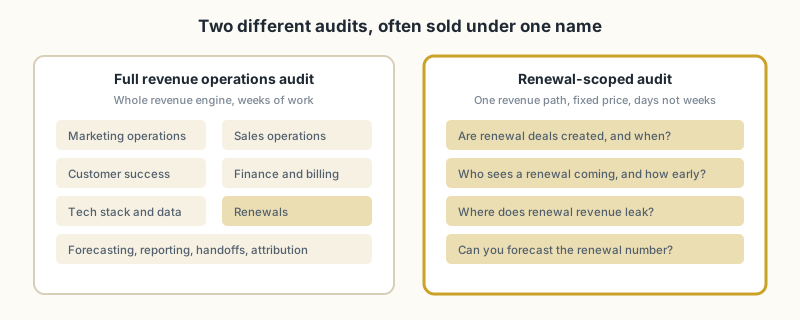
This distinction matters more than most buyers realise, because both are sold under the same name at very different prices.
A full revenue operations audit examines the whole revenue engine. It requires interviews across every revenue team, runs for several weeks, and is priced as a consulting engagement. It is the right purchase when you genuinely do not know where the problem is, or when a new chief revenue officer needs a map of business operations before committing to a revops strategy.
A scoped audit examines one revenue path in depth. Because the scope is fixed, it can be fixed-price and delivered in days. It is the right purchase when you already know which part of the revenue lifecycle is underperforming and need to know why.
Most mid-market companies asking for a RevOps audit already know the answer to “where”. They can name the problem in a sentence: renewals slip, the forecast is wrong, deals stall at one stage. Buying a full audit to confirm something you already know is an expensive way to feel thorough.
Run the First Hour of the Audit Yourself
You do not need to buy anything to find out whether you have a problem. Five checks, roughly an hour, all doable in a HubSpot or Salesforce instance by anyone with reporting access. Write down each number before you look at the next one.
Check 1: Deals with no next step. Filter open deals where the next activity date is empty or in the past. Record the percentage. Under 10% is healthy. Over 30% means your pipeline is a list, not a forecast.
Check 2: Stage age outliers. Sort open deals by days in current stage, descending. Look at the top 20. If deals are sitting three or more times longer than your average sales cycle, your stage definitions do not match reality, and every conversion rate you report is wrong.
Check 3: The ownership gap. Filter closed-won deals from the last 6 months where no customer success or account owner is assigned. Anything above zero is a handoff that did not happen. These accounts are your churn risk for next year.
Check 4: Required-field completeness. Pick the three properties your reporting depends on most, usually renewal date, contract value and account owner. Count records where any one is empty. Above 20% and no dashboard built on those fields can be trusted, which usually explains why people keep asking for spreadsheets.
Check 5: The forecast backtest. Find the forecast you submitted for the quarter that closed two quarters ago. Compare it against actuals. The size of the gap matters less than whether it is consistent. Consistently 15% over is a calibration problem you can correct. Randomly wrong is a data problem, and no amount of sales discipline fixes it.
How to read the results together. Checks 1 and 2 failing point at process discipline. Checks 3 and 4 failing point at systems and automation. Check 5 failing while the others pass usually means your stage definitions are fine but nobody agrees what they mean, which is a definition problem rather than a tooling one.
If all five come back clean, you probably do not need an audit. That is a genuinely useful outcome for an hour’s work, and it is the reason we publish the checks rather than gate them.
Common Challenges a RevOps Audit Surfaces
Across mid-market revenue teams the same findings recur, and recognising them early tells you whether you need an audit or already have your answer.
- Nobody owns the middle. Marketing owns the top, sales owns the deal, customer success owns the account, and the joins between them belong to no one. Most operational inefficiency lives in those joins.
- The CRM records outcomes, not the process. Customer data goes in after the fact, so the system reports history instead of prompting the next action.
- Two sources of truth. The revenue number finance reports and the number the CRM reports differ, and reconciling them is somebody’s recurring manual job.
- Tools bought to fix process problems. A tool added to solve an inefficient sales process usually preserves the process and adds a licence.
- Reporting nobody uses. Dashboards exist, but the revenue teams making decisions still ask someone to pull a spreadsheet.
None of these are exotic. That is the point: a competent audit finds them quickly, which is also why paying for a lengthy discovery process to surface them can be poor value.
RevOps Metrics an Audit Should Baseline
An audit that does not leave you with numbers leaves you with opinions. Whatever the scope, insist the findings baseline these, so you can tell later whether anything improved.
| Metric | Why it belongs in the baseline |
|---|---|
| Stage conversion rate | Shows where the revenue cycle actually stalls, rather than where people believe it does |
| Forecast accuracy | The clearest single test of whether your revenue data is trustworthy |
| Cycle time by stage | Separates a slow process from a stalled one |
| Data completeness on key fields | Determines whether any other metric here means anything |
| Share of steps that are manual | The best predictor of whether the process stays reliable as volume grows |
These are the revops metrics worth re-measuring in six months. A roadmap without them cannot be evaluated, only believed.
What a Revenue Operations Audit Costs
Full RevOps audits are consulting engagements and priced like them, usually as a multi-week project with a proposal rather than a list price. That is defensible for genuinely broad scope, though it does mean you cannot compare providers without going through several sales conversations first.
Scoped audits should be published prices, because a fixed scope has no reason to be quoted. SWOTBee’s renewal-scoped audit is $600, credited in full toward any build. It examines one question in depth, whether your renewal revenue is leaking and where, and it comes back with findings against your own HubSpot data plus a roadmap you can hand to your team.
The comparison worth running is against the cost of being wrong. If renewal revenue is leaking, the leak compounds every quarter you do not measure it, and it is almost always larger than the diagnostic.
What a Renewal-Scoped Audit Actually Looks At
For teams whose revenue problem is concentrated in renewals rather than spread across the funnel, the audit narrows to four questions:
- Are renewal deals created at all, and when? Renewals that only become deals thirty days out cannot be forecast or worked properly.
- Who sees a renewal coming, and how early? Visibility is usually the actual failure, not effort.
- Where does renewal revenue leak? Missed uplifts, unbilled expansions, discounting under time pressure, and renewals that quietly lapse.
- Can you forecast the renewal number? If renewal deals are created inconsistently, the recurring revenue forecast is an estimate everyone downstream distrusts.
If you want the underlying mechanics before buying anything, the renewal pipeline guide covers how the process should be built, and renewal risk scoring covers surfacing at-risk accounts early.
When You Do Not Need an Audit
Three situations where the honest answer is to skip it.
- You already have the findings and have not acted on them. If a previous audit or an internal review produced a list nobody executed, another audit adds a second list. The constraint is capacity or priority, not diagnosis.
- The problem is one known, specific thing. If you know the renewal reminder never fires, fix the workflow. A structured assessment to confirm a thing you can already name is not a good use of money.
- You are pre-product-market-fit. Revenue operations optimises a repeatable motion. If the motion is still changing every quarter, auditing it captures a snapshot that expires before the roadmap is finished.
Frequently Asked Questions
What is a revenue operations audit? A structured assessment of how your revenue engine actually runs: the processes, data, tech stack and handoffs across marketing, sales and customer success. A RevOps audit produces findings and a prioritised roadmap, not a general opinion.
What does a RevOps audit examine? Typically data quality and CRM hygiene, lifecycle stages and conversion rates, handoffs between teams, the tech stack and where it duplicates itself, forecast accuracy, and the revenue processes that run on manual work rather than automation.
How much does a revenue operations audit cost? A full RevOps audit is usually a multi-week consulting engagement priced accordingly. A narrow, single-path audit is far cheaper because the scope is fixed. SWOTBee’s renewal-scoped audit is $600, credited in full toward any build.
How long does a RevOps audit take? A full audit across the revenue engine typically runs several weeks because it requires interviews across teams. An audit scoped to one revenue path, such as renewals, is measured in days.
What should a RevOps audit deliver? Audit findings tied to evidence in your own data, a prioritised roadmap with effort and impact against each item, and enough detail that your team could execute it without the auditor. A slide deck of observations is not an audit.
Do we need a full RevOps audit or a narrower one? If you cannot name where the problem is, a full audit finds it. If you already know which revenue path is leaking, a scoped audit costs far less and answers the question faster.
SWOTBee runs renewal-scoped audits against your own HubSpot data, not a generic RevOps checklist. You get findings, a roadmap, and the option to have us build the fix.
Get your 1-page renewal leakage estimate →
No call needed. Prefer to talk it through first? Book a free 30-minute discovery call →