This article is part of our guide to who should run your renewals.
Revenue leakage is the gap between the revenue you were contractually entitled to and the revenue you actually billed and recognised. It is not lost deals or churn: it is earned revenue that quietly never arrives. In subscription and SaaS businesses the largest source is the renewal, because that is the moment contract terms get re-applied, and re-applying them is usually manual. This guide covers the common causes of revenue leakage, why leaking revenue so often goes unnoticed, and how to identify and prevent it.
What Revenue Leakage Is, and What It Is Not
Revenue leakage refers to money you had a right to and did not collect. That distinction matters, because it changes who should fix it.
- Not churn. A customer who leaves is a retention problem.
- Not a lost deal. Revenue you never won is a sales problem.
- Revenue leakage is revenue that was contracted, delivered, or both, and then failed to convert into billed and recognised revenue.
In revenue operations this category is sometimes called revenue assurance. The reason it deserves separate attention is that it is the cheapest revenue in the business to recover. There is no acquisition cost, no competitive displacement and no persuasion involved. The customer already agreed. The only thing missing is a process that carries the agreement through to the invoice.
The Common Causes of Revenue Leakage at Renewal
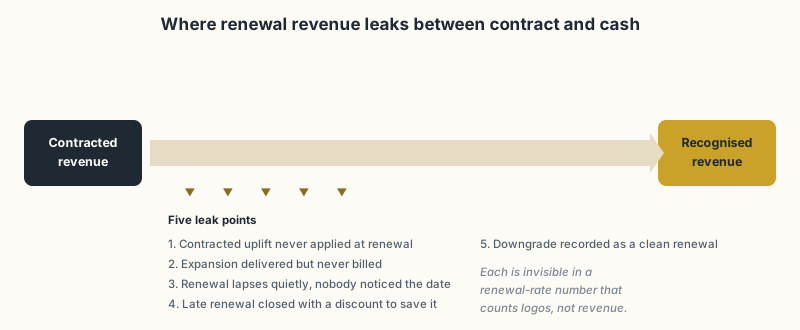
Five sources of revenue leakage account for most of what we see in mid-market recurring revenue models.
- Contracted uplifts never applied. The contract specifies an annual increase. At renewal nobody reads the contract, so the subscription renews at last year’s price. This is the single most common source of contract value leakage, and it compounds: an uplift missed once is missed in every subsequent year.
- Expansion delivered but never billed. The customer added seats, usage or a module mid-term. Delivery happened. The billing system was never told.
- Silent lapses. The renewal date passed without a renewal conversation, and the account quietly stopped. Nobody logged a churn reason, because nobody registered the event.
- Late-renewal discounting. The renewal surfaced with two weeks left, the customer used the deadline as leverage, and the account was saved with a price concession. The renewal counts as a win, and revenue slips anyway.
- Downgrades recorded as renewals. The customer renewed at a lower tier or fewer seats. Logo retention is unaffected, so the reporting shows a successful renewal while actual revenue fell.
Note what these have in common. None of them involve an unhappy customer, and none of them appear in a renewal rate that counts logos.
One cause deserves separating out, because it is invisible in most reporting: contracts that renew themselves at the old price because the notice window closed before anyone reviewed the account. Our guide to evergreen contracts and auto-renewal clauses covers how the clause works and why the notice date, not the contract end date, is the deadline.
Why Revenue Leakage Often Goes Unnoticed
Leakage survives because nothing fails visibly.
- No error is raised. No system alerts you that a 5% uplift was not applied. The renewal processed successfully, just for the wrong amount.
- The headline metric still looks fine. If you report renewal rate by customer count, every one of the five causes above can be running at scale while the number stays healthy.
- Nobody owns the reconciliation. Sales owns the contract, finance owns the invoice, and customer success owns the relationship. Comparing the first against the second is nobody’s job.
- The amounts look small individually. A missed uplift on one account is not worth escalating. The aggregate across a book of business usually is.
- It is invisible in the CRM. If contract terms live in a signed PDF rather than structured fields, no report can ever surface the gap, because the data is not in a form anything can query.
The Impact of Revenue Leakage in SaaS
Revenue leakage in SaaS behaves differently from a one-off billing error, because the loss repeats.
A missed uplift is not a single-year shortfall. It resets the base that every future renewal is calculated from, so the gap between actual revenue and potential revenue widens each year even if nothing else goes wrong. The same applies to an unbilled expansion: the revenue lost is not the amount you failed to invoice once, it is that amount compounded across the remaining life of the account.
That compounding is what makes leakage worth attention disproportionate to its apparent size. A leak that looks like a rounding error against this quarter’s number is a structural reduction in annual recurring revenue and, because valuation multiples apply to recurring revenue, in enterprise value.
The second-order impact is on revenue reporting. Once contracted and billed values have drifted apart, your revenue data no longer describes your revenue streams accurately, and forecasts built on it inherit the error. Teams usually discover this during diligence, which is the worst available moment.
Can You Recover Revenue Already Leaked?
Sometimes, and it is worth checking before you focus only on prevention.
- Unbilled expansion is often recoverable. If the customer received seats or usage they did not pay for, and the contract covers it, this is usually a straightforward billing correction. Most customers accept it when the evidence is clear.
- Missed uplifts are recoverable going forward, rarely backwards. You can generally apply the correct rate at the next renewal. Retroactive claims tend to cost more in goodwill than they return.
- Lapsed accounts are worth a win-back attempt. A renewal that lapsed through inattention rather than dissatisfaction is a different conversation from a customer who chose to leave.
- Discounts already given are gone. Treat them as data about your renewal timing, not as a recovery opportunity.
Run the identification exercise below first. Recovering missed revenue opportunities is satisfying, but it is a one-off, and it does not address the root cause.
How to Identify Revenue Leakage
Detecting revenue leakage does not require revenue management software. It requires one reconciliation that most teams have never run.
Take a sample of accounts that renewed in the last twelve months. For each, compare the contracted value against the amount actually billed.
Here is the exact version, which takes about two hours for a 30-account sample.
Step 1. Pull the list. Export closed-won deals in your renewal pipeline with a close date in the last 12 months. You need four columns: account name, deal amount, original contract value, and the contracted uplift percentage. If the last two are not properties in your CRM, that finding alone is the answer to why leakage is invisible, and it is worth stopping to fix that first.
Step 2. Calculate what each renewal should have been.
expected = prior term value x (1 + contracted uplift)
         + value of any expansion delivered during the term
Step 3. Compare against what was actually billed, not what the deal record says. Deal amounts are frequently aspirational; the invoice is the truth. Pull actual billed amounts from your billing system or accounting export.
Step 4. Put every variance in one of three columns.
| Column | What it means | Example |
|---|---|---|
| Deliberate | Someone chose this and can say why | “We waived the uplift to secure a 3-year term” |
| Leakage | Nobody decided, it just happened | “The 5% uplift was never applied” |
| Unknown | Nobody can say either way | The most alarming column, and usually the largest |
A worked example. An account on £48,000 with a contracted 5% uplift, which added 10 seats worth £6,000 mid-term:
- Expected: £48,000 x 1.05 + £6,000 = £56,400
- Actually billed: £48,000
- Variance: £8,400, of which £2,400 is the missed uplift and £6,000 is unbilled expansion
Neither number is dramatic on its own. Across 30 accounts, if a third show a similar pattern, you are looking at roughly £84,000 a year, recurring, from customers who never complained and never left.
Step 5. Annualise it. Divide the total leakage by your sample size, multiply by your total renewing accounts. That number is your budget for fixing the problem, and it is the number to take to whoever approves the spend.
The ratio between those columns tells you what you have.
- Mostly deliberate decisions. Your process works and your team is making commercial judgements. Fine.
- Mostly nobody knew. You have a process problem, and the sample size tells you roughly what it costs annually.
Then baseline three numbers so you can tell whether anything improves, and so you can identify gaps that widen again later:
| Metric | What it exposes |
|---|---|
| Gross revenue retention | Revenue leakage that logo retention hides |
| Realised uplift rate | The share of contracted uplifts actually applied |
| Billed versus contracted variance | The direct measure, and the only one that catches all five causes |
Gross revenue retention is the one to watch. A business can hold 95% logo retention and still lose meaningful revenue, and only the revenue-based number shows it. Our guide to gross versus net revenue retention covers how the two diverge.
Billing Problem or Renewal Problem?
The fix depends on where the gap opens, and these are genuinely different problems sold by different vendors.
A billing and revenue recognition problem is when the invoice does not match the contract. The commercial terms were right; the system that bills them was wrong. This is what billing platforms and contract lifecycle management tools address, and if your leakage is concentrated here, that is the category to look at.
A renewal process problem is when the contract itself was renewed on worse terms than it should have been. No billing system fixes this, because the billing system correctly billed a renewal that should never have been agreed at that price. This is a visibility and timing problem in the renewal motion.
Most mid-market teams assume the first and have the second. The reconciliation above tells you which, and it is worth running before buying anything.
How to Prevent Revenue Leakage
Four changes remove most renewal leakage, and none of them require new software if you already run a CRM.
- Make the renewal visible early. Ninety days, not thirty. Almost all discounting under time pressure is a symptom of a late start. Renewal reminders that fire on the contract date rather than on someone’s memory are the single highest-return fix here.
- Put contract terms in structured fields. Uplift percentage, renewal date, notice period and committed quantities belong in CRM properties, not only in the signed PDF. If it is not a field, it cannot trigger a workflow or appear in a report.
- Create renewal deals automatically. A renewal that exists as a deal can be forecast, assigned and worked. One that exists only in someone’s calendar cannot. The renewal pipeline guide covers the structure.
- Report on revenue, not logos. Switch the headline renewal metric to a revenue basis. This one change makes four of the five leak causes visible for the first time.
None of this is sophisticated. The root cause is almost never capability, it is that nothing in the system complains when leakage occurs, so it persists quietly through every renewal cycle until somebody reconciles the numbers.
Frequently Asked Questions
What is revenue leakage? Revenue leakage is the gap between the revenue you were contractually entitled to and the revenue you actually billed and recognised. It is earned revenue that never arrives, as distinct from revenue you never won.
What causes revenue leakage in subscription businesses? The common causes are contracted uplifts never applied at renewal, expansion delivered but never billed, renewals that lapse because nobody saw the date, discounting under time pressure on late renewals, and downgrades recorded as clean renewals.
Why does revenue leakage often go unnoticed? Because nothing fails visibly. No alert fires when a 5% uplift is not applied. Logo-based renewal rates still look healthy, since the customer did renew. The loss only appears if you compare contracted value against billed value, which most teams never do.
How do you identify revenue leakage? Reconcile contracted value against billed value for a sample of renewed accounts. Every difference is either a deliberate decision or leakage, and the ratio between those two tells you whether you have a process problem.
How do you prevent revenue leakage at renewal? Make the renewal visible early enough to work, hold contract terms like uplifts in structured CRM fields rather than PDFs, create renewal deals automatically, and measure revenue retention rather than logo retention.
Is revenue leakage a billing problem or a renewal problem? Both exist and the fix differs. If the invoice does not match the contract, it is a billing and revenue recognition problem. If the contract itself was renewed on worse terms than it should have been, it is a renewal process problem.
SWOTBee finds renewal revenue leakage in your own HubSpot data and builds the system that stops it recurring. The reconciliation above is the first thing we run, and it is usually the last thing anyone expected to be the problem.
Get your 1-page renewal leakage estimate →
No call needed. Prefer to talk it through first? Book a free 30-minute discovery call →