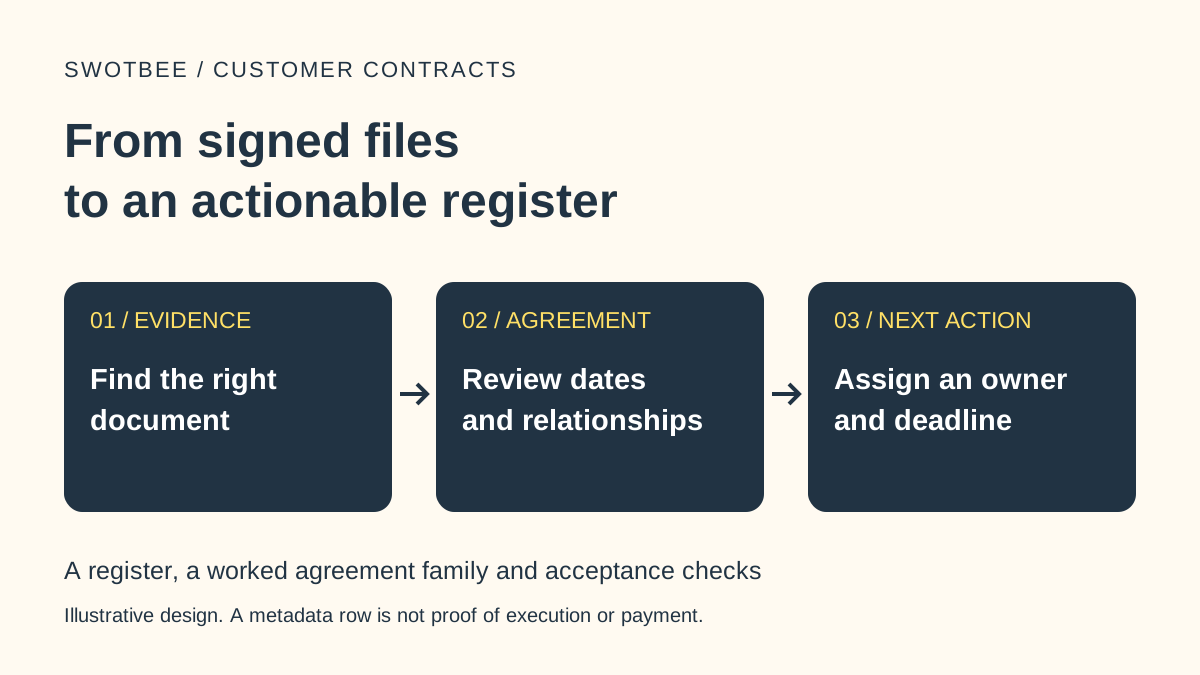
This practical guide supports our contract management guide for revenue teams. For HubSpot record architecture, use the HubSpot customer-contract guide.
A customer contract repository is a controlled place to find the executed agreement, its related documents and the structured information needed to act on it. Build a register around stable agreement identities, reviewed dates and accountable owners. Keep the original signed evidence accessible, and link amendments without overwriting the history.
A folder of PDFs can hold the documents. It cannot, by itself, establish which SOW is current, whether an amendment changes the support price or who must prepare the next renewal. The register connects those questions to evidence.
Three things you can take away:
- A copyable register schema for document identity, ownership, dates and sources.
- A worked agreement family showing one MSA, two service commitments and an amendment.
- Retrieval, access and reconciliation checks to run before relying on the repository.
Download: Customer-contract register (CSV, five illustrative entries). Read the usage notes before adapting it. Use the retrieval and correction checklist to record what you found and what needs fixing. No signup is required. This is a repository working sheet, not a HubSpot import file. It contains values, not formulas, reminders or access controls. The existing contract tracker template is available for date tracking, but it does not replace the document-relationship register described here.
What belongs in a customer contract repository?
Preserve the executed evidence and enough structured information to identify the agreement, understand its relationships and assign the next action. Include the relevant MSA, SOW, order form and amendment; keep drafts distinguishable from executed versions.
Decide where the authoritative file lives. The CRM may link to it while the document platform controls signatures and versions. Finance may retain invoice evidence in another system. A single navigation point does not require every system to hold an editable copy of everything.
| Record | What it answers | Suggested authority |
|---|---|---|
| Executed legal document | What did the parties sign? | Approved document store or signing platform |
| Agreement register | Which agreement/version should we inspect? | Reviewed metadata record linked to the document |
| Commercial commitment | What revenue terms are represented operationally? | Selected commercial system |
| Renewal opportunity | What decision and customer work is underway? | CRM opportunity process |
| Invoice/payment evidence | What was billed and collected? | Billing/accounting controller |
HubSpot’s Contract overview distinguishes its committed-revenue record from the legal agreement. That distinction is useful even when the repository uses another platform: a commercial amount and the executed document require separate verification.
Is a shared drive enough, or do you need contract software?
Choose according to the controls you need and can maintain, rather than the number of files alone. A shared drive plus register may fit a simple process if access, document identity and ownership remain reliable. More demanding search, version governance, obligations or approval needs may justify a specialist system.
Test the job with representative agreements before comparing tools. Can the intended reader find the current evidence? Can someone recover the prior version? Can a restricted user obtain only the information they need? Can the team export the register and document references if it changes platforms?
According to Google’s shared-drive guidance, shared-drive availability depends on edition and administrator settings, and access levels have different capabilities. Do not assume that a folder name proves the underlying permissions are correct.
Use our contract software comparison for product selection and CLM versus CRM guide for the ownership decision. This article focuses on building a usable repository after those responsibilities are clear.
What fields should the agreement register contain?
Start with identity, evidence, relationship, responsibility and reviewed timing. Separate commercial agreements from document references and line items, so a row count does not become a misleading agreement count.
Copy this schema and adapt it to the chosen system. These are editorial design labels, not guaranteed native property names or a ready-to-import product file.
| Field | Meaning and check |
|---|---|
record_id | Stable unique identity; never reused for another entity |
record_type | MSA, SOW, order, amendment, project or reference |
customer_id | Stable customer identity, separate from display name |
governing_record_id | Parent agreement or document relationship |
changes_record_id | Target of an amendment, when applicable |
document_reference | Controlled location of the executed evidence |
execution_status | Draft, executed, superseded or unresolved, based on evidence |
effective_from / effective_to | Reviewed applicability; blank where genuinely unknown |
amount / currency / basis | Explicit monthly, annual or one-time basis |
notice_rule_reference | Clause/source and reviewed calculation rule |
notice_deadline | Reviewed result; blank is different from no notice required |
owner / backup_owner | Accountable roles or people approved for the process |
access_class / retention_rule | Approved access/retention policy reference |
reviewed_by / reviewed_at | Evidence that metadata was checked |
The download uses friendly column names, including Entry ID, Parent ID and Evidence location. Parent ID points to the governing MSA for agreements; on the amendment row it identifies the agreement being changed, A-101. Entry type distinguishes these two relationship meanings. Its 19 columns are a starting subset of this fuller schema. Add dedicated change-target, access/retention and reviewer fields where required; document identity alone does not establish those controls.
To open the CSV, import it as UTF-8 with comma as the delimiter. Keep Entry ID, Customer ID, Parent ID and Document reference as text, and preserve date text as YYYY-MM-DD. If every value appears in one column, reopen with the comma delimiter. The usage notes include the expected row count and checks before saving a working copy.
Keep repeatable documents or changes as related records where a single row cannot represent them safely. A register with one overwritten “current price” and no effective date cannot explain what applied to an older invoice.
How do you link an MSA, two SOWs and an amendment?
Give every meaningful record its own identity, then express which agreement governs or changes another. Do not treat all documents as separately renewable revenue commitments.
This standalone example uses fictional customer C-101, called Sample Services. Its A-101/A-102 labels belong only to this register. Other guides reuse those labels for different illustrative scopes and prices; do not join their rows or totals to this example. This is not a customer case study or tested portal result. The MSA supplies a legal framework. Two SOWs carry distinct commercial commitments. The onboarding source row and amendment have different roles.
The accompanying source documents are demonstration-only, unsigned references. None is executed evidence. References to executed documents elsewhere in this guide describe the controls a real implementation must satisfy, not the status of these sample files.
| Record | Role and relationship | Commercial meaning |
|---|---|---|
MSA-001 | Framework governing A-101/A-102/A-103 | No standalone recurring amount in this example |
A-101 | Support agreement; source document SOW-A101 under MSA-001 | USD1,000/month, 2026-11-01 to 2027-10-31 |
A-102 | Backup agreement; source document SOW-A102 under MSA-001 | USD250/month, 2026-12-01 to 2027-11-30 |
A-103 | One-time onboarding order; source document ORDER-A103 under MSA-001 | USD1,500 once, 2026-11-01 to 2026-11-30; representation as line/project is decided in the implementation |
M101-1 | Amendment reference changing A-101; source document AMEND-M101-1 | Separate scenario: USD1,200/month effective 2027-05-01 |
Preserve A-101’s original support price and M101-1’s effective change. The amendment is evidence of a change, not automatically a third recurring commitment or a new native HubSpot Contract. Record the accepted legal change, then verify how the commercial and billing systems represent it.
The downloadable register contains MSA-001, A-101, A-102, A-103 and M101-1: five entries, including only two baseline recurring agreements. The separate import guide uses Company 42 and a different two-agreement specification totalling USD1,100 monthly. It explains import mapping and reconciliation; this register explains document relationships and evidence retrieval. Do not upload or combine these examples. The future amendment scenario is isolated from the baseline renewal scenario.
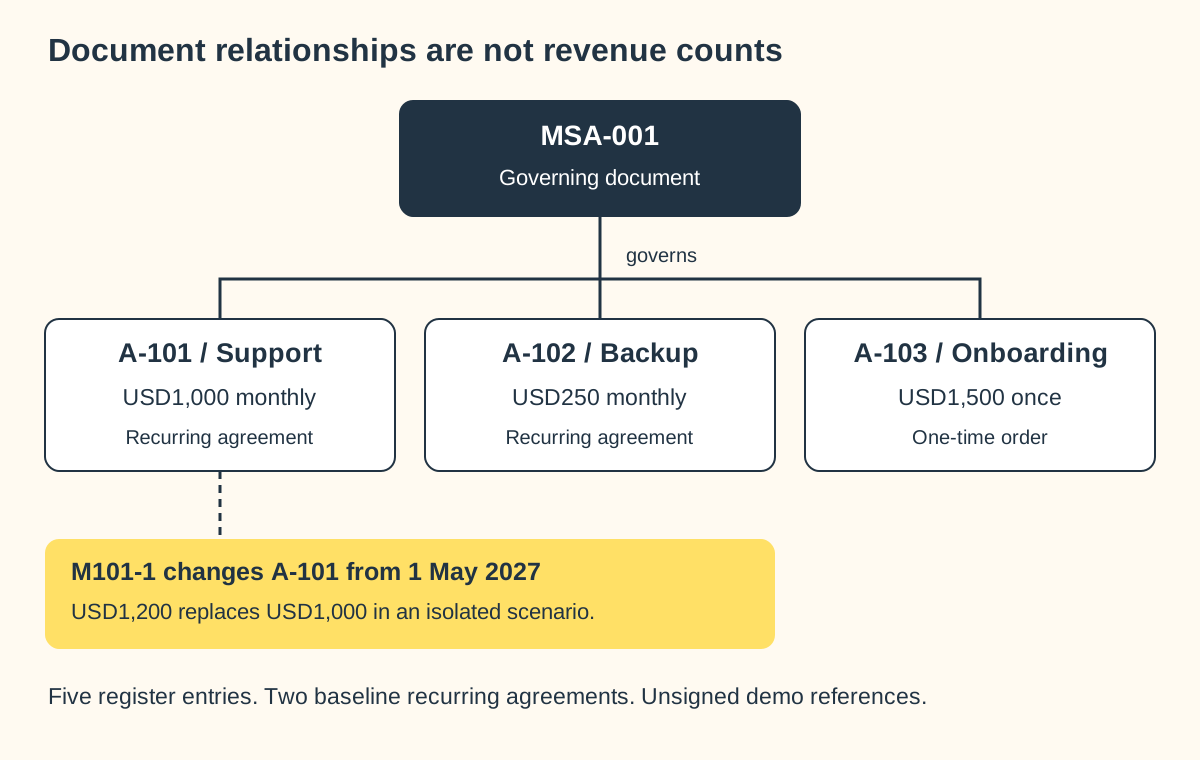
Original design diagram. The document references are unsigned examples, not product screenshots or executed evidence.
How do you avoid counting documents as revenue?
State the date and amount basis before calculating a total. The repository can contain multiple related documents while the commercial population remains two recurring agreements.
In the baseline future run-rate view, after both services have started, support USD1,000 plus backup USD250 is USD1,250 monthly recurring value. The USD1,500 onboarding amount stays separate. Before backup begins on 1 December 2026, it is a future commitment, not current monthly revenue.
In the isolated amendment scenario from 1 May 2027, support is USD1,200 and backup USD250, giving USD1,450 monthly recurring value while both remain active. Adding the amendment as another USD1,200 recurring agreement would double-count the changed support commitment.
These totals are illustrative before tax. They do not calculate recognized revenue, cash collection or invoice proration. Use the amendment guide for commercial change handling and quote-to-cash guide for billing and accounting evidence.
How do you test retrieval and access?
Test whether the intended person can find the right evidence, and whether an unauthorized person is prevented from accessing it. A working link for the repository administrator does not establish access for the account owner.
Give the tester a real operational question: “Find A-101’s signed terms, its governing MSA and the amendment effective in May.” Ask them to identify which price applies to the period being reviewed. Record where they looked, what they found and any ambiguity. Set a practical local retrieval target; do not invent a universal speed benchmark.
Run a second test with the restricted role. Confirm the correct boundary for document content and metadata. Exporting a register must not expose a document through an unrestricted link. Retention and deletion rules require an approved policy, including any preservation instruction; moving a file does not authorize deleting its source evidence.
How should you migrate existing documents and records?
Inventory and reconcile a representative pilot before moving the whole population. Migration succeeds when the destination preserves the intended identities, relationships and usable evidence, not when an upload counter reaches the expected number.
- List the source locations and identify who can approve the current executed copy.
- Resolve duplicate-looking records without discarding amendment or historical evidence.
- Assign stable identities and parent/change relationships.
- Review dates, values and ownership against the executed sources.
- Pilot documents with multiple agreements, restricted access, missing metadata and an amendment.
- Compare source and destination identities, document access and amount controls.
- Record exceptions and retest corrected records before expanding the population.
For HubSpot record import, follow the separate customer-contract import guide. Making a reference visible does not migrate billing. Preserve the original archive until its retention and cutover decision has been approved.
Who keeps the repository current?
Assign ownership to the update event, rather than expecting a quarterly cleanup to discover every change. Signature, amendment, renewal and owner departure should each have a defined review path.
| Event | Required update | Control |
|---|---|---|
| Agreement executed | File evidence; review register and owner | Executed version linked and accessible |
| Amendment accepted | Preserve change target and effective date | Prior terms remain explainable |
| Renewal agreed | Link old/new commitment and evidence | No duplicate next-term record |
| Owner changes | Reassign responsibility and pending work | Named successor accepts the handoff |
| Link/access fails | Route a visible exception | Restore approved access and retest |
Use the automation workflow guide to specify durable tasks and recovery. Keep continuous obligation monitoring separate from checking whether the register and source evidence agree.
What must pass before you rely on the repository?
Test identity, evidence, access, commercial meaning and maintenance together. A complete-looking metadata row does not pass if it links to a draft or the wrong customer’s document.
- A-101 and A-102 retain separate identities under the intended customer.
- The governing MSA and any applicable amendment can be retrieved.
- Executed and superseded evidence remain distinguishable.
- Monthly and one-time amounts are separate, with the effective period stated.
- M101-1 changes A-101 without being counted as another baseline commitment.
- Missing or unreviewed dates remain visible exceptions.
- Intended readers can access evidence; restricted readers cannot exceed policy.
- Owner, backup, correction and retest responsibilities are recorded.
- Exported metadata retains usable identities and controlled references.
- Billing responsibility has not changed merely because records moved.
Frequently asked questions
Is a contract repository the same as a shared drive?
A shared drive can store the evidence. A usable repository also needs reliable identities, relationships, metadata, access and update responsibility. Test those controls before deciding that another platform is necessary.
Should the signed PDF or the CRM record be authoritative?
The executed evidence establishes the signed terms. CRM can hold reviewed operational values and customer work. Decide field ownership and reconcile changes rather than letting both become independently editable versions of the agreement.
Does every amendment need a new commercial Contract?
No universal rule follows from the word amendment. Preserve the legal change and effective date, then use the supported commercial change path. Test billing and renewal consequences separately.
Can one customer have several contracts?
Yes. Represent independently managed commitments separately and associate them with the customer. A company-level end date cannot safely replace agreement-level dates, owners and renewal decisions.
Will this register prove legal compliance?
It provides operational evidence and highlights mismatches. Legal interpretation, retention obligations and compliance judgments require the applicable policy and qualified review.
Need help turning signed files into an operational register?
Bring one representative agreement family and the question your team cannot answer today. We can discuss where the evidence should live, which values need review and what a small implementation pilot should verify.
Start with a usable agreement record and an acceptance test you can inspect. Discuss your customer-contract setup.